(This story was updated to add new information.)
An Inner Harbor seawater desalination plant may be ostensibly dead — at least for the time being.

As 1 a.m. approached on Sept. 3, the Corpus Christi City Council voted 6-3 to end a contract with Kiewit Infrastructure South Co., the design-builder working on the project, and also to seek reallocation of state financing that had been earmarked for the Inner Harbor project, potentially redirecting it to other water supply projects.
It was a move that represents a dramatic reversal in the city’s strategy for boosting the region’s water resources, which in recent years has primarily, but not exclusively, focused on desalination.
The decision came after hours of public comment dominated by opposition to the proposed plant, followed by hours of council debate over the merits and the disadvantages of extending the existing contract with Kiewit to continue work on the estimated $1.2 billion project.
Several council members who have championed the project have said they had faith that as design was refined, cost estimates would drop, while skeptics suggested the figure may reflect what would ultimately be a minimum cost.
City Councilman Gil Hernandez noted in the meeting the volume of current debt at Corpus Christi Water, adding that he believed there were what he described as practical, as well as political, costs.
“No one on council is going to want to say, ‘Yep, I’m going to double rates; I’m going to vote for it gladly,’” he said. “It’s not going to happen. It’s just reality, because I would hate to be that council that has their hands tied, that has to write that check that we made the IOU for.”
The city has made investments into the project and the contractor who had been selected to lead it, said Mayor Paulette Guajardo.
Officials have said that the city had so far spent $50 million on development of the plant, which had been planned to generate as much as 30 million gallons of treated water per day.
Not moving forward meant that “we’re going to flush (the money) down the toilet,” Guajardo told the council.
She later told the Caller-Times that although the vote was disappointing, work to secure additional water supply won’t come to an end.
“We’re going to continue to pursue every option available, expanding our current supplies, exploring new technologies … working closely with CCW to continue to be innovative to provide immediate water,” Guajardo said. “Water powers every city’s survival and it drives every city’s economy and, of course, it secures our city’s future. So we can’t stop.”
What led up to the vote
The plant’s most recent estimated cost had been based on 10% of design work completed, meaning it lent limited insight into what would be the final cost, city staff has said.
Continuing design to 60% completion would provide more certainty, according to officials.
The council was initially slated to vote on extending the contract — which would have taken the project to 60% design — in July.
Instead, the majority of council members voted to suspend contractors’ work for about a month to mull the new project estimate and to clarify with the Texas Water Development Board questions about the low-interest loans that had been awarded by the state agency to the city for development of the Inner Harbor seawater desalination plant.
The vote Sept. 3 — held near the conclusion of what had been a nearly 14-hour meeting consumed largely by desalination, as well as the 2026 budget — was to consider a $50 million contract amendment with Kiewit to resume its work and develop the plant’s design to 60%.
Reaching that milestone would come with a final cost estimate in March, according to city documents.
The vote to end the contract represented two-thirds of the council — City Council members Carolyn Vaughn, Eric Cantu, Everett Roy, Kaylynn Paxson, Sylvia Campos and Hernandez supporting its termination, with Guajardo and City Councilmen Roland Barrera and Mark Scott in dissent.
At one point, some city officials had suggested that the council consider beginning negotiations with the second-highest bidder for the project, an option officials said was allowed under contract.
That was ultimately not pursued.
A Sept. 3 statement sent by Kiewit spokeswoman Teresa Shada states that the company was disappointed by, but respected, the council’s decision to end the contract.
“We stand by the work our team delivered, including the design and supporting data,” the email reads. “The progressive design-build process worked as intended — it surfaced an early professional estimate of cost and allowed the owner to decide whether to proceed to vet out additional details which could further guide price and scope.”
The cost
Primary focus of preceding discussions centered on the cost of the proposed plant, which had more than doubled since an initial quote — delivered by different consultants — of about $757 million in January 2024.
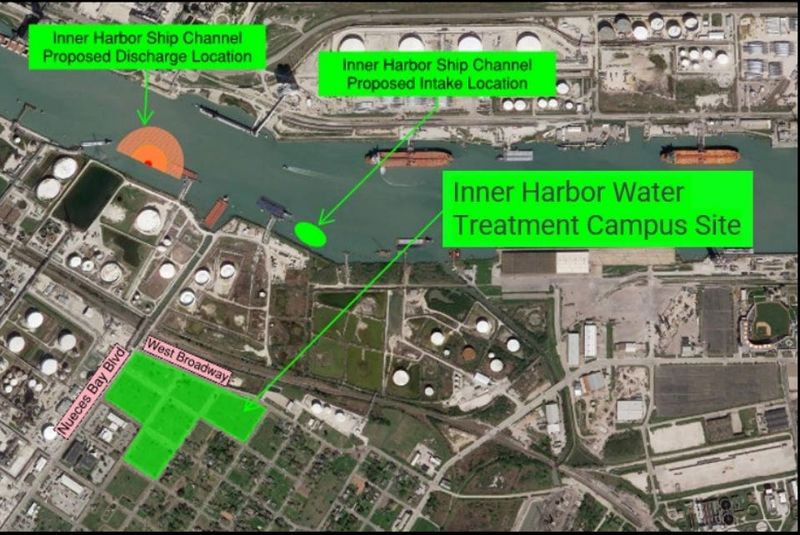
The plant, years in the making, has for almost as long been at the crux of controversy over its rising price tag, environmental questions and location adjacent to a historically Black and Hispanic neighborhood.
Fostering growth of the region’s residential population, as well as economic opportunities, lay in establishing substantial new water supply, with desalination being the most effective option, proponents of the plant have said.
The endeavor could have been accomplished within a reasonable budget and in an environmentally sound manner, according to supporters.
The project was vetted and permitted, Scott told his fellow council members.
“I do think a lot of citizens support it … certainly not a majority of people in this room,” Scott said, referencing opponents of the project in the audience.
However, he added, “I do think it creates the greatest certainty to a long-term, reliable, drought-proof water supply.”
Opponents have said other water supply projects could convey the same or a higher volume of water as had been touted by the Inner Harbor project, but at a fraction of the overall cost — a route some said would also resolve concerns aired about the plant.
Projects in the works or under consideration, either by the city’s initiative or by partnering with other entities, include Corpus Christi Polymers’ private desalination plant, water reuse and groundwater projects near Driscoll and Sinton, as well as along the Nueces River.
There are options, Hernandez said, although none are perfect and “all have warts, just like this particular project.”
Not moving forward with Inner Harbor desalination “doesn’t mean we’re going to stop pursuing water projects in order to make sure we have that water to fulfill the obligations that we have to you as citizens as well as to our industrial partners,” he said.
What happens to the funding
What will become of the $757 million in low-interest loans awarded by the state’s water development board for the Inner Harbor desalination facility is unclear.
Bonds issued total at least $232 million, according to a city memo.
The prevailing council majority on Sept. 3 directed city staff to request the state agency permit an extension for the financing, with an intent to use the loans for other water supply projects listed in a regional water plan.
The vote was 7-2, with Guajardo and Barrera voting in dissent.
A letter sent by the state agency to council members last week cast significant doubt on the board’s reception to a potential request for a change in project scope.
The funding is directly tied to the Inner Harbor site, Assistant City Attorney Janet Whitehead told the council.
It was unclear as of the afternoon of Sept. 3 whether the Inner Harbor project may be revived sometime in the future.
In Kiewit’s statement, representatives wrote that the company was “working with the City and our partners to responsibly close out the remaining scope of our contract.”
“While this project will not continue, the need for safe, reliable and sustainable water in the Corpus Christi region remains important,” the email states. “Seawater desalination is a proven, drought-proof solution, and we hope the community can come together on a long-term plan for water security.”
This article originally appeared on Corpus Christi Caller Times: Years in the making, desalination plant appears to be dead after City Council vote
Reporting by Kirsten Crow, Corpus Christi Caller Times / Corpus Christi Caller Times
USA TODAY Network via Reuters Connect