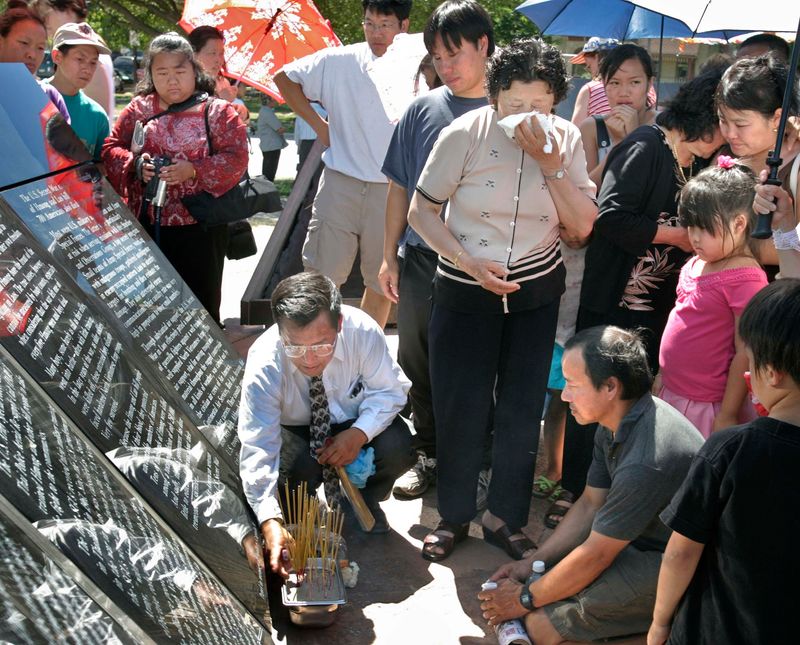
SHEBOYGAN – Several hundred veterans are memorialized on the engraved panels of the Lao, Hmong and American Veterans Memorial at Deland Park.
Some died during the Secret War in Laos. Others fled to places in the United States after the war, like Connecticut, Colorado, Minnesota and Sheboygan.

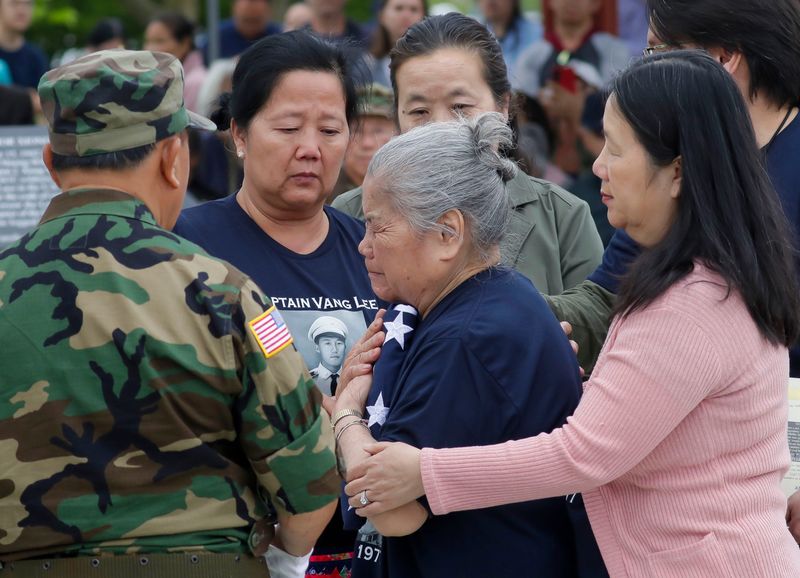
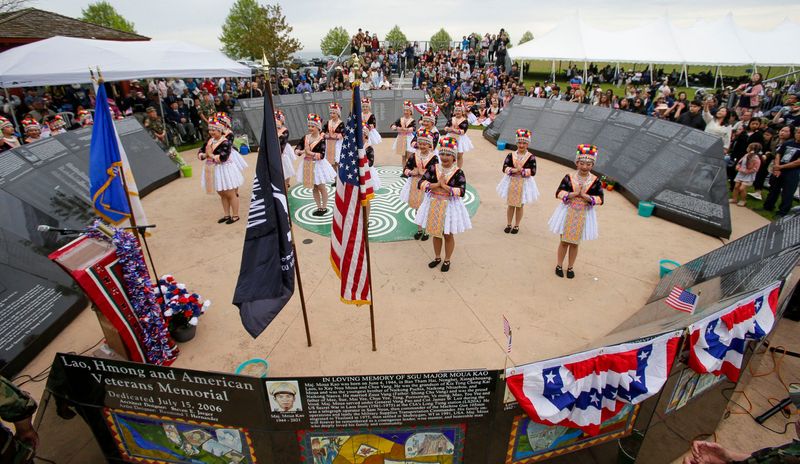
The memorial, one of only a few of its kind in the U.S., celebrated its 20th anniversary during a Memorial Day dedication this year. There was a celebratory and somber feeling as kids ate popsicles from a paleta cart and played on nearby playgrounds while some family members cried when they were presented with American flags and wreaths for their loved ones. The ceremony included traditional Hmong dancers, Taps, a gun salute and the release of two pigeons, symbolizing the release of the soul.
It was the last public ceremony because the 24 panels of portraits and biographies are full, and there are not enough Secret Guerrilla Unit veterans left in Sheboygan to participate in the ceremony.
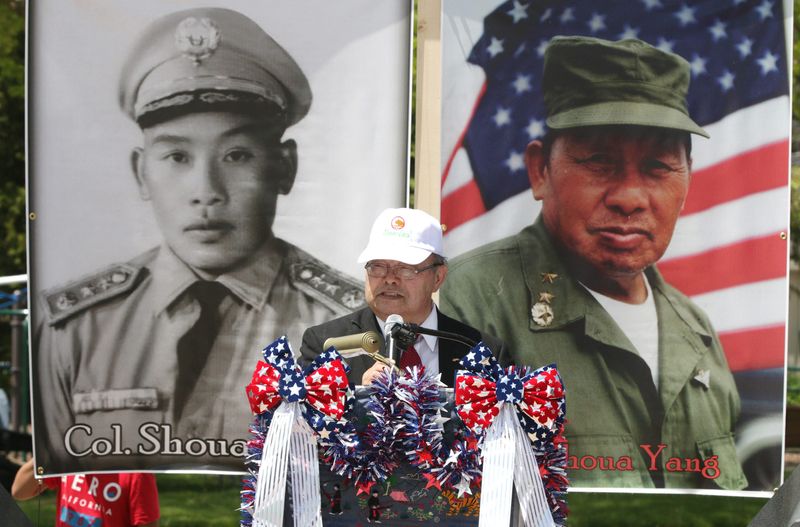
“You have witnessed yourself today that this place is truly treasured ground, highly respected and truly appropriate to preserve the names of our SGU veterans forever,” Vue Yang, chair of the LHAVM, said in Hmong through translator M.C. Cher Lue Yang.
“This memorial is 20 years in the making,” he said. “It doesn’t look like long, but let’s look at our children, who are now 20 years old. They already graduated from high school, and many are in their second year of college. This memorial is still standing here, steady, not moving even 1 inch or 1 step.”
What was the Secret War in Laos and why are Hmong veterans honored in Sheboygan?
Between 1961 and 1975, the CIA carried out a secret operation and recruited Hmong men and boys, some as young as 12 and 13, to fight against the North Vietnamese, who had gained a foothold in Laos and posed a threat to U.S. troops. The U.S. didn’t want to deploy more American troops to Laos, so this secret war ensued alongside the Vietnam War.
Familiar with the land, Hmong soldiers stifled the flow of supplies to North Vietnamese troops along the Ho Chi Minh Trail, rescued dozens of downed American pilots, provided close air support from the ground and carried supplies, and guarded a secret U.S. Air Force radar used for bombing.
It is estimated that between 35,000 and 40,000 Lao and Hmong people were killed. More than 700 Americans also died during the Secret War.
“The true losses, however, cannot be measured by body counts, especially when considering that the war left one of every five Hmong men and boys dead,” the memorial reads. “Many boys, some barely as tall as their rifles, went into battle — often with little training.”
Thomas Lee, owner of Wisconsin Home Health Care, said there used to be about 400 Hmong veterans in Sheboygan two decades ago, but that number has dwindled to fewer than 10.
Lee said the majority of veterans would attend the ceremony and the Memorial Day parade, but many can no longer walk. From his experience working with community members in home health care, he saw many pass away during the pandemic because of health conditions or age.
How Hmong families in Wisconsin worked to preserve culture and language after resettlement
But Nengher Vang, a professor of history at the University of Wisconsin-Whitewater, said Hmong people have struggled to preserve their culture, history and language since arriving in the U.S. in the late 1970s and early 1980s.
Today, Hmong culture and language are intertwined throughout the Sheboygan community through businesses, schools, language services and events such as Hmong New Year and the Hmong Several Festival.
Vang said the U.S. implemented a dispersal policy, spreading Hmong refugees across the country — across 25 states and more than 50 cities — to encourage assimilation and decrease economic burdens on local communities.
“Families were broken up. Community was broken,” Vang said.
Many Hmong people sought family reunification and jobs in Wisconsin after former President Bill Clinton’s 1996 welfare reform reduced or eliminated federal assistance to legal immigrants within their first five years of living in the U.S., including Hmong people.
Church organizations such as Catholic Social Services and Lutheran Social Services helped resettle Hmong refugees.
Many communities did not initially know who the Hmong were or why they were in Wisconsin, Vang said, because their contributions to the U.S. military were kept secret, as was the need to flee Laos when it was taken over by communist troops after the U.S. left Southeast Asia at the end of the Vietnam War.
According to the Hmong Association of Washington, only about 3,000 individuals were evacuated from Laos after the U.S. pulled troops from South Vietnam, leaving 100,000 to flee the country. More than half died trying to cross the Mekong River to get to Thailand.
Hmong communities experienced severe bigotry and racism across the state, with perpetual narratives about Hmong being lazy and relying on welfare, coming to the country to take jobs and eating dogs.
Vang said Wisconsinites’ understanding and acceptance of Hmong may have improved as they saw them assimilate into American society, becoming politically active and academically successful.
How the Sheboygan Hmong veterans memorial was built after years of debate and advocacy
The idea of creating an LHAVM in Sheboygan was not immediately supported. It took several years for the memorial to come to fruition.
Sheboygan Press archives dating to 2000 show conversations during Common Council meetings and letters to the editor that showed both fierce support and wariness about a proposed memorial with bronze statues of two Hmong fighters supporting a downed U.S. pilot. It was initially envisioned at Fountain Park, where Civil War and Spanish-American War memorials stand.
A couple of veterans, council members and community members raised questions about the location; why the Hmong deserved a memorial; whether it was appropriate to Sheboygan history; the belief that memorials for a single ethnic group should be privately funded; speculation about whether Hmong people fought on behalf of the communists; and scrutiny over how Hmong veterans could prove they fought with the U.S. military.
Those comments were evidence of the misinformation and lack of public awareness about how and why Hmong people came to Sheboygan, Hall said. The memorial aimed to tell their story.
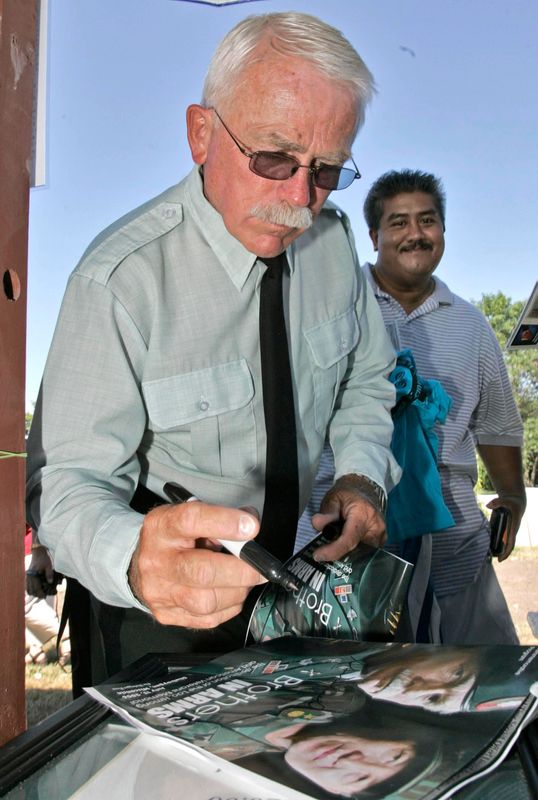
Tim Hall was one of the top advocates for the memorial, along with Vue Yang and Steven Schofield, who served as an Army medic in 1968 and later as a public health adviser in northern Laos.
Hall didn’t learn about the Hmong community until he attended UW-Madison as an undergraduate student. Despite hearing horrible stereotypes about Hmong people from a friend who had lived in northern Wisconsin, Hall said he became “emotionally invested” after hearing a radio show about the Secret War.
“I thought that was a terrible injustice, that people don’t know the story and that such rotten stereotypes are being perpetuated by folks who don’t know them,” he said.
After Hall left Sheboygan in 2002, Ray Hernandez, a former dean at the UW-Green Bay Sheboygan campus who died in 2007, led the effort again. He proposed a new design resembling other war memorials and a new location: Deland Park.
Mary Lynne Donohue, an advocate for the memorial, said Ray’s standing in the community and revised vision helped propel the memorial forward amid changing leadership on the council and fundraising. Others, such as Schofield and Vue Yang, were dedicated to honoring the history and didn’t give up.
“I think many of us who were involved just wanted to make it crystal clear that we honored what the Hmong had done for Americans in the Secret War, and we wanted to be part of not forgetting,” she said. “That has really been the motivator and the sustainer.”
The LHAVM was dedicated on July 15, 2006.
In addition to the panels on the circular black granite structures that memorialize veterans, several panels detail the history of the Secret War and the Hmong people’s involvement. There is a mosaic in the center done in the design of Hmong needlework, or Paj Ntaub, that was added in 2010.
Donohue is fond of the mosaics on the outside of the memorial that depict life in Laos, the war, and the journey across the Mekong to Thailand and the U.S. The pictures were designed by about 900 local students, an Appleton-based artist helped transfer the images onto the tiles and 350 volunteers helped glue them.
How the Sheboygan memorial and local schools are keeping Hmong history alive for younger generations
Vue Yang’s brother, Shua Yang, who retired after 23 years in the U.S. Army and earned the rank of first sergeant, said the LHAVM still plans to hold private ceremonies and accept 300 to 400 more names for engraving.
Shua Yang is also among a few Hmong veterans who participate in school events for Veterans Day and Memorial Day. South High School has hosted a community event in honor of Hmong-Lao Veterans Day. Gov. Tony Evers designated May 14 as a day to honor and recognize Hmong veterans who fought in the Secret War.
Sheboygan has developed a deeper understanding of Hmong people over the years. Shua Yang hopes his involvement with youth and the memorial can continue to educate younger generations about where their families came from and why they came to the U.S.
Contact Alex Garner at 224-374-2332 or agarner@usatodayco.com.
This article originally appeared on Sheboygan Press: Sheboygan Hmong memorial’s final public ceremony somber and celebratory
Reporting by Alex Garner, Sheboygan Press / Sheboygan Press
USA TODAY Network via Reuters Connect
By Alex Garner, Sheboygan Press | USA TODAY Network