The Oxnard City Council has again refused to put the city’s half billion dollars in investments in the hands of the city treasurer, accusing him of mismanaging funds in the past and inflating his professional credentials.
The council has been fighting with Phil Molina, Oxnard’s elected treasurer, for years. In 2020, it stripped him of most of the duties of his office and cut his salary, after an investigation commissioned by the city concluded that he made inappropriate comments to women in his office, falsely accused an employee of theft, exceeded the duties of the office and interfered with the investigation. Molina denies those allegations.

Molina sued the city and an appeals court ruled in his favor in 2024, ordering the city to give Molina back the powers of his office, restore his salary and pay him nearly $500,000 in back pay. Since then, the City Council has moved some of the former duties of the treasurer to other city departments, while keeping under Molina’s purview the duties assigned to the treasurer under state law.
On July 7, the City Council voted for the third straight year not to delegate authority over the city’s investments to Molina. As of May 31, the city had $514 million invested, according to its most recent investment report.
Instead of delegating authority to the treasurer, the city will keep the legal authority for itself for the coming fiscal year and hire an outside firm to manage its money. The vote was 6-0, with Councilmember Aaron Starr absent for the meeting.
“This is a $500 million decision that the City Council gets to make,” Assistant City Manager Eric Sonstegard said before the council’s vote. “There’s a lot of noise surrounding it, but I think it just boils down to this: trust. Who do you trust to invest the city’s money?”
In their discussion of the vote, council members made it clear they do not trust Molina.
Councilmembers Bert Perello and Gabriela Basua both blasted Molina’s judgment for investing $133 million in city funds in 2020 and 2021 in five-year investment vehicles that paid interest of between 0.47% and 1.25%. Within the next few years, interest rates on similarly low-risk investments rose as high as 5%, but the city’s money was tied up in the lower-return investments and couldn’t be moved, according to a report from Sonstegard to the council describing the city’s issues with Molina’s investing in the past.
“We probably lost millions of dollars by doing that,” Basua said.
“It questions in my mind the trust I have in the individual who is making our investments,” Perello said. “Personally, I would not trust this individual to look after my funds.”
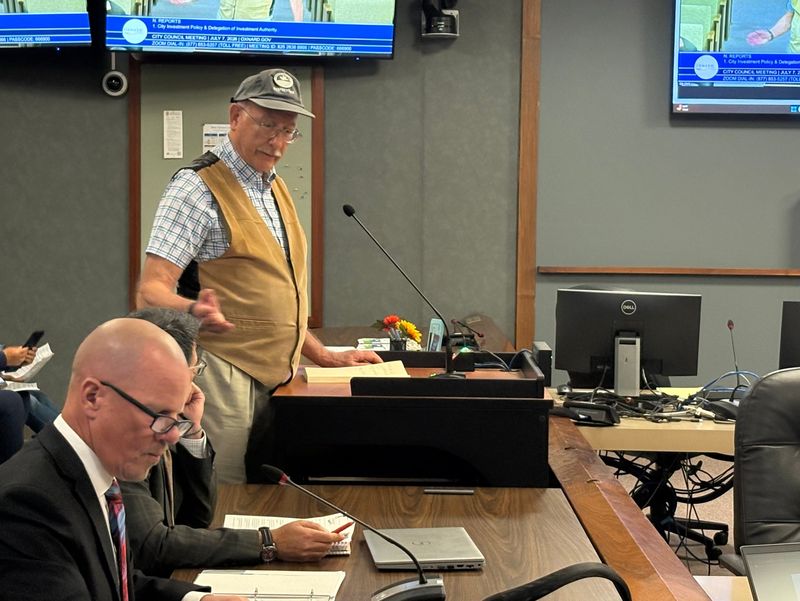
Molina addressed the council and defended his investment strategy. He said he studied the market at the time, spoke to brokers and decided those investments were safe and prudent.
“Are the rates going to go up, go down, stay the same?” he said. “It’s a toss-up some of the time.”
Molina emailed Basua and other council members the next morning and said he agreed that putting all the city’s cash in five-year bonds would be a bad idea, but putting all of it in shorter-term investments would also be poor financial management.
During the July 7 meeting, Molina accused the city of violating the order from the appeals court that restored his duties. He said city officials have prevented him from attending meetings and viewing documents regarding the city’s finances.
Ken Rozell, Oxnard’s chief assistant city attorney, told the council the city is in “full compliance” with the court order.
Molina defends bond purchases, use of private email
Sonstegard’s report to the council included other alleged investing mistakes that have been uncovered by the city’s outside auditors over the years. In 2022, the city’s annual audit found that Molina submitted the same trade twice, resulting in $1 million in city funds being tied up until a refund was issued. On another occasion, a delay cost the city a $750 broker fee.
The same audit found that Molina had invested in bonds that didn’t meet the city’s requirements for risk – for example, city policy says the city can only invest in notes rated A or higher by a credit rating agency, but in 2021 the city had $2.8 million in notes rated BBB+, a lower grade.
In an interview on July 8, Molina said he did invest in some bonds with below A ratings, which is allowed by California law.
“We never invested in anything that was below what the California codes identify as being investment grade for cities,” Molina said. “If you only looked at AAA, you would get nothing other than U.S. government bonds. I mostly bought government bonds, but I did buy some good commercial bonds.”
The report to the council also states that in 2023, Molina made trades with city funds using his personal email addresses and aliases other than his full name. That raises serious concerns about data security and records retention, the report states.
Molina said he does use his personal email address to communicate with brokers but always tries to use his city address to finalize trades. The “pseudonym” the city report said he used for trades is his first and middle name, Molina said.
Molina said that in 2023, he didn’t have access to his city email at home, so when he was working from home in the mornings he would use his personal email. He said he now has a separate laptop for city business. He also provided emails from 2021 that show him discussing one of the trades using his city email address.
Molina said that though he uses his own email and phone number to communicate about trades, the actual trades were executed through staffers at City Hall, and no private account information was transmitted via email.
Did Molina exaggerate qualifications?
Council members also grilled Molina about his professional licensing status. Molina’s email signature states that he is a retired certified public accountant. Councilmember Gabe Teran told the council that he could find no record of Molina holding a CPA license in California. He has a license in Illinois that has been listed as “inactive” since 2012, as Illinois does not have a “retired” designation.
“Even if he was an amazing investor and never made any mistakes, if he truly hasn’t been licensed in the state of California but he says he was, how can I trust him with the public’s money?” Teran said.
Molina told the council his license from Illinois is transferable to California. He said he never obtained an active CPA license in California because he never planned to work as an accountant in the state. He said he saw the “retired” label as interchangeable with “inactive” and apologized if mixing the two up created confusion.
“I’m not an active CPA. I cannot offer myself to do auditing, and I would not do that, but I have the knowledge to be a CPA,” Molina said.
Basua pointed out that keeping an active California license would require completing courses every year, and asked Molina if he has done that. Molina said he has not.
Tony Biasotti is an investigative and watchdog reporter for the Ventura County Star. Reach him at tbiasotti@vcstar.com. This story was made possible by a grant from the Ventura County Community Foundation’s Fund to Support Local Journalism.
This article originally appeared on Ventura County Star: Oxnard council won’t let treasurer invest city funds
Reporting by Tony Biasotti, Ventura County Star / Ventura County Star
USA TODAY Network via Reuters Connect
By Tony Biasotti, Ventura County Star | USA TODAY Network