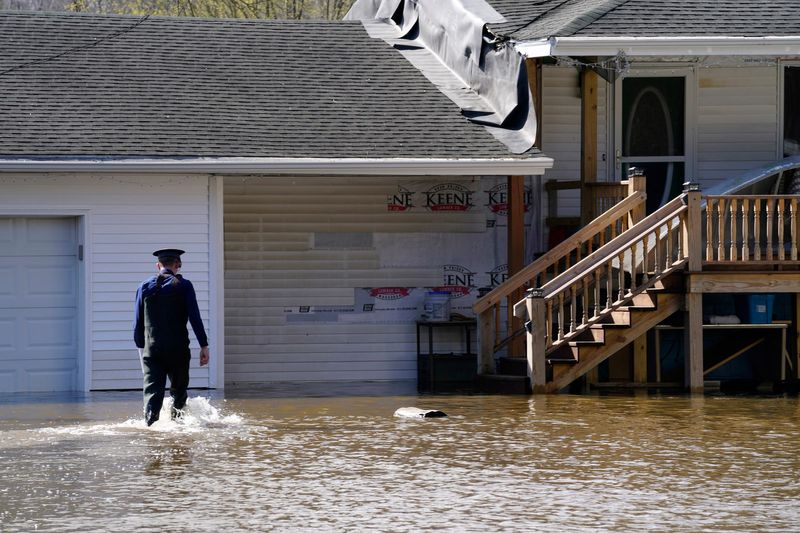
Michigan taxpayers who saw dramatic losses after severe flooding hit northern Michigan and the Upper Peninsula in April could benefit from some key income tax breaks after Gov. Gretchen Whitmer declared state disasters in many areas.
It’s a tax break that many people could easily overlook — especially since we’re dealing with some new rules that only went into place in 2026.

The One Big Beautiful Bill Act permanently expanded the federal personal casualty loss deduction to include certain state-declared disasters, not just federal ones, beginning in 2026, according to Mark Luscombe, principal analyst for Wolters Kluwer Tax & Accounting in Riverwoods, Illinois.
As a result, many of the disaster-related casualty losses that took place during some major storms in Michigan this spring could end up qualifying for personal disaster losses under the federal casualty loss deduction, Luscombe said. The casualty loss deduction would be available for 2026 tax returns filed next year.
Currently, a taxpayer can only claim such a disaster-related loss if it exceeds 10% of their adjusted gross income and you would then reduce the amount by $100 per casualty loss event during the calendar year.
On April 28, Whitmer extended the existing state of emergency to Tuscola County and the village of Holly due to extreme flooding caused by severe weather. Michigan now has 41 counties and three municipalities that faced damage to homes, businesses and infrastructure from recent severe weather, including historic flooding, tornadoes, and straight-line winds in 2026.
The governor expanded the state of emergency declarations repeated times in April to cover various communities and counties.
What’s quirky is that one tax rule is slightly different. When it comes to a federally declared disaster, Luscombe noted, the deduction could be claimed on 2025 tax returns. You could opt to amend the 2025 return or claim the deduction on the 2026 return filed next year to take advantage of the tax break if dealing with a federally declared disaster. But that’s not the same case with a state-declared disaster.
Taxpayers in a federally declared disaster area have the option of claiming disaster-related casualty losses on their federal income tax return for either the year when the event took place, or the prior year.
Starting this year, the change allows more taxpayers across the country to claim casualty losses after a major emergency if the governor in that state declares an event as a state disaster.
The Internal Revenue Service notes that a personal casualty loss deduction is no longer limited solely to losses attributable to federally declared disasters; it may also include losses resulting from state-declared disasters in many circumstances.
This tax break exists, Luscombe noted, whether the Federal Emergency Management Agency takes action or not relating to Michigan’s major weather disasters in the spring of 2026.
One way to recoup some losses for Michigan families hit by flooding
It’s a complex deduction to take, and you cannot claim losses that might already have been covered by insurance.
Casualty losses are calculated using Form 4684, Casualties and Thefts.
Then, taxpayers claim the deduction by itemizing deductions on Schedule A of the Form 1040. You’d review itemized deductions in the casualty and theft losses section. Business or income‑producing property losses are reported on the appropriate business schedules, according to Carl Breedlove, lead tax research analyst at The Tax Institute at H&R Block.
Breedlove said it’s essential to maintain documents now even if you’ll claim the deduction when filing a 2026 return next year.
Taxpayers should keep paperwork, he said, on police or fire reports, insurance claims, and appraisals. You’d want receipts, invoices or quotes for repairs to the damages. You’d also need the bills of sale, real estate contracts, and other documents.
You’d also want to keep insurance claims or proof there was no coverage.
“This paperwork won’t be submitted to the IRS, but you will need it to determine the deduction amount, along with substantiating the deduction should the IRS question the amount claimed,” Breedlove said.
As an aside, he also noted that the One Big Beautiful Bill Act did not change the general treatment of personal robbery or theft losses.
Luscombe noted that taxpayers will be taking into account the adjusted basis, which typically involves the purchase price plus the cost of improvements to the property minus any depreciation claimed with respect to the property. That amount is then further reduced, he said, by any insurance proceeds received or expected and any other assistance received, such as, perhaps, state assistance.
Brandon Nishnick, manager for Tax Practice & Ethics with the American Institute of CPAs, said if someone’s storm damage wasn’t completely covered by insurance, one’s ability to claim the deduction will depend on how thoroughly you’re able to document the loss and if the loss surpasses specific adjusted gross income and per-event limits.
For this deduction to apply, it’s essential that the storm be declared a federal disaster or, beginning in 2026, a state-declared disaster.
“A federal disaster declaration is still the clearest path to a deduction, but newer laws are beginning to broaden relief — so this area is evolving,” said Tom O’Saben, director of tax content and government relations at the National Association of Tax Professionals.
The Doug LaMalfa Federal Disaster Tax Relief Certainty Act bill, for example, would provide tax relief for victims of federally declared disasters, including hurricanes and wildfires. Among other changes, it would make casualty loss deductions available to non-itemizers, replace the $100 floor with a $500 floor, and eliminate the 10% of AGI limit. The bill passed the House in late April and was sent to the Senate. The bill would apply to disasters occurring through Dec. 31, 2026.
Luscombe noted that the change proposed in the tax relief act appears to apply only to federally declared disasters, not state-declared disasters.
Right now, Michigan taxpayers hit by the April storms have a good deal of time before filing taxes next year. But it can help to create that necessary paper trail now to prepare for any potential tax deduction next year.
Contact personal finance columnist Susan Tompor: stompor@freepress.com. Follow her on X @tompor.
This article originally appeared on Detroit Free Press: Extra tax breaks can apply to many in Michigan hit by severe flooding
Reporting by Susan Tompor, Detroit Free Press / Detroit Free Press
USA TODAY Network via Reuters Connect