For Teacher Appreciation Week, May 4-8, USA TODAY NETWORK-Wisconsin shadowed teachers and is sharing their stories with our readers.
It was a week before Ramadan, and preparations for the holy month were underway when Noor Jubeh opened her classroom at Milwaukee’s Salam School to the Milwaukee Journal Sentinel on Feb. 12.

There were exams to finish, and the club she advises, the National Honor Society, was working on a “random acts of kindness” project for the upcoming weeks of prayer and fasting.
Jubeh is used to a packed schedule. Welcoming journalists at 7:20 a.m., she had already laid out a selection of refreshments for her guests – “a little snack to make your day a little sweeter.”
Jubeh keeps a drawer of snacks for her students, too, never wanting anyone to go hungry. Once when her students could tell she was having a hard day, they returned the favor, quietly leaving a chocolate on her desk.
School hadn’t started yet, but students were already buzzing in and out of her room, dropping off their cell-model projects for her biology class and donations for the National Honor Society’s book drive. “I’m so proud of you,” she told them – an affirmation she’d repeat throughout the day, visibly landing meaningfully with her students.
Soon she was on the move, heading toward the school’s daily morning assembly. “Your steps are going to be a lot today,” she warned, rounding toward the gym where hundreds of shoes were piled outside. Inside, students sat in rows to begin prayers.
The morning assembly is a time when teachers can prepare anything they need for classes, but Jubeh generally is already prepared and likes to use the time to connect with students and colleagues, pacing through the rows to greet them.
The growing private school on Milwaukee’s south side, where about 90% of students cover tuition with state-funded vouchers, has an Islamic foundation. In addition to setting aside time to pray twice a day and serving halal meals, the K-12 school emphasizes character traits like respect, cooperation and sharing – subjects that get covered in the morning assembly and are especially emphasized in Ramadan.
“We teach our kids, what can you give up to give other people?” Jubeh said. “It’s not just about food. You’re going to say, ‘This is the month I’m going to become better, and then hopefully by the end of that month, you are better. You work on something and you build upon it.”
After prayers, members of the school’s student council gave a Black History Month presentation featuring Muhammad Ali, sharing how he fought not only for himself but for others’ rights.
On the way back to her classroom, Jubeh explained that her students’ families come from dozens of countries. They used to have an annual multicultural day where students would set up tables about their home countries, but the school’s population has gotten too big, Jubeh said, so the fair is on hold until the school opens another building.
The Islamic Society of Milwaukee, which operates Salam School, recently bought property in Franklin where it plans to move its high school students, allowing middle school students to spread out in the current main campus. Students currently take some classes in trailers in the parking lot.
Jubeh’s focus is middle school science.
Born and raised in New York City, Jubeh started her higher education in Palestine with aspirations of becoming a doctor, but she soon found her passion was elsewhere when she was asked to be a teaching assistant at a nearby American school. After nine years teaching there, she moved to Milwaukee where she is in her 10th year teaching at Salam School.
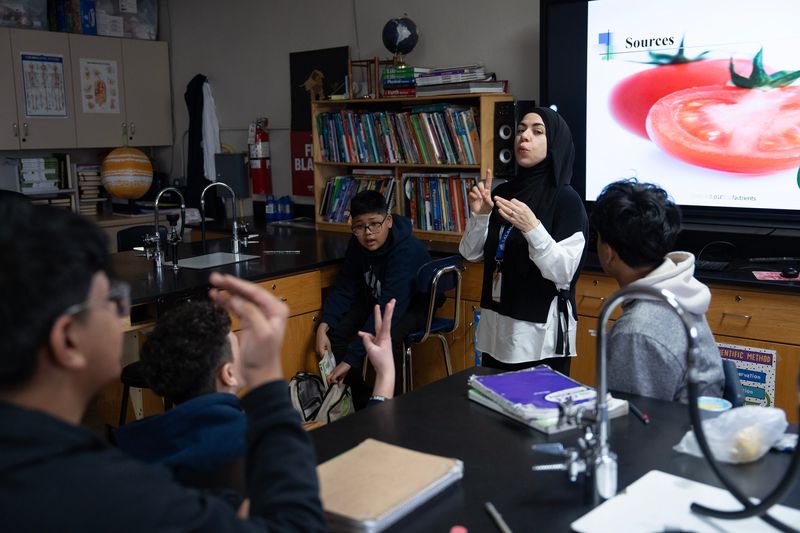
Jubeh knows the curriculum front and back; today, it’s nutrition for seventh graders, Newton’s laws for eighth, and cellular models for ninth. But each class feels fresh, she said, because it’s a collaboration with the students.
Jubeh teaches content almost entirely by asking students questions and fielding their questions in return. As sleepy eighth graders ate their breakfasts in their first period, she asked them about their breakfast habits, launching lively discussion. She fielded questions about things students had seen promoted on social media: raw eggs, creatine powder and protein shakes – all entry points to the nutritional curriculum she needed to cover.
“This was fun,” a student remarked as she packed up at the end of class. “It’s always fun,” another student added.
As she taught throughout the day, Jubeh kept her head on a swivel, tracking students that were losing focus or needed an extra push to participate.
“I want a girl in the back,” she said as she sought an answer to a question, picking a section of the room where hands hadn’t been raised. Then, to a student having a side conversation: “Tell the class what tomorrow’s quiz is on.”
The key, she said, is helping the students get to an answer even if they’re shaky. She’s willing to coach them through it, building their confidence to keep participating. She calls her students “sunshine.”
“If they feel that you are seeing them and you give them that, ‘Oh, I love how you said that,’ they’ll engage more with you than against you,” Jubeh said.
At lunch, Jubeh hosted high school and middle school students from the National Honor Society and National Junior Honor Society. They had lots of logistics to cover for four initiatives: an underway book drive for COA Youth & Family Centers, a future blanket drive, a hot cocoa sale after school that day to fund the club’s projects and upcoming acts of kindness for Ramadan – including compiling care kits for the school custodians with “actual good stuff” and handwritten notes: “We thank you for everything you do for the school.”
After teaching another class, Jubeh had a free period – spent with a stack of papers in the teachers’ lounge. There, she caught a rare moment of relaxation with her colleagues, sharing a laugh when another teacher walked in and pulled french fries out of her pocket; she’d used her break to go get ice cream and fries for a “self care” moment. They traded stories about their days before it was time for another prayer session and back to class.
It was Jubeh’s last period teaching and her favorite part of the day: watching her ninth graders present their cellular models. “You included the protein pumps?” she exclaimed to a student who built a clay model. “I find that cool.”
She likes to find opportunities for students to do projects that allow unexpected students to shine with different skills.
“That’s why I like to do hands-on stuff – where kids that don’t just go home and study and memorize and they get a full mark, they actually could showcase something else,” Jubeh said. “And I felt every single one of them, when they got up, they wanted to showcase what they’ve done.”
Jubeh considers it her duty to find the “key” that unlocks achievement for each student.
“I sometimes can’t sleep at night when a kid is like, ‘I get it,’ but I know he didn’t,” Jubeh said. “I would come back the next day and say, ‘Before I move on, I’m going to go over this subject and make sure you get it.’”
The rewarding feeling of seeing a student understand an academic concept, gain some confidence or grow into a leader is why she can’t see herself doing anything else.
“I love what I do. I love that I make a difference in kids’ lives because sometimes these kids don’t have anyone except us. This is like their home,” Jubeh said. “I try my best to make them know that I’m not here just to teach you what’s in the book; I’m here to care for you, I’m here to help you, I’m here to understand you, I’m here to listen to you, I’m here if you are going through something. I tell them, ‘I love you guys from the bottom of my heart.’ They know.”
When Jubeh can tell something is off, she’ll find a moment to pull a student aside or send them an email: “I’ll say, ‘I saw you. I just want to say that whatever it is, it’s going to get better. And if you need anything, please come to me.’”
Despite straying from her original goal of being a doctor, she feels like in a way, she achieved it anyway. A few weeks ago, a former student emailed her to say her classes always stuck with him and he planned to go to medical school. “You made me feel that I can one day become a doctor,” he told her. Other former students have already become doctors.
“So I am a doctor now,” Jubeh said. “A piece of me is a doctor.”
Rory Linnane covers K-12 education at the Milwaukee Journal Sentinel. She can be reached at rlinnane@gannett.com.
This article originally appeared on Milwaukee Journal Sentinel: Middle school science teacher uses interactive style to engage students
Reporting by Rory Linnane, Milwaukee Journal Sentinel / Milwaukee Journal Sentinel
USA TODAY Network via Reuters Connect