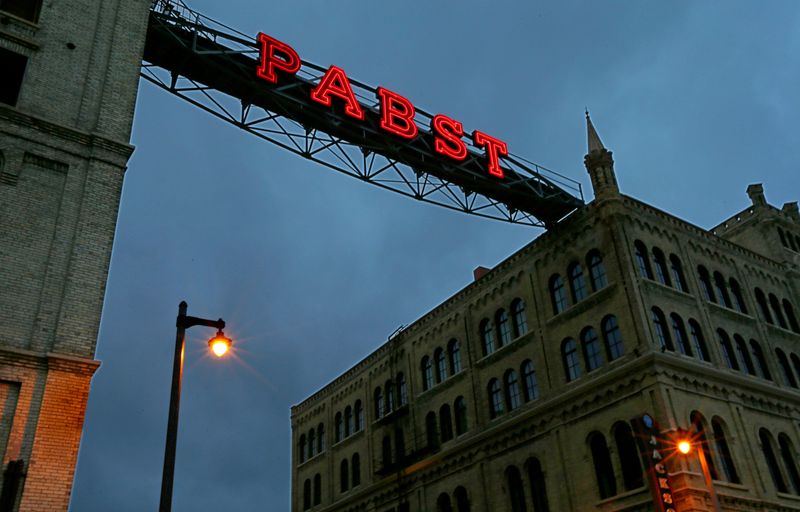
Wisconsin’s highest court recently ruled beverage giant Pabst Brewing Co. is liable for the asbestos exposure that led to a contracted steamfitter developing and eventually dying of cancer. News of the court’s 5-2 ruling, which extends Wisconsin’s “safe-place” statute to include contractor employees, quickly spread through Wisconsin’s labor community.
What are implications for other longtime businesses that have worked to eliminate asbestos from their workplaces? It may be too early to tell.

Alexander B. Lemann, an associate law professor at Marquette University Law School, said the broader impacts of the decision aren’t totally clear.
Still, he believes the effects won’t be as significant as they might seem on the surface, largely because the late Gerald Lorbiecki, who sued Pabst in 2017, was a contractor, not a company employee.
“For most businesses that have old facilities, like Pabst, most of whatever litigation they might face from their workers who get exposed to this stuff … would be filed through the workers comp system,” Lemann said. “That means that they won’t be liable in a traditional tort case, and that this ruling won’t have any impact on their liability to their employees.”
Lorbiecki worked as a steamfitter for numerous independent contractors from the 1970s to the 2000s, including Pabst’s brewery in Milwaukee. While there, Lorbiecki cut out existing insulated pipes before replacing them.
Lorbiecki was diagnosed with mesothelioma in 2017. He filed a lawsuit that same year against multiple defendants, including Pabst, for negligence and violations of Wisconsin’s safe-place statute.
Lorbiecki died on Jan. 8, 2018, but his case continued and went to trial in 2021.
During the trial, expert testimony emerged indicating “thousands of pounds of insulation” had to be stripped off of the pipes by hand using a hammer, chisel, a saw, or even a pocketknife” to finish the job.
A jury initially awarded $26.5 million, but the Supreme Court’s April decision upheld a revised amount of roughly $6.9 million in damages from Pabst, based on liability caps.
Jonathan Holder, the attorney at Dean Omar Branham Shirley, the Dallas law firm that represented the Lorbiecki family at trial, hoped the decision would inspire positive changes.
“Companies who invite workers on to their property to perform work have to provide a safe work environment,” Holder told the Milwaukee Journal Sentinel. “This decision reminds businesses of their ongoing responsibility to provide a safe workplace too all those working on the premises, even during the removal of asbestos.”
Union: Every worker deserves right to employment ‘free from danger’
Wisconsin AFL-CIO President Stephanie Bloomingdale released a statement after the state Supreme Court’s ruling, lauding it as a significant decision on worker safety and justice.
Bloomingdale singled out the affirming opinion of Justice Rebecca Dallet, who said that under the safe-place statute, the owner of a worksite owes all employees regardless of contractor status a safe place of employment, free “from danger to the life, health, safety or welfare of employees or frequenters.”
“Every worker should be able to go to work and return home safely, unscathed by physical injury or occupational illness from the worksite,” Bloomingdale said in the statement. “In its decision in this case, the Wisconsin Supreme Court not only affirmed the rights of Mr. Lorbiecki under the law and the dignity of his life and work, but the rights and dignity of every worker in Wisconsin.”
Is this a wake-up call for employers?
Lemann said the decision might serve as a word of warning for other legacy businesses in the Milwaukee area that at one point used asbestos or may still being working to get rid of it.
“The best thing to do is to ensure that injuries like this don’t happen in the first place,” Lemann said. “I think the good news is that … the worker, in this case, was exposed a very long time ago. These days, people are much more careful about asbestos than they were 30 or 40 years ago.”
Chris Ramirez covers courts for the Milwaukee Journal Sentinel. He can be reached at caramirez@usatodayco.com.
This article originally appeared on Milwaukee Journal Sentinel: Could Wisconsin Supreme Court ruling against Pabst have greater impact
Reporting by Chris Ramirez, Milwaukee Journal Sentinel / Milwaukee Journal Sentinel
USA TODAY Network via Reuters Connect