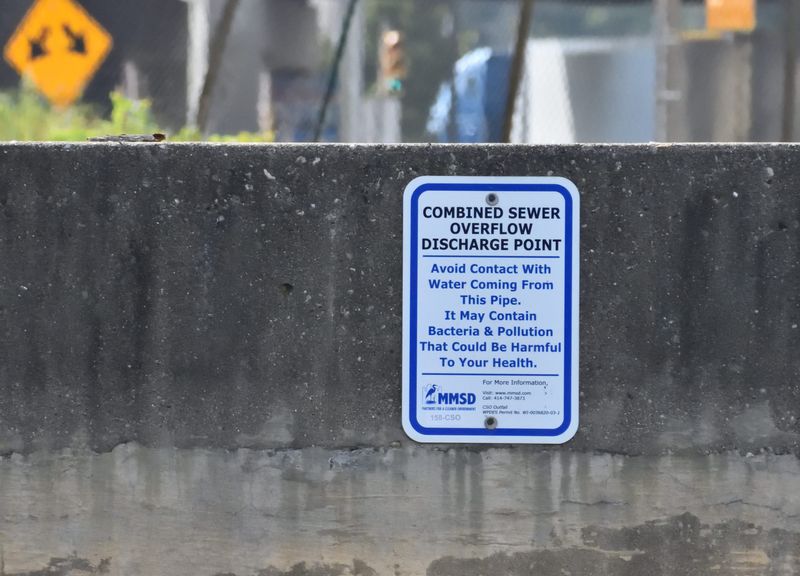
Whether you refuse to accept them, or understand they are a part of city life on the Great Lakes, sewer overflows are a hot button topic.
But what — or who — decides whether and when they happen?

It’s not AI. It’s not a computer algorithm. It’s a person — Kevin Shafer, executive director of the Milwaukee Metropolitan Sewerage District.
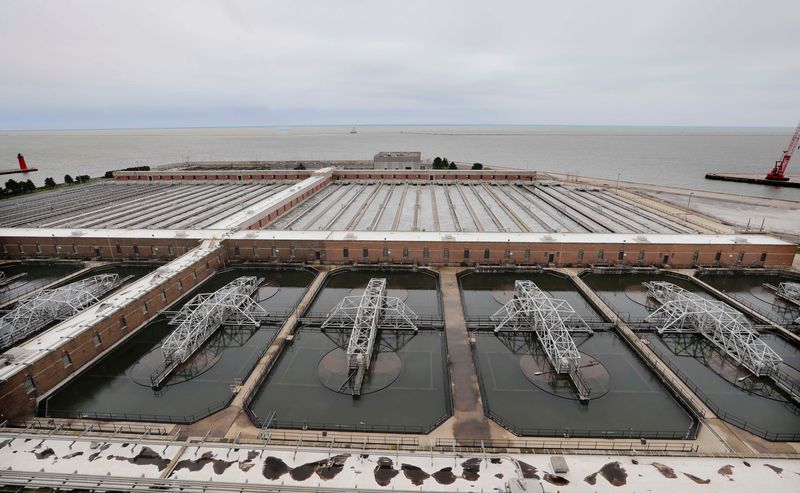
Milwaukee, like many cities throughout the Great Lakes and northeastern U.S., has a combined sewer system, meaning stormwater and wastewater from homes and businesses go through the same pipes before they are treated at the sewerage district.
If a storm hits, water flows into the Deep Tunnel, a 19.4 mile system dug 300 feet underground. If a heavy storm hits in a compressed time period, water could reach the limit of what the water treatment plants can process. Then the sewerage district — Shafer specifically — can shut the gate to the tunnel, initiating a combined sewer overflow.
The overflow releases untreated wastewater into local waterways. It’s a decision Shafer makes very reluctantly, but one that prevents sewage backups into homes and businesses.
In 2002, when Shafer took charge of the district, large amounts of wastewater were still being released from the sewers, despite the Deep Tunnel having gone into operation nearly a decade earlier. For instance, in 1992, one year before the tunnel went into operation, roughly 9 billion gallons of untreated wastewater were released into Milwaukee’s waterways. In 2002, that number was about 441 million − a 95% drop − but still far too much for Shafer.
Before Shafer took the helm, it was an algorithm that controlled the Deep Tunnel, triggering an overflow if the tunnel filled to 200 million gallons, just about half full.
Since then, for more than two decades, it’s been Shafer making the call − which sometimes means scouring storm data in the middle of the night trying to make the right decision.
When it comes to making that decision, it depends largely on rainfall intensity, with ground saturation and rate of flow into the system also taken into account. There can be a lot of rain, but if it’s drawn out over the course of days instead of hours, it won’t necessarily trigger an overflow.
Too much, too fast during 1,000-year flood event
When Shafer saw the rain starting to pour heavily on Aug. 9, he knew by around 8:30 p.m. that it was going to be one to watch. Usually, if a forecast predicts more than two inches of rain, he anticipates the potential for a combined sewer overflow.
By 10 p.m., Shafer made the call to close the gate from the combined sewer system to the Deep Tunnel — which initiates an overflow — as some of the district’s rain gauges were already reading 4 inches.
The rain showed no sign of slowing. Forecasts didn’t predict upwards of 14 inches in some parts of the city, which is what eventually happened.
The district serves 1.1 million people across 28 communities, including Milwaukee and many of its surrounding suburbs. Only 5% of that service area uses a combined sewer system, roughly within the city limits. The rest rely on a sanitary sewer system.
By law, the sewerage district can’t overfill the Deep Tunnel, so by early Sunday morning, the district had to initiate a rare sanitary sewer overflow. At that point, more than 9 inches of rain had fallen at one rain gauge in less than five hours.
The 1,000-year-flood event led to the largest combined sewer overflow since the Deep Tunnel was installed, with more than 5 billion gallons of untreated water released into nearby waterways over the course of 78 hours. The sanitary sewer overflow released an additional 131 million gallons.
Even with the overflows, basement backups still happened because the system was so overloaded, Shafer explained. The Deep Tunnel, regional sewers, local sewers and storm sewers all filled up, causing water to pool in roads and yards, Shafer explained.
“During that whole time, you had basement backups, unfortunately,” he said.
To put the enormity of the storm into perspective, when one inch of rain falls on the MMSD’s 28 communities, it equates to 7 billion gallons of water flowing through the pipes to be treated.
According to the sewerage district’s rainfall data from Aug. 9 to 13 − the 78 hours in which the overflow occurred − an average of 9 inches of rain fell on the service area.
That would mean roughly 63 billion gallons of water flowed through the pipes − or enough to fill the three Mitchell Park Domes more than 3,700 times.
Flooding would have been worse without green investments
The sewerage district operates the tunnel with a permit from the Wisconsin Department of Natural Resources. By federal law, the sewerage district is allowed six combined sewer overflows per year. Before the Deep Tunnel there were upwards of 60 overflows per year. Now, it averages 2.2 overflows a year, and has captured and cleaned an average of 98.6% of wastewater since 1994.
Shafer explained the district does everything it can not to overfill the tunnel and to prevent sanitary sewer overflows. Technically, sanitary sewer overflows also are not allowed by state and federal law, but regulations acknowledge extreme conditions, like the recent flooding, may make them unavoidable.
It’s possible that the floods and overflow earlier this month could have been a lot worse if the historic storm happened decades ago. Since 1995, the sewerage district has invested more than $580 million in green infrastructure and flood management projects to improve the landscape’s ability to hold onto water, minimizing overflows.
Green infrastructure helps nature do its job by absorbing and storing rain and melting snow. It protects against flooding and excessive heat as well as improves air, soil and water quality, which can help the city better adapt to a changing climate.
According to the sewerage district, it has more than $700 million in projects it hopes to complete in the coming years.
Caitlin Looby covers the Great Lakes and the environment for the Milwaukee Journal Sentinel. Reach her at clooby@gannett.com, and follow her on X @caitlooby.
Caitlin’s work is supported by the Brico Fund, Fund for Lake Michigan, Barbara K. Frank, and individual contributions. Grants and donations help make this reporting possible. The Journal Sentinel maintains full editorial control.
To learn more about our community-funded journalism initiatives, or to make a tax-deductible donation, visit https://givebutter.com/milwaukee-journal-sentinel. Checks can be addressed to Local Media Foundation with “JS Environment” in the memo, then mailed to: Local Media Foundation, P.O. Box 85015, Chicago, IL 60689.
This article originally appeared on Milwaukee Journal Sentinel: How did Milwaukee’s sewerage district decide to do a sewer overflow during historic flood?
Reporting by Caitlin Looby, Milwaukee Journal Sentinel / Milwaukee Journal Sentinel
USA TODAY Network via Reuters Connect