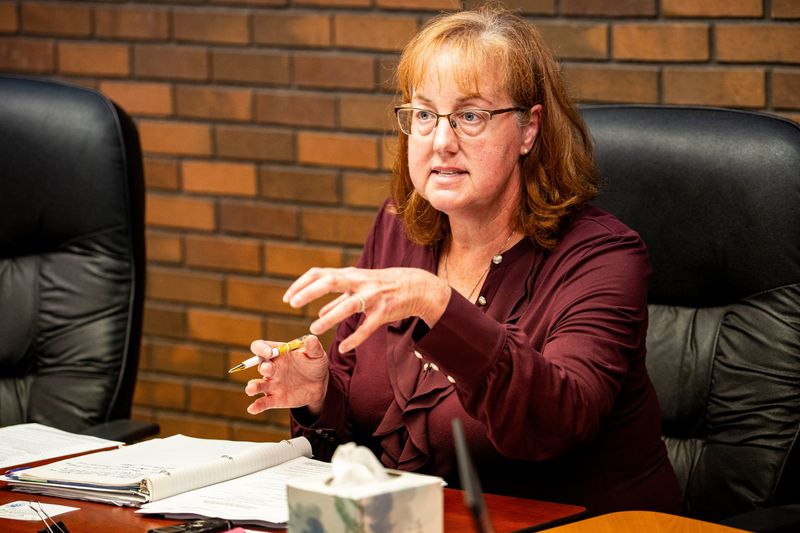
Madison County Auditor Michele Brant paused payment on invoices from outside legal counsel as she reviews whether taxpayer money is being used to fund a supervisor’s personal lawsuit against county officials.
Brant, who was elected in a special election in August, inherited an office in disarray, in a county that has spent the past year lurching from one government crisis to the next.

Her win itself was born from that turmoil. After supervisors appointed an auditor without a public vote in July, residents forced a special election by petition. Brant won it decisively, ousting the appointed auditor with 70% of the vote.
By the time she took office, the county had already spent months in a cycle of emergency meetings, legal disputes and packed boardrooms where shouting and jeers had become commonplace.
Then the invoices began landing on her desk.
Each, she said, carried the same sparse description: “pending litigation.”
“They’re billing us. We don’t know what for,” Brant told the Des Moines Register. “It just says ‘pending litigation,’ ‘pending litigation,’ ‘pending litigation.’”
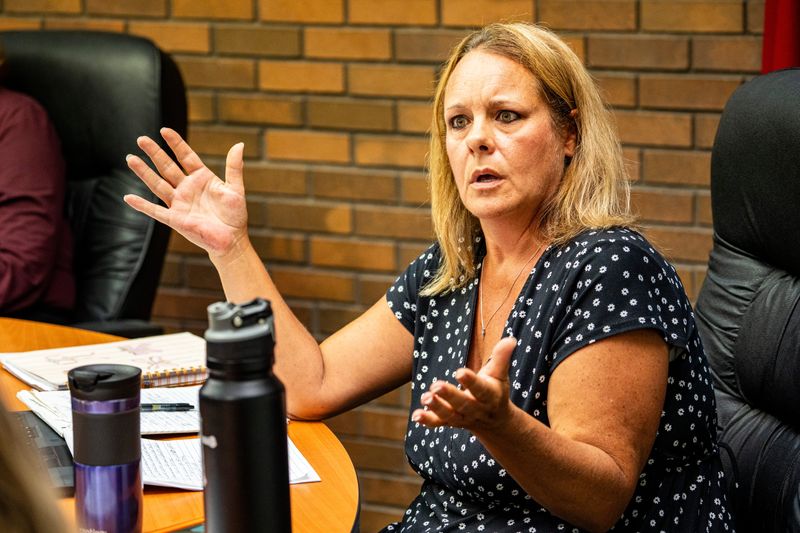
Those bills arrived as Board of Supervisors Chair Heather Stancil is suing the county under allegations tied to the same special election that put Brant in office.
In a July Facebook comment, Stancil wrote that if a special election petition effort succeeded, she would “offset” election costs by “shrinking government.” Sheriff Jason Barnes then referred that comment to the Iowa Attorney General for potential voter intimidation and election interference.
Stancil, in turn, sued Barnes in federal court, later adding County Attorney Stephen Swanson and employees in the auditor’s and sheriff’s offices as defendants, alleging retaliation against her political speech.
The contrast now sits at the center of Brant’s review of county spending: a special election expected to cost about $10,000 became the basis for a public fight over cutting costs, while county supervisors later voted to retain outside legal counsel at rates of $305 an hour, citing lost confidence in the county attorney.
Already, the costs associated with that outside counsel have climbed to nearly $21,000 and the board has approved spending up to $70,000, according to Brant, who said she is worried taxpayers may be footing the bill for something other than official county business.
Supervisors say they’ve lost confidence in county attorney
Brant campaigned on transparency and financial accountability in the county of about 17,000 residents named after James Madison, the “Father of the Constitution” and an early advocate for careful limits on government spending.
She previously lost a supervisor race to Stancil in 2020 and, before running for auditor, served as Board of Supervisors clerk. She resigned from that role in early 2025, saying she was effectively ousted as her position was being slated for elimination.
She said her demands for legal billing review a statutory obligation that comes with the job.
“I want verification that the county has not paid for anything related to their private lawsuits,” Brant said. “As the auditor, that’s my job.”
She said she has already paid almost $8,000 of the outside counsel invoices. She is holding roughly $13,000 worth more while seeking sworn clarification from the Board of Supervisors about what the bills cover. She said she has found reason and evidence to be concerned.
“I’m absolutely not refusing to do anything. I’m just doing diligence to ask for supplemental information,” Brant said.
Stancil and Supervisor Diane Fitch did not respond to requests for comment.
In prior public statements and meetings, Stancil and Supervisor Jessica Hobbs said outside counsel was needed, though they did not specify for what matters, citing a loss of confidence in the county attorney’s advice.
Hobbs told the Register in an email recently she supported hiring outside counsel “in order to protect the County from the County Attorney,” adding that “the majority of outside legal costs to date are a direct result of Steve Swanson’s actions.” She did not elaborate.
She said that legal billing details cannot be publicly itemized because that would reveal attorney-client privilege, writing that “every decision I make is an attempt to serve the taxpayer,” but that “some information will not be public information for quite some time.”
She added she hopes “a legal decision will be made soon that will provide some clarity and will encourage Auditor Brant to pay the bills,” though she did not specify what decision.
Fitch, who voted against hiring outside counsel when it was approved in August, argued at the meeting that spending is hard to justify when the county already has an elected attorney. The county attorney makes about $126,000 a year, with a 13% raise recommended to the board in January.
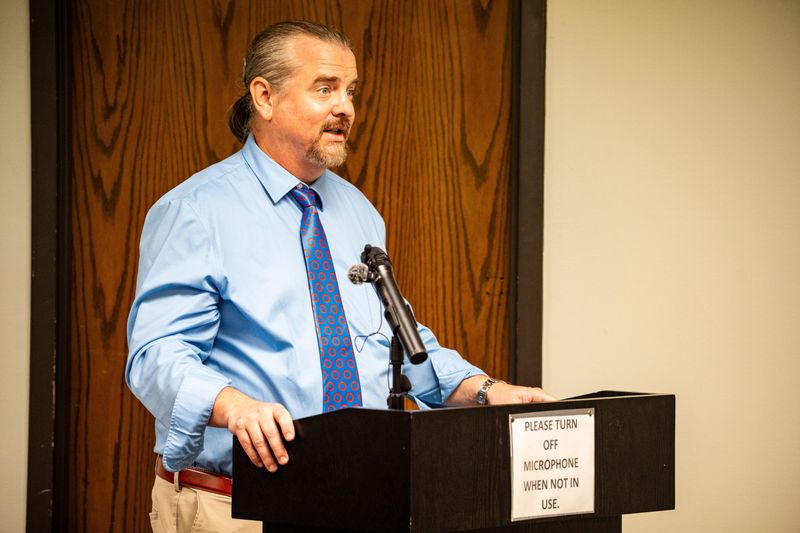
Swanson said he is unsure why supervisors Stancil and Hobbs have lost confidence in him, adding that day-to-day working relationships in county government have strained.
“I don’t necessarily have a lot of interaction with two members of the board right now, so they don’t contact me anymore,” he said, referring to Hobbs and Stancil. “It was you’re either with me or against me, and I guess I landed on the against me side.”
He said Iowa law makes the county attorney the lead official for lawsuits involving the county, and questioned the outside counsel invoices’ repeated use of the phrase “pending litigation.”
“The problem with the bills is that the bills don’t say what they are doing,” he said.
Asked what litigation outside counsel could be billing against, Swanson said he is aware only of Stancil’s personal lawsuit, in which he is a defendant. He said there is “no mechanism” at the moment that would allow the board of supervisors to remove him from his position.
The worry about attorney payments reflects a broader budget anxiety. Brigette Brockmann, an assessor’s office employee, told supervisors in August that leaking county buildings were damaging records and questioned spending priorities.
Its former treasurer, Amanda DeVos, resigned July 14 following felony charges related to allegedly forging documents. She also is separately accused of misallocating over $250,000. She has since been charged with additional felonies, bringing her total to six criminal charges. A jury trial is set to begin May 5.
Debate over closed board sessions fuels further disputes
Brant’s billing review is unfolding alongside additional friction over closed sessions. Brant said the board twice moved into closed sessions that excluded her and the county attorney.
“They verbally said that they have a conflict of interest with me,” she said. “Then they said they had a conflict of interest with the law clerk I was going to appoint to take notes and record the meeting, then they said they had a conflict with the entire Auditor’s Office, and then also the Attorney’s Office.”
Residents have forwarded complaints to the Iowa Public Information Board, which oversees enforcement of the state’s open meetings and open records laws.
Two separate complaints tied to an Oct. 27 special session — filed by Brooklyn Krings and Jared McDonald, president of the Winterset Community School District Board — alleged supervisors violated Iowa’s open meetings law after a public confrontation over whether the county attorney and auditor could remain in the room.
The meeting ended without any closed-session discussion after supervisors voted to adjourn.
The Iowa Public Information Board later dismissed both complaints, writing that because no closed-session discussion ultimately occurred and the dispute unfolded in public view, there was no actionable violation to enforce.
In her email to the Register, Hobbs said “my purpose for the closed session was to reassure Supervisor Fitch that outside counsel was not being used for Supervisor Stancil’s private case, while also discussing the counsel’s utilization in a manner compliant with Iowa’s open meetings law.”
She said staff from the Auditor’s Office were not included in the meeting invitation “because the discussion pertained solely to (Board of Supervisors) legal counsel” and that, to her knowledge, all matters she has discussed with outside counsel “were previously known to County Attorney Swanson and Supervisor Fitch, except for numerous open-records requests received since August.”
Swanson embroiled in separate controversy over criminal charge
As outside-counsel invoices draw scrutiny, Swanson also is navigating questions about his past that have added another front to the county’s already fractured political climate.
On Jan. 21, the local platform The Madison Report published Swanson’s mugshot and raised questions about whether he fully disclosed a prior Texas criminal matter on his 2024 county job application. He was appointed after former Madison County Attorney Erin Hardesty resigned and her interim replacement, Matt Schultz, left the post after winning election as Dallas County attorney.
The focus centered on an application question Swanson answered “No” to: “Have you ever been convicted of a misdemeanor or felony? (For purposes of this question, ‘convicted’ includes found guilty, plead guilty, plead no contest, or been given a deferred sentence or judgment.)”
Court documents reviewed by the Register show Swanson was arrested on assault causing bodily injury and public intoxication charges following a December 2020 incident near AT&T Stadium. The case was later resolved as a guilty plea in absentia to disorderly conduct, a Class C misdemeanor, followed by six months of deferred adjudication and payment of fees.
Deferred adjudication in Texas typically results in dismissal if conditions are met, though the underlying records remain visible in some background searches.
Swanson told the Register he had reported the incident to the Iowa Supreme Court’s attorney disciplinary board as soon as he returned to the state and believed the matter had been resolved, expunged, and effectively behind him.
A search of the Iowa Judicial Branch’s Office of Professional Regulation website shows Swanson listed as an active attorney in good standing with no public disciplinary actions. The board does not publicly disclose self-reports or investigations unless formal discipline is issued.
Swanson said the case ended without a standing conviction after he completed required terms.
“I got a deferred adjudication, which means that the case is dismissed after I took an anger management class and paid a civil (fine),” he said, adding he didn’t disclose it on his application because he believed the matter had been taken off the record.
The online post prompted at least one private citizen to file a complaint with the Iowa Supreme Court disciplinary board and share videos of Swanson at county meetings. Hobbs told the Register the matter has also been referred to the Iowa Attorney General’s office.
Swanson said he plans to run to retain the elected position in November.
Nick El Hajj is a reporter at the Register. He can be reached at nelhajj@gannett.com. Follow him on X at @nick_el_hajj.
This article originally appeared on Des Moines Register: Madison County auditor asks, are taxpayers footing lawsuit bill?
Reporting by Nick El Hajj, Des Moines Register / Des Moines Register
USA TODAY Network via Reuters Connect