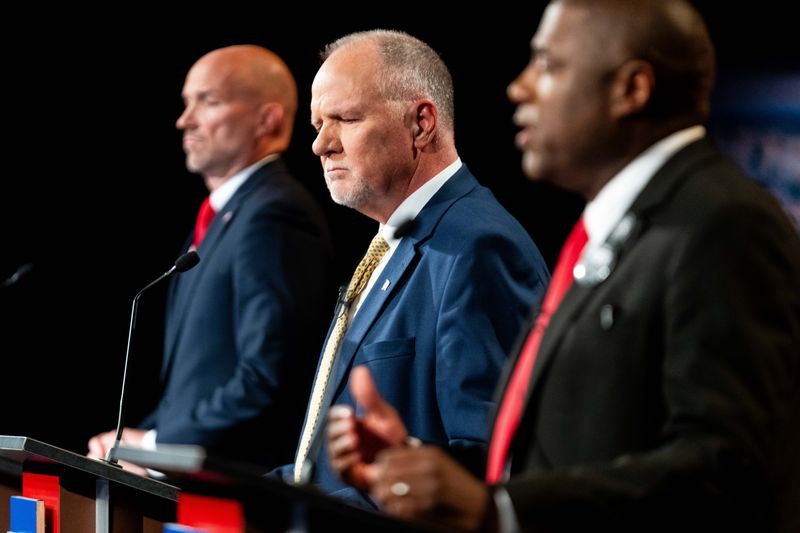
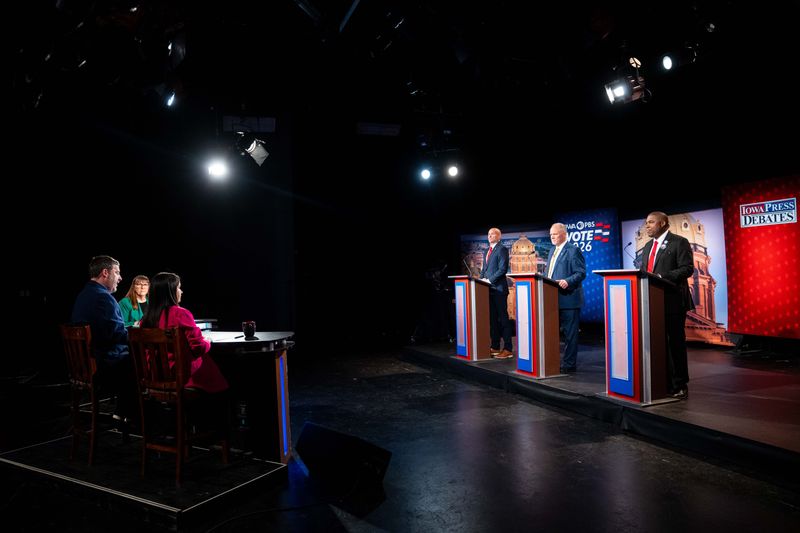
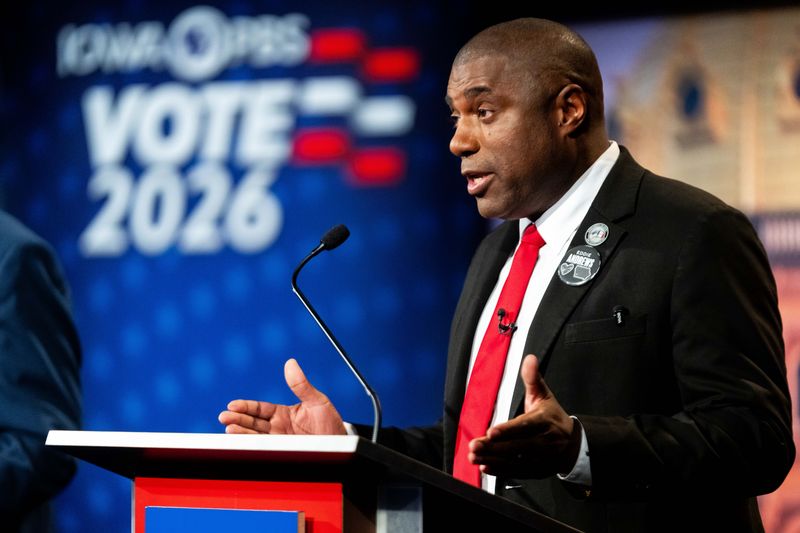
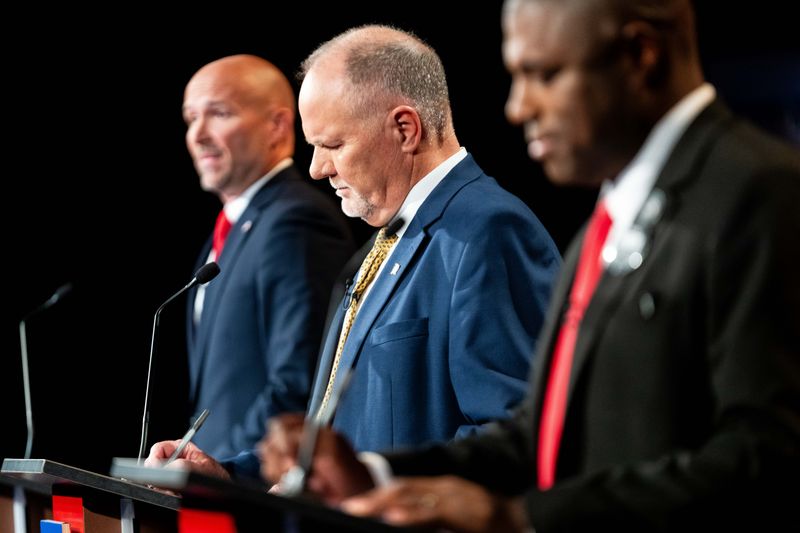
Three Republican candidates for Iowa governor sparred April 28 at a televised forum, and much of the debate quickly turned to a candidate who didn’t show up.
The Iowa PBS debate was one of the few statewide televised forums ahead of the June 2 primary. It came as U.S. Rep. Randy Feenstra remains the perceived frontrunner despite not participating in multi-candidate events, including Tuesday’s.

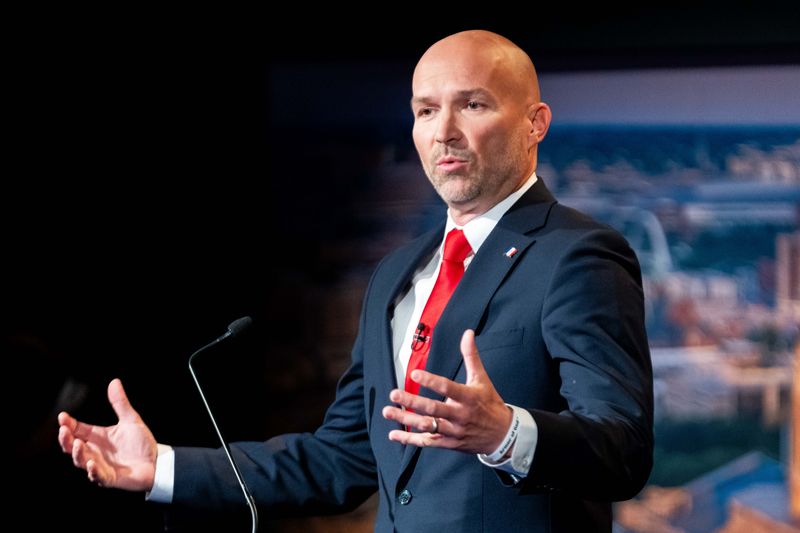
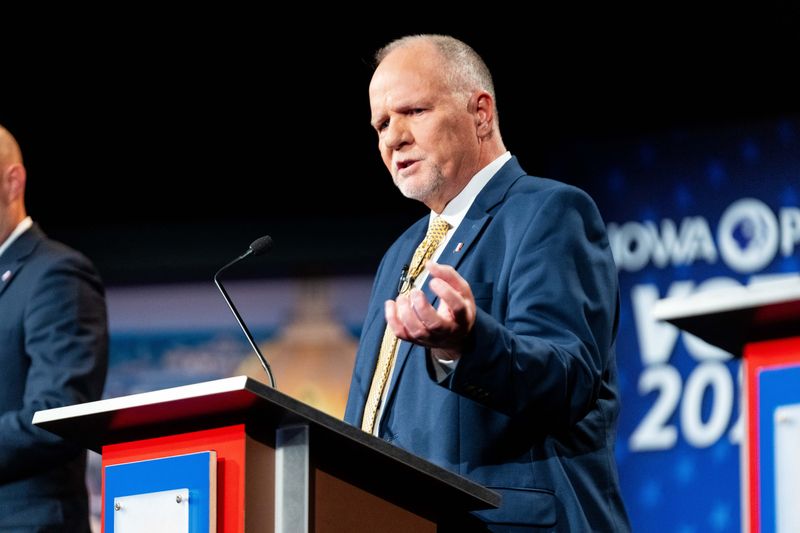
State Rep. Eddie Andrews, former state Rep. Brad Sherman and former Department of Administrative Services Director Adam Steen used the forum to outline their positions on topics such as electability, abortion and property taxes, offering occasional breakout moments in a race still shaped by the absent frontrunner.
Also skipping the event was businessman Zach Lahn, who, unlike Feenstra, was spared any jabs or even mentions from candidates on stage.
The hourlong debate was moderated by Kay Henderson of Iowa Press, Erin Murphy of the Gazette and Brianne Pfannenstiel, the Register’s chief politics reporter.
With Gov. Kim Reynolds not seeking reelection, the five Republican candidates have taken differing positions as they compete for the open seat.
The winner of the GOP primary will face Democratic state Auditor Rob Sand in November. Early voting begins May 13.
Here are three key takeaways:
Candidates make electability case, target Feenstra’s absence
Feenstra entered the race with higher name identification, millions of dollars in fundraising and backing from prominent Republican officials. But he has struggled to connect with some factions of the GOP base, and his absences from multi-candidate events have frustrated some activists in a state known for retail politics.
On Tuesday, candidates used the televised event to argue they could consolidate Republican support and defeat Sand, while also criticizing Feenstra’s absence.
“Rob Sand right now has a tremendous head start in this election process. He’s been pretending to be auditor for seven years,” Steen said. “It’s unfortunate that Congressman Feenstra is not showing up in this space. It’s unfortunate that he’s hiding in D.C. right now.”
Andrews echoed that.
“You have to be present, seriously. Why are we taking quotes from someone who is not here,” he said, referring to one of the questions.
Some polling has indicated both Feenstra’s advantage in the primary and weakness in a potential general election matchup. There has been scant independent polling in the race.
An April 14-15 poll by Victory Enterprises, a Republican firm associated with Feenstra’s campaign, found him leading the GOP field with 41%. Steen followed at about 9% and Lahn at 8%, while Sherman and Andrews each polled around 5%. About 31% of voters were undecided.
In a potential general election, a March poll by Democratic pollster GBAO showed Feenstra trailing Sand in a head-to-head matchup. Nonpartisan analysts at the Cook Political Report have also shifted Iowa’s gubernatorial race to a “toss-up.”
Feenstra needs at least 35% of the vote in the June 2 primary to avoid the nomination being decided by delegates at a statewide convention. On Tuesday, all three candidates on stage said they support keeping that process in place.
Lahn, speaking to reporters at the Iowa State Capitol Tuesday, said “any debate without Randy Feenstra present is a farce, and we should not participate.”
He challenged Feenstsa to four debates around the state.
“I’d like to have a response by this next Monday. If not, I’m going to go down this hall and I’m going to ask Rob Sand to do debates with me,” he said.
In a statement to the Des Moines Register, Feenstra campaign spokesperson Billy Fuerst said Congress being in session was the reason Feenstra couldn’t attend. Feenstra “is working to pass a full, five-year Farm Bill for Iowa, hold liberal Democrats accountable for putting illegal immigrants over Iowans, and deliver on President Trump’s America First agenda,” he said.
Responding to Lahn’s comments, Fuerst added: “It’s flattering Zach Lahn recognizes the obvious fact that Randy holds a clear and commanding lead in the primary because Republicans want a leader who will defeat extreme liberal Rob Sand and stand with President Trump. We’ll leave the theatrics to the campaigns trailing badly.”
Abortion, enforcement divide candidates
Abortion policy caused some of the clearest divides among the candidates Tuesday. While all three candidates said they support expanding existing abortion restrictions, their answers diverged on enforcement and how far restrictions should go.
Sherman took the most expansive position, arguing that legal protections should begin at conception and extend to enforcement.
“There’s only one place that you can go to avoid just an arbitrary line, that’s conception,” he said. “If it’s a person, we have to protect that life, and there should be prosecution.”
Pressed by reporters after the debate whether that would include prosecuting the women who get abortions, Sherman said he would not rule it out.
“Possibly … every situation is different if the judge would have to figure that out,” he said.
Andrews, however, drew a line against that approach.
“I believe in life at conception until natural death,” Andrews said. “However, putting those young ladies in jail … that was a step too far for me.”
Iowa’s ban on abortions after about 6-weeks, known as the “fetal heartbeat bill,” went into effect in July 2024, prohibiting abortions once embryonic cardiac activity can be detected and has narrow exceptions in cases of rape, incest, fatal fetal anomalies and to save the life of the pregnant woman.
Steen aligned with both candidates on restricting abortion, but focused his answer on expanding existing law.
“The heartbeat bill was tremendous legislation for the state, but we need to expand that,” he said. “We need to turn that into a blanket at conception.”
He also said restricting medication abortion is a priority.
“I’ll tell you what’s a crime — when these abortion pills are being shipped into the state right now, and we don’t know how many abortions are taking place,” Steen said. “The first thing we need to do to protect life here in the state is shut down those abortion pills and keep those from entering the state.”
The issue also tied into candidates’ views on Sand’s positions.
“I’ll tell you who won’t champion life, it’s Rob Sand,” he said.
“… If Rob Sand is our governor, we will be the next Minnesota; Illinois; Dearborn, Michigan; California; Virginia — the list goes on and on,” Steen said.
Sherman criticized Sand on gender issues.
“They asked Rob Sand here a while back … they said, ‘How many genders are there?’ And he couldn’t answer the question,” Sherman said. “I thought the name of that dance — it’s called the ‘shifting Sand shuffle.’”
Property taxes, eminent domain take center stage
On economic issues, candidates shared the broad goal of lowering taxes.
Steen said property taxes are part of a broader spending problem.
“This is a decades-long issue that really no true reform has come out of, but what I’ve seen over the last decades is a continual increase in government spending,” he said, adding that he would “attack” state and local spending as a first step toward reform.
Sherman focused less on a specific plan and more on transparency, arguing that greater oversight would allow voters to hold local governments accountable.
“The people will take care of this. There’s a reason the Constitution starts out with ‘We the people,” he said.
Andrews said he is the only candidate pushing to eliminate property taxes altogether, adding that his business background shapes his approach to incentives and growth.
Steen also rejected the idea that policies such as legalizing recreational marijuana would generate meaningful revenue.
“He’s going to legalize recreational marijuana … it kills the culture, hurts the streets,” Steen said, referring to Sand, arguing instead that Iowa should invest in manufacturing small modular nuclear reactors.
On eminent domain, the candidates were aligned in opposing its use for private projects, especially private carbon capture pipelines.
Steen called for a “middle ground” approach that would still prohibit the use of eminent domain for carbon sequestration projects.
Sherman rejected the projects outright.
“Nobody, literally nobody, would be interested in building a pipeline to capture CO2 if it wasn’t for the federal tax breaks,” he said. “This is just a scam to get a few people very rich.”
Andrews said he would act immediately as governor.
“As governor, I will not put up for not one day eminent domain for private gain,” he said.
Nick El Hajj is a reporter at the Register. He can be reached at nelhajj@gannett.com. Follow him on X at @nick_el_hajj.
This article originally appeared on Des Moines Register: Iowa GOP debate sharpens divides on taxes, pipelines and abortion
Reporting by Nick El Hajj, Des Moines Register / Des Moines Register
USA TODAY Network via Reuters Connect