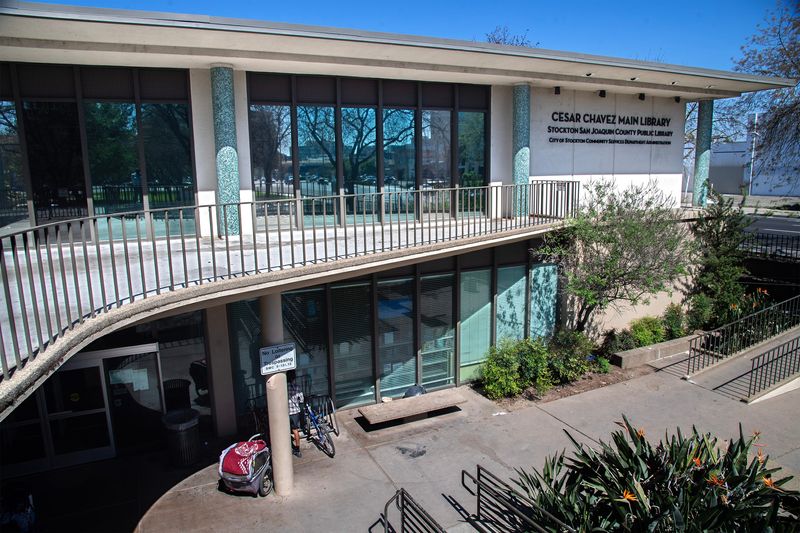
The Stockton City Council voted Tuesday to temporarily cover the name of the Cesar Chavez Central Library and form an ad hoc committee to consider next steps following allegations that the late farm labor leader sexually abused and raped women and minors, according to a New York Times investigation.
The agenda item, continued from a prior meeting, focused on whether to retain or remove Chavez’s name from the library, which has been on display since 1994. Responding to residents who have proposed new names for the library, Mayor Christina Fugazi said the council is not yet considering a replacement and any renaming would follow an established city policy, including formal applications, committee review and public input.

The discussion came more than a month after The New York Times published an investigation that reported two women said Chavez sexually abused them when they were under 18, and that the labor leader and civil rights activist Dolores Huerta said she was raped by him. Huerta, who co-founded United Farm Workers with Chavez, grew up in Stockton.
Vice Mayor Jason Lee attended a community listening forum led by District 4 Councilmember Mario Enríquez in March and said he heard concerns from attendees. He noted his 11-year career as a union leader and organizer with the Service Employees International Union and said he understood the importance of the labor fight.
“When I think about the Cesar Chavez name and the historical context it represents when it stands on our buildings, there are two things,” Lee said. “One, it represents the fight that Cesar Chavez and Dolores Huerta and all the other people in that movement did to progress the rights of workers for their families and for the immigrant community. But I also understand the difficult situation that we find ourselves in that is beyond our control.”
Lee said he has been an advocate for victims of violent crime similar to those alleged in this case. He said it is not a question of whether the allegations are true or whether survivors should have come forward sooner. Lee said that, as a sexual abuse survivor himself, he believes it would be inappropriate to keep Chavez’s name on the building and urged the council to remain committed to the farmworker movement.
Residents who spoke during public comment opposed removing Chavez’s name, citing his role as a prominent labor and civil rights leader who helped organize farmworkers and advocate for improved working conditions. Supporters said his name represents a broader social justice movement and cautioned against revising historical recognition based on allegations that have not been substantiated.
“Allegations are not evidence and proof, I think, until they’re proven,” Stockton resident Alicia Ramirez said. “I do support survivors, but I believe that it’s separate and I believe that adjudication is necessary.”
District 5 Councilmember Brando Villapudua, one of four Latino members on the council, said it was “a tough decision” and that he has traditionally marked Chavez’s contributions to the community and country each year.
“As a Hispanic male, that was our man, our leader in our community for many years,” Villapudua said.
Villapudua said he thought the situation “moved really quickly” and that councilmembers should “slow down a little bit” before making a decision. He said he had not heard about local schools taking down Chavez signs and the council had more important issues to address, including public safety. He said he was not opposed to acting but wanted to hear community input first.
Besides the Cesar Chavez Central Library, Cesar Chavez High School in the Stockton Unified School District also bears Chavez’s name. District officials have not confirmed whether the school’s name will be changed.
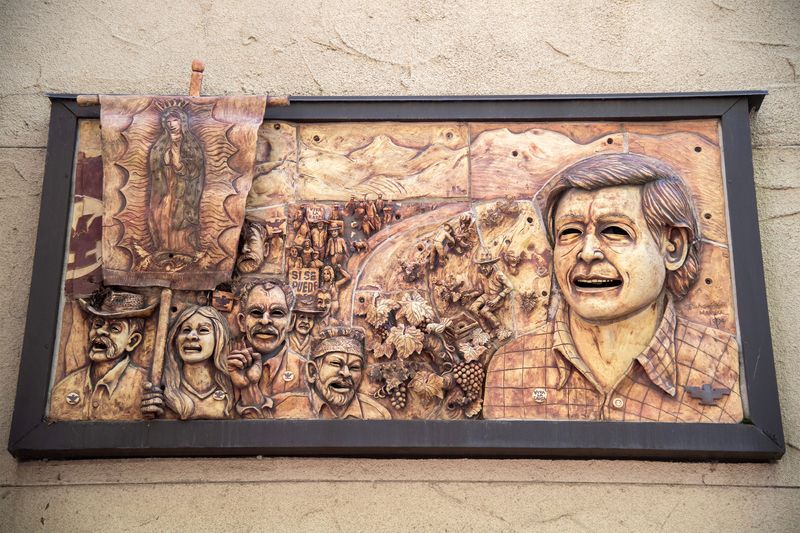
While it does not have a building named for Chavez, San Joaquin Delta College previously had a ceramic mural honoring him on its campus. In the days following the publication of the New York Times article, the college’s Heritage Committee voted to remove the artwork.
Enríquez said he was curious to know “how many people actually read the New York Times article,” which took nearly five years of reporting to complete, and said he did not think the issue should be left hanging for too long.
“A lot of us are mourning,” Enríquez said. “As Councilman Villapudua said, a lot of us, especially in the Latino community, grew up with this person who was our hero and idolized him and Dolores Huerta and the United Farm Workers, and to all of a sudden wake up to the news that all this is happening, you almost feel like that person you believed no longer exists. It was taken away from you and the community.”
Still, Enríquez said it was important to believe survivors. He said city councils, school boards and state legislators are currently voting on similar issues and people are still discussing them, so the council should not act in a vacuum or pretend the issue does not exist.
District 1 Councilmember Michele Padilla said she did not want to discredit any allegations and wanted to recognize Chavez’s accomplishments in the community. She said the issue warranted a broader discussion with residents and made a motion to cover the library’s name while an ad hoc committee is formed and research is conducted regarding its potential removal or change.
The council approved Padilla’s motion in a 6-0 vote. Voting yes were Fugazi, Lee, Villapudua, Enríquez, Padilla and District 3 Councilmember Michael Blower. District 2 Councilmember Mariela Ponce was absent from the vote.
Fugazi said she will appoint councilmembers to the ad hoc committee at the next council meeting.
Record reporter Hannah Workman covers news in Stockton and San Joaquin County. She can be reached at hworkman@recordnet.com or on Twitter @byhannahworkman. Support local news, subscribe to The Stockton Record at https://www.recordnet.com/subscribenow.
This article originally appeared on The Record: Stockton council moves to temporarily cover Cesar Chavez library name
Reporting by Hannah Workman, The Stockton Record / The Record
USA TODAY Network via Reuters Connect