Part of a series on the labor practices of the Des Moines Metro Opera.
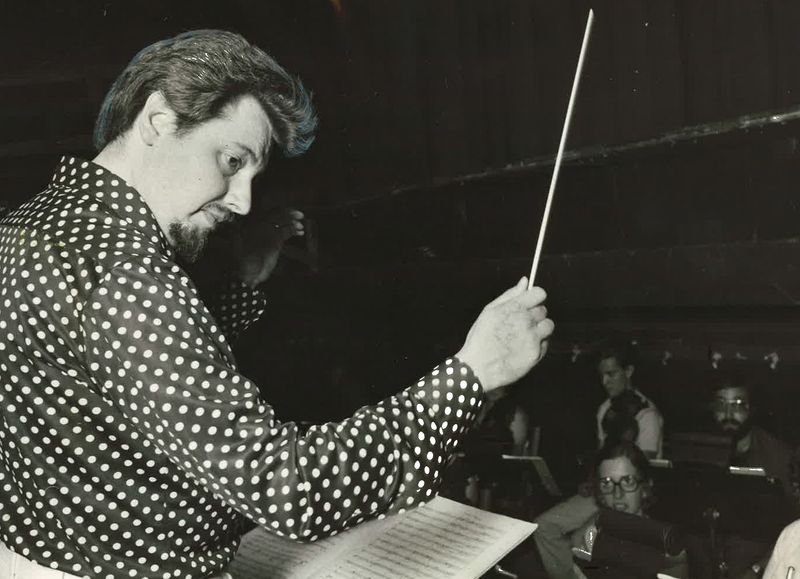
A world-renowned opera in a small town like Indianola is the kind of thing that starts with an idiosyncratic, indefatigable founder. In the Des Moines Metro Opera’s case, that founder was Robert Larsen.

Born in 1934, Larsen grew up in the southeast Iowa community of Walnut, where his father farmed and owned the local grain elevator. In Larsen’s telling, recounted over the years in interviews with the Des Moines Register and other Iowa media, he fell in love with opera around the age of 8 by listening to radio broadcasts of New York’s Metropolitan Opera. He convinced his father to drive him to shows in Omaha and taught himself to play piano by ear until his family splurged on lessons.
He attended Simpson College in Indianola and started staging his own operas as a student. The college hired him as a professor after he graduated, and he taught piano and medieval literature. He also formed a crew of madrigal singers who, under his direction, performed in the Renaissance style around Iowa.
He said leaders at the Met offered him an assistant conductor job, but he turned them down to start his own festival.
“Throughout the country it is the duty of people interested in opera to start local opera companies that will provide local singers with a chance to sing and local audiences with a chance to become acquainted with opera,” he told the Des Moines Tribune in 1964, days before he staged his first production at Hoyt Sherman Place in downtown Des Moines.
He kept singers at the venue to rehearse past midnight and warned that he may shout at them as he became nervous about the show, a Tribune reporter who observed preperations warned at the time. But the organization, the Des Moines Civic Opera, lasted just two years.
In 1973, a surgeon, the head of a grocery store chain and the owners of a chicken vaccine manufacturer donated $22,000 to Larssen’s next attempt, the Des Moines Metro Opera.
Inside the Blank Performing Arts Center, a Simpson building that opened two years earlier, those first shows were humble. Larsen served as both director and conductor and insisted that singers perform in English, not the Italian or French or German that U.S. opera houses usually featured at the time.
Donors and their family members painted the sets. Donors also gave away blocks of tickets to their friends as a form of marketing.
“Larsen approaches regional opera with the zeal of a missionary,” Register arts writer Joan Bunke wrote in an August 1974 profile.
With big ambitions came growing workload
The organization formed amid the industry’s “explosion” around the country, according to OPERA America.
The Met had toured the country for years, boosting interest in opera in all parts of the United States. When the National Endowment for the Arts formed in 1965, opera supporters hoped for government backing that would put the United States on par with Austria, Germany and Switzerland. To spur more domestic productions, the Ford Foundation increased funding for opera houses that agreed to stage original work.
In Indianola, Larsen organized his company as a summer stock, a theater that presents shows when bigger houses break for the season. He envisioned filling the 467-seat auditorium with small-town families and farmers like his father.
“I like to get people who have never been to opera before,” Larsen said. “… I think they’d be really fascinated.”
But Larsen was ambitious. He ran the opera in repertory, meaning the theater would host three different shows on three consecutive nights in hopes that patrons and critics from cities around the country would travel to Iowa for a long weekend of performances.
Larsen put “Des Moines” in the festival name because he wanted to move his productions to the bigger city 20 miles north. The festival ultimately stayed at Simpson, where the seasonal staff could sleep in the campus apartments. But the opera did present a memorable show at the Des Moines Civic Center in 1984, when elephants, camels, zebras and tigers filled the stage for a production of “Aida.”
With a small crew to carry out Larsen’s vision, the festival was challenging for workers. In a 1978 broadcast of “Assignment Iowa” on Iowa PBS, host Mary Jane Odell observed that singers rehearsed from 8 a.m. to 11 p.m. Production crews stayed late to change the sets on weekends.
“It takes a lot of doing,” Larsen told Odell.
At the same time, a former department head who worked at the Des Moines Metro Opera in the 1990s said the organization earned a reputation as a quirky, fun place to make art in a small town.
“You get to create,” said the woman, who like several other current and former opera employees spoke to the Register on condition of anonymity out of concern for their careers. “It’s a little nutty. The living situation isn’t the best. But this is what you do.”
The opera’s leaders accented the organization with small-town touches. They sold popcorn and soda in the lobby, making Blank feel more like a movie theater than the Met. Since the 1980s, opera staff has run outreach programs to build generations of fans, bringing shows to rural schools and low-income residents.
One department head recalled watching a crowd of teenagers boo the racist character of Iago in a production of Shakespeare’s “Othello,” a kinetic response that he had never witnessed inside stuffier, emptier opera houses.
“You’re making a difference,” he said, “making kids interested in doing or supporting theater down the line.”
Greg Funaro, who owned a bakery and deli two blocks south of the opera’s office, said administrators and crew members came by every day. His late wife saved cookies for the crew, who showed up in sweat-soaked shirts.
“The opera treated us very, very well,” he said. “And we treated them.”
New director brings professional focus
Michael Egel, a Simpson alumnus who is now the opera’s general and artistic director, started at the opera as an intern in 1994. He shuttled opera workers from the airport to the college, cleaned bathrooms, bartended in the theater and served as an extra in a production of “Carmen.”
A native of Algona, Egel found his way to the arts through community theater before college. He enjoyed picking shows, building sets and making costumes “into all hours of the morning.” He said the work and friendships in theater changed his life.
“I don’t know if I would be alive today,” he said in an interview with the Register. “That was a really challenging time; high school is a really challenging time as you’re trying to find your way. Many people, I think, have stories of having to endure tremendous amounts of bullying and finding a new way, a new community, where they feel accepted.”
Egel enrolled at Simpson to study voice, with dreams of becoming a Broadway singer. But he fell in with the opera, and he grew close to Larsen. While attending graduate school at the University of Memphis, he returned to Indianola every summer to intern. He has spent his whole career at the Des Moines Metro Opera.
“He really began to trust my instincts and my input and my advice and vision,” Egel said. “I think that relationship just grew over time.”
Larsen appointed Egel as the executor of his will. When Larsen died in 2021, he left Egel $10,000, a 1978 Mercedes 450 SL convertible, a Japanese vase he had displayed on his living room mantle, an etching in his hallway, a marble sculpture in his dining room and “any other household articles he desires.”
Larsen also left his Indianola home and about 315 acres of Shelby County farmland to the opera. Larsen’s estate sold the farm for $5.5 million in December 2021, nine months after Larsen’s death.
Veterans of the opera describe Egel as soft-spoken and kind. He learns the names of the apprentice artists and production crew. He tells employees that the organization is a family.
“He’s very earnest,” a former hair and makeup designer said. “He’s able to speak to people and weirdly get closer to them.”
In 2010, the board promoted Egel to artistic director. They gave him the opera’s top position, general and artistic director, three years later.
Egel told Indianola’s Record Herald and Indianola-Tribune at the time that he planned to “expand our repertory by presenting works that have never been seen at DMMO or in our state.” He recently told the Register that he also prioritized bringing in the best singers he could.
“It was time, I think, for some fresh ideas,” he said. “I have really leaned into some things that he did not do.”
In 2024, the opera’s budget was $6 million, up from $2.2 million in 2013. The opera foundation’s endowment grew to $21.6 million from $9 million during that period.
Egel has been an avid fundraiser. He told the Register that many of the opera’s donors come from families that have supported the company for generations. The opera’s critical acclaim under Egel’s leadership has helped.
“It’s become one of my favorite parts of the job,” he said. “I love going out to a donor and taking the work of our production designers and our production team and saying, ‘Look at what we’re about to do. Look what’s possible here. The opportunity create one of the greatest opera festivals in America exists here.’”
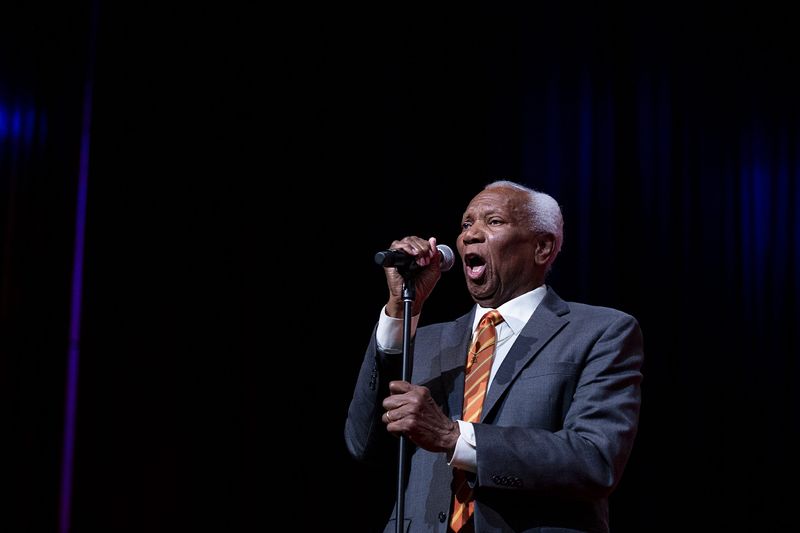
In 2022, the organization’s 50th anniversary, the opera staged “Porgy and Bess” with Simon Estes, the famed singer from Centerville who had performed in the show at major houses around the world, including the Met.
A year later, the company produced “Bluebeard’s Castle,” subverting the show’s usually stark set with a cascade of AI-generated images that filled 744 LED panels behind Christian Van Horn, the bass-baritone lead and another veteran of the Met. Opera professionals and critics around the country raved.
“I heard from people all over the place: ‘Oh, you were part of Bluebeard’s Castle,’” one former department head said.
A former opera leader who worked under Larsen and Egel said the organization stopped emphasizing the summer stock’s educational aspects over the last decade. She said the opera used to recruit designers who worked as teachers most of the year. Now, it recruits some of the industry’s most successful artists.
“The pressure becomes greater (on the crew),” she said, noting that veterans of larger opera companies “want something to be professional, and they want something to be perfect. They don’t remember this is a (expletive) summer opera company. You have apprentice artists. You have apprentice carpenters. They may not live up to your expectations.”
As the opera’s star rose, Indianola became a waystation for young production workers and singers who hoped to one day get roles in the country’s top houses.
One former intern said her professors encouraged her to work at the Des Moines Metro Opera, though they warned her it would be a grueling summer. They said the job would look good on her resume. (Two other professors told the Register they had stopped recommending students go to Indianola.)
“If you could work in Des Moines,” she said, “you could work anywhere.”
Tyler Jett is an investigative reporter for the Des Moines Register. Reach him at tjett@registermedia.com, 515-284-8215, or on X at @LetsJett. He also accepts encrypted messages at tjett@proton.me.
This article originally appeared on Des Moines Register: As Des Moines Metro Opera grew, its ambitions extended beyond its small-town Iowa origin
Reporting by Tyler Jett, Des Moines Register / Des Moines Register
USA TODAY Network via Reuters Connect