Emergency room wait times for hospitals in the Peoria area can range between 50 minutes to well over four hours, according to data from a website specializing in hospital reviews.
Hospital Stats, a website that allows people to provide feedback on hospitals and clinics across the country, showed that out of 14 hospitals surveyed in the Peoria area, only a single one had a wait time that lasted under one hour: Hopedale Hospital, with a wait time of 50 minutes.

Even then, Hospital Stats said that Hopedale struggled to meet people’s expectations when it came to providing care. Key issues included: lack of communication between patients, doctors and nurses; a lack of quick response when a patient needs help; and dirty facilities.
Officials at Hopedale did not respond to a phone request for comment by the Journal Star.
Here’s a look at wait times at other hospitals in the area:
Mason District Hospital, Havana
Wait time: 1 hour, 25 minutes
A critical access hospital in Mason County, MDH also received criticism for lack of communication and lack of quick response.
Mason District Hospital also did not respond to a phone request for comment by the Journal Star.
Graham Hospital, Canton
Wait time: 1 hour, 40 minutes
Graham did receive praise for nurses being able to communicate with their patients, but Hospital Stats reported that the mortality rate for heart disease and pneumonia was higher than the national average there, at a rate of 20% worse.
Graham Hospital did not respond to a phone request for comment by the Journal Star.
Carle Health Pekin Hospital
Wait time: 1 hour, 56 minutes
Carle Health is investing $8 million to upgrade the aging hospital, which got praise for nurse communication. However, it received complaints with getting patients help and dirty facilities, according to the site.
Carle Health Eureka Hospital
Wait time: 1 hour, 56 minutes
While generally receiving poor grades overall by users of Hospital Stats, some users did praise Eureka for getting patients help and for having quiet rooms at night.
OSF HealthCare Saint Clare Medical Center, Princeton
Wait time: 1 hour, 59 minutes
Saint Clare did receive some praise for low mortality rate when it came to treating pneumonia, 8% better than the national average of 18.2%.
OSF HealthCare Saint Luke Medical Center, Kewanee
Wait time: 2 hours, 2 minutes
Saint Luke does have a slightly shorter wait time for serious illnesses, with a wait time of 1 hour, 40 minutes for those in Kewanee.
OSF HealthCare Saint Elizabeth Medical Center, Peru
Wait time: 2 hours, 4 minutes
Opened in 2024 on the same site that housed St. Margaret’s Health – Peru, Saint Elizabeth was criticized for poor communication, poor response times and dirty facilities in a similar manner to other facilities on this list, according to the site.
OSF HealthCare St. Mary Medical Center, Galesburg
Wait time: 2 hours, 57 minutes
While doctors and nurses at St. Mary were praised for their communication, they also received criticism for not providing quick-enough help for patients and for having a dirty facility, the site said.
Carle Health Proctor Hospital, Peoria
Wait time: 3 hours, 2 minutes
Proctor’s mortality rate was only about 1% worse than the national average, while praise was given for staff’s communication skills.
Carle Health BroMenn Medical Center, Normal
Wait time: 3 hours, 29 minutes
BroMenn received praise for clean rooms and good communications, but got docked for not providing help quick enough for patients.
OSF HealthCare St. Joseph Medical Center, Bloomington
Wait time: 3 hours, 38 minutes
While the wait time at St. Joseph can sometimes last nearly four hours, it’s much more sedate for those with serious cases, lasting for 1 hour, 45 minutes in most instances.
Carle Health Methodist Hospital, Peoria
Wait time: 4 hours, 21 minutes
Methodist was praised for good communication between staff and patients, although quick treatment could sometimes be an issue, according to the site.
Methodist’s medical director, William Fletchall, said that they put a priority on treating patients with unstable vital signs or acute conditions, such as heart attacks, stroke and trauma. He said that the time that a person has to wait to see a physician in the ER can vary due to factors like the capacity of a hospital and surge effects during busy periods.
“ER arrivals are not a normal distribution,” Fletchall said. “You can have a few patients that show up in a 2-3-4-hour span that we can easily handle, but if you get a surge of 10-20 patients in one or two hours, we have to get through all of that. It doesn’t change the amount of time we’re seeing those patients.”
Fletchall said that in terms of communicating with patients and their families, they like to use language they can understand, knowing that the time they may need to wait for treatment could change. Carle has implemented a patient care liaison in the waiting room in order to alleviate concerns about their wait, something that he says has worked well.
“In the fourth quarter of 2025, we achieved the experience goal that our patients would be satisfied with our care and our communication was improved, especially from our providers,” Fletchall said. “While they did note there was some long wait times, they were understanding better why the wait times were occurring, they were feeling satisfied that they were saving the care that was appropriate for them, and they were understanding that the wait time allowed them to get the highest-quality care not only for them but other members of the community.”
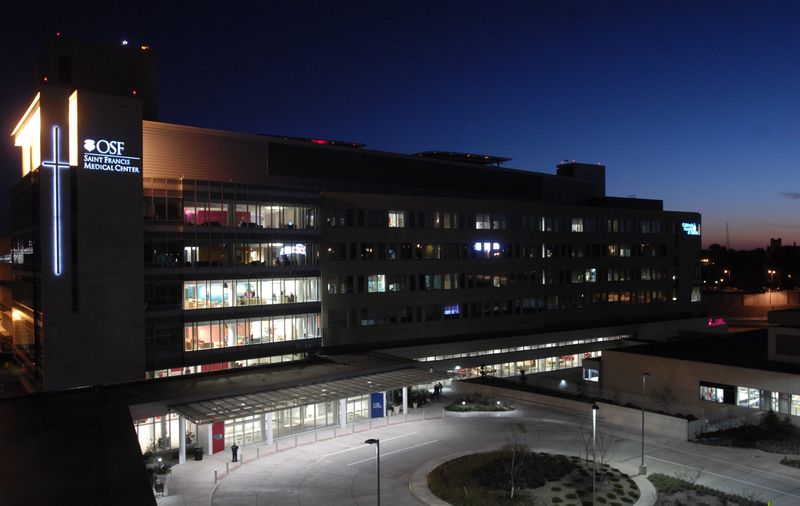
OSF HealthCare Saint Francis Medical Center, Peoria
Wait time: 4 hours, 24 minutes
Saint Francis saw a 9% worse mortality rate than the national average for serious illnesses, but communication between staff and patients was praised, according to the site.
In a statement provided to the Journal Star, OSF said that “nationally-recognized triage protocols” were used to ensure those who need care receive it. They said that priority was given to those with “critical emergencies,” such as trauma, heart attack and stroke, which could cause a longer wait time for those with less serious injuries.
OSF said it was continuing to work on enhancing emergency department services through better staffing, operational improvements, stronger flow of patients, and ensuring that patients receive the most appropriate level of care. It also noted that people could receive quicker care through PromptCare or OnCall Urgent Care facilities, in addition to virtual care services and primary care doctors.
OSF also said that some of the data on Hospital Stats could be out of date by as many as 36 months. The health care system said it uses real-time operational data to help improve access to patients and reduce wait times as much as possible at its facilities.
This article originally appeared on Journal Star: Here’s a look at wait times for central Illinois hospital emergency rooms
Reporting by Zach Roth, Peoria Journal Star / Journal Star
USA TODAY Network via Reuters Connect
By Zach Roth, Peoria Journal Star | USA TODAY Network