Wade Mapes of Madison is an avid birder and in his fourth year as a volunteer with the Bald Eagle Nest Watch program run by Southern Wisconsin Bird Alliance.
He has absolutely no difficulty identifying the big feathered animal that serves as our nation’s symbol.

“I see [a bald eagle] pretty much every day somewhere around Madison,” Mapes said. “It’s pretty cool, yes, especially when you consider how they’ve recovered.”
But June 8 when he was doing his regular check of a bald eagle nest in Dane County, he wasn’t sure if he could believe his eyes.
Per protocol of the nest watch program, Mapes had documented the activities of the adult pair at the site weekly since early February.
Things had progressed nicely, too, with egg laying, brooding and hatching. In mid-March, Mapes began seeing a small, downy head protruding above the side of the hulking, stick nest.
From a distance so as not to disturb the birds, he took documentary photos with his phone through a spotting scope.
The one eaglet was soon joined by another. And another.
By early June, Mapes had taken photos of three eaglets together and both adults continued to feed and tend the youngsters. All things considered it was a very successful nest, well above the average of 1.1 eaglets fledged per nest from the 267 sites monitored in 2025 by the program.
But it was about to rise to a whole other level.
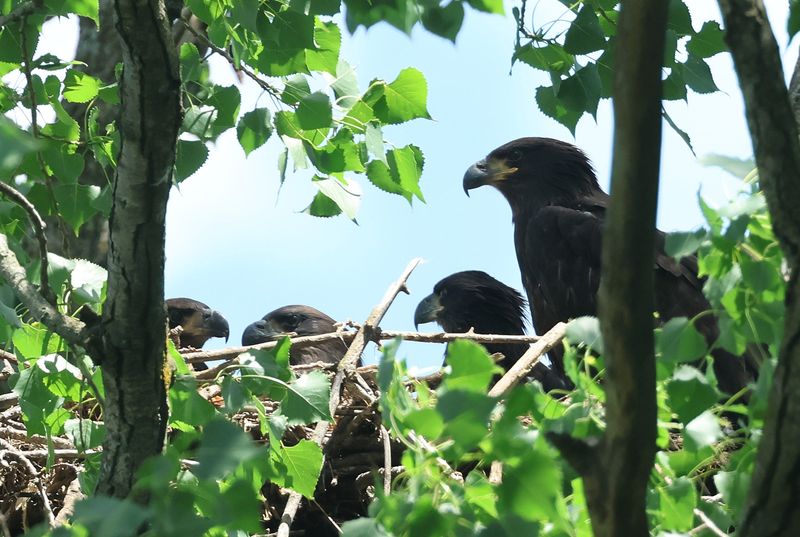
On his June 8 outing to view the nest, Mapes saw the usual mob of eaglets in the stick bowl, now more crowded than ever by their weeks of growth and development.
But as he struggled to get a clear view through fluttering cottonwood leaves, he thought he saw something that would make the space even more jammed – a fourth brown head.
After a few minutes he was able to capture an image on his phone and count the nestlings.
He texted Drew Cashman, volunteer southern program lead for the nest program.
“I’m not sure what’s going on here, but there’s four eaglets,” Mapes wrote.
Cashman confirmed the count on the texted image.
“What best describes my feelings was excitement and then confusion,” Mapes said. “I had no idea there could even be four!”
Bald eagles are slow to mature, typically nesting for the first time at age 4 or 5, and then usually lay from one to three eggs.
It’s rare, Cashman said, for an eagle to lay four eggs. And it’s MegaBucks-winner rare for a pair of eagles to have four eggs hatch and the young survive to near-fledgling stage.
A nest with four healthy, young eaglets ready to fledge happens about 0.1% of the time in U.S. bald eagle nests, according to Brenna Marsicek, director of outreach for Southern Wisconsin Bird Alliance.
Before the Dane County nest this year, it had been observed only once among the thousands of Wisconsin bald eagle nests monitored since 2018 by the nest program. And that 2020 nest in the Fox River Valley was a further oddity because it was a “triple,” a nest with three adult eagles tending the eaglets, according to program documentation.
Three adults have a higher probability of successfully providing for four hungry eaglets, Cashman said.
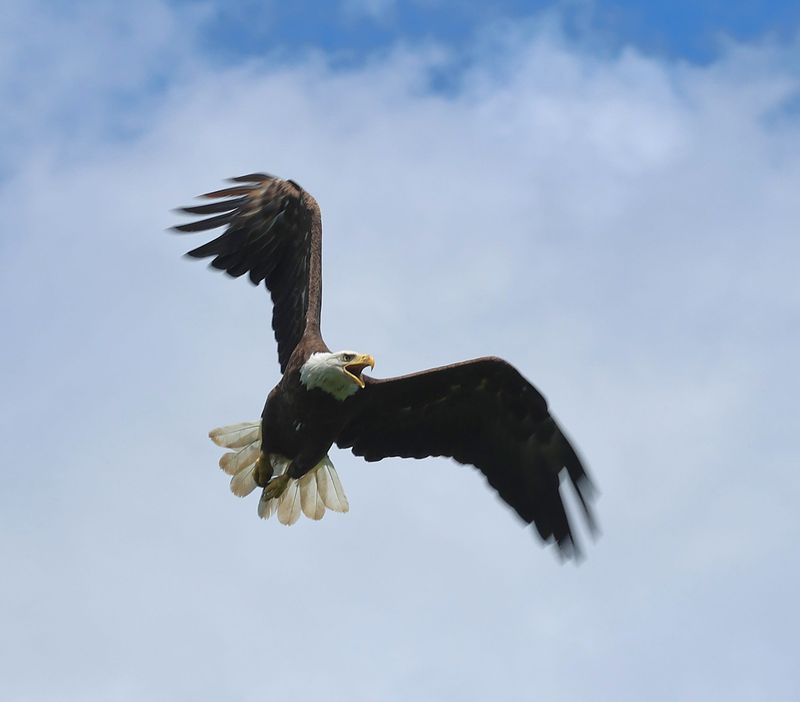
“The four eaglets in one nest is a great sign that the eagle territory is healthy with enough prey to support this large family of eagles,” Cashman said. “The adult pair in Dane County has been really busy providing enough food for the young, and the eaglets look great.”
The nest is located on the shore of a lake and Mapes has seen the adults bringing fish to the nest. Eagles also eat mammals, including rabbits, and carrion, such as road-killed white-tailed deer and raccoons.
The adult pair may be maturing into peak form, too.
It’s the fourth year Mapes has monitored the nest; the first two years the eagles at the site were unsuccessful but last year they fledged two eaglets.
Although he can’t be sure it’s been the same two adults each year, he thinks there’s a good chance it has.
“It would make sense, since they are now more experienced and in prime breeding age,” Mapes said. “And this is their territory.”
The nest program is a citizen science initiative to monitor bald eagle nests over roughly the first half of the year, including egg laying, hatching, chick rearing and fledging.
The program trains volunteers to observe eagle nests from a distance, documenting nesting success to aid biologists in understanding the strength and distribution of the state’s bald eagle population. The volunteers spend at least one hour per week observing and recording data at each nest.
More than 500 volunteers are monitoring hundreds of nests in 2026 in Wisconsin for the Bald Eagle Nest Watch program, Marsicek said.
The project is made possible through partnerships with many organizations, including 1000 Islands Environmental Center, Barkhausen Waterfowl Preserve, The Ridges Sanctuary, Woodland Dunes Nature Center, Beaver Creek Reserve, the Bald Eagle Socialite Club, and the Wisconsin Department of Natural Resources.
Since the banning of the insecticide DDT in 1970 in Wisconsin and nationally in 1972, bald eagle numbers have increased substantially. The chemical entered the food chain and caused eagles and other birds to lay very thin-shelled eggs, resulting in extremely poor nesting success.
In 1974 the DNR documented 108 active eagle nests in Wisconsin. In 2019, the number had risen to 1,684.
Volunteers with the nest program were instrumental in documenting milestones in Wisconsin in recent years. In 2022 they helped record the first active bald eagle nests in Milwaukee County. And in 2023 they observed the first bald eagles fledging from nests in Milwaukee County.
The activity meant bald eagles were successfully nesting in all 72 Wisconsin counties, likely for the first time in about 150 years.
The growth of the program has had a similar arc.
“I think it’s cool to be involved,” Mapes said. “It’s great to be able to watch the birds through the weeks and months and contribute data, too.”
In 2025, program volunteers monitored 267 active bald eagle nests in 46 Wisconsin counties, according to project data.
Eighty percent of the nests produced at least one young, on par with the longterm average.
Of the successful nests, 44% produced one eaglet, 48% produced two and 8% produced three.
None, of course, produced four.
The Dane County nest is on private property and the owner has granted program volunteers access.
“The nest with four eaglets shows that when we take care of the environment, even in one of the most populated places in Wisconsin, wildlife can thrive,” Cashman said.
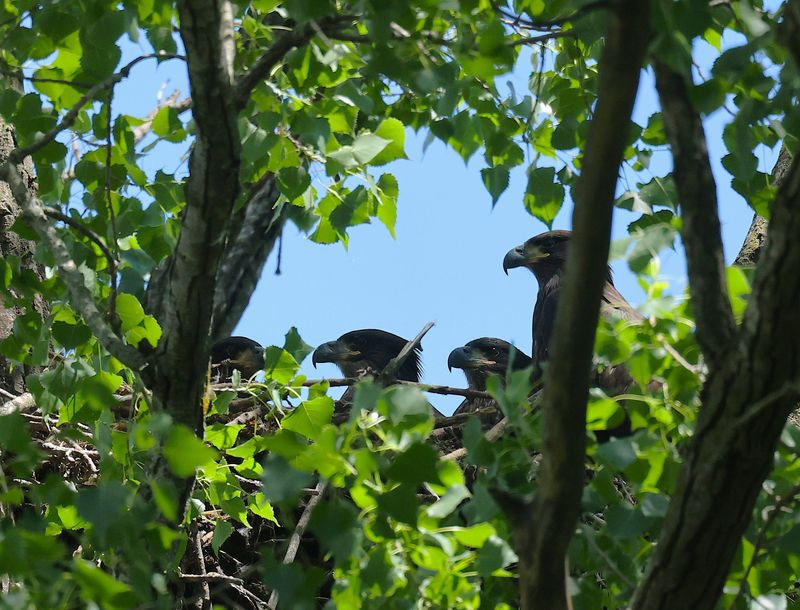
On June 12, Beth Berger Martin and Ken Martin, volunteers who live in Lake Geneva, visited the Dane County site and gathered more photographs of the eagle quadruplets. It was the first time the experienced eagle viewers had ever seen four young in a nest. The sites they are monitoring this year in southeastern Wisconsin average 1.7 eaglets per nest.
“I cannot imagine what was going through Wade’s mind as he was seeing this all for the first time,” Berger Martin said. “Pretty thrilling.”
The eaglets are about 12 weeks old, Cashman said, and entering the next phases of development called “branching” when they hop out of the nest onto adjacent tree limbs and exercise their wings, and fledging, when they take their first flights.
On June 20, two eaglets were observed at least 40 feet from the nest, the results of their first, short flights.
And no matter what happens, at least once a week Mapes will be documenting the action. And believing his eyes when he sees four eaglets, a Wisconsin exclamation point in the remarkable recovery of the nation’s symbol.
Wisconsin endangered species license plate
Wisconsin offers a bald eagle design on the state’s endangered species license plate. Proceeds from license plate sales help support the DNR’s work on threatened and endangered species.
“Bald eagles have made an amazing recovery in our state. They’re an iconic Wisconsin endangered species success story, and part of that work was supported by the Endangered Resources Fund,” said Drew Feldkirchner, DNR natural heritage conservation director. “Endangered Resources license plates raise funds for current endangered species recovery efforts in Wisconsin, like little brown bats, rusty patched bumble bees and ornate box turtles while allowing drivers to show their support and make their car look great.”
Endangered Resources license plates include an annual $25 donation to the Endangered Resources Fund. Revenue from the fund has helped DNR work on more than 400 wildlife species and 300 plant species listed as endangered, threatened or special concern. The DNR’s Natural Heritage Conservation Bureau works across the department and with partners and volunteers to locate, protect and manage native plants, animals and Wisconsin’s natural communities from the common to the critically endangered.
The Endangered Resources license plate is $40 for the first year, with a one-time charge of $15 to the Wisconsin Department of Transportation and the remaining $25 to the DNR’s Endangered Resources Fund.
Endangered Resources license plates, along with tax form donations and state matching funds, have accounted for as much as 40% of funding for endangered species conservation in some years and have supported the recovery of bald eagles, trumpeter swans and other species while preventing hundreds of other species from vanishing from Wisconsin, according to the DNR. In 2025, license plate sales raised about $470,000 that was reinvested to protect rare species and their habitat in Wisconsin.
To buy a new plate, fill out the WisDOT Endangered Resources License Plate Application Form. People can switch to this license plate at any time, and there is no need to wait for registration renewal.
Visit the Endangered Resources License Plates webpage for more information.
This article originally appeared on Milwaukee Journal Sentinel: Bald eagle pair raises an astounding four young in Wisconsin nest | Paul A. Smith
Reporting by Paul A. Smith, Milwaukee Journal Sentinel / Milwaukee Journal Sentinel
USA TODAY Network via Reuters Connect
By Paul A. Smith, Milwaukee Journal Sentinel | USA TODAY Network