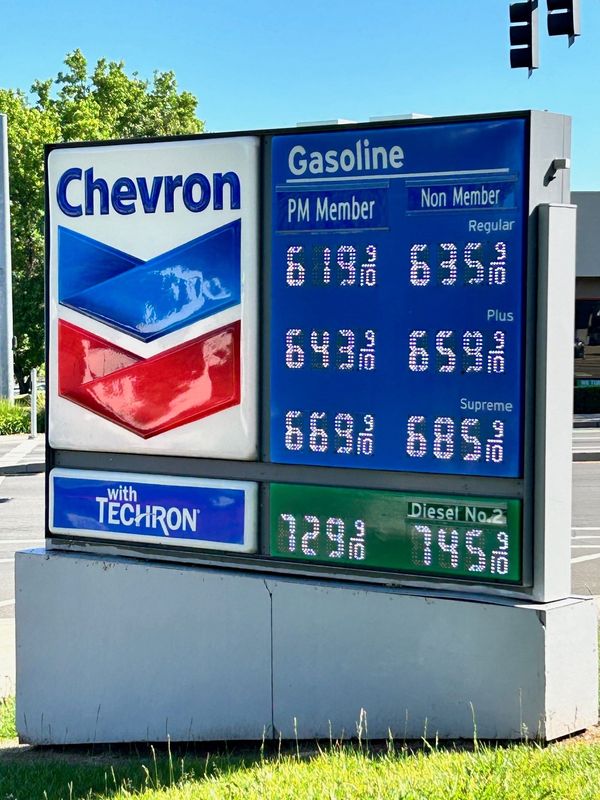
After gas prices decreased a bit the past two weeks, they are going up again, with the national average up 33 cents in the past week and Florida seeing a 31-cent increase in that time.
In Palm Peach County, which usually has the highest gas prices in Florida, prices rose 32 cents in the past week. A gallon of regular gas in the county now costs on average $4.44, up from $3.97 last week. Last year, motorists paid $3.18 per gallon.

Floridians are now paying $4.28, compared with $3.97. Last year, that gallon cost $3.18.
According to the American Automobile Association (AAA), the national average is $4.39, or $1.12 higher than it was this time last year. Oil prices surged above $100 per barrel with the Iran war going on and no indication of when the Strait of Hormuz will reopen. Gas prices are at the highest they’ve been in four years — since late July 2022, AAA reported.
California is now seeing gas prices over $6 per gallon, at $6.06 per gallon.
“Average gasoline prices rose in 39 states over the last week, with the national average moving higher, while diesel prices declined in most states, offering a brief divergence at the pump,” Patrick De Haan, head of petroleum analysis at GasBuddy, said on Monday, April 27. “However, that divergence may prove short-lived. Oil prices have been climbing again as markets react to renewed geopolitical tensions and the cancellation of talks between the U.S. and Iran. As a result, gasoline prices are set to rise further this week, with diesel expected to follow.”
As for electric-vehicle charging, the national average per kilowatt hour of electricity at a public EV charging station went up by one cent this past week to 41 cents, AAA reported.
Prices for an average gallon of regular gas
(Last week prices in parentheses)
National: $4.39 ($4.06)
Florida: $4.28 ($3.97)
Palm Beach County: $4.44 ($4.12)
Gas prices in Florida
(Last week prices in parentheses)
Bradenton/Sarasota: $4.32 ($3.96)
Fort Walton Beach/Crestview: $3.96 ($3.73)
Daytona Beach: $4.32 ($3.99)
Fort Lauderdale: $4.32 ($4.03)
Fort Myers/Cape Coral: $4.33 ($3.96)
Gainesville: $4.31 ($4.02)
Jacksonville: $4.32 ($3.98)
Lakeland/Winter Haven: $4.29 ($3.98)
Melbourne: $4.30 ($3.96)
Miami: $4.21 ($4.01)
Naples: $4.40 ($4.04)
Ocala: $4.30 ($3.98)
Orlando: $4.33 ($3.96)
Panama City: $3.97 ($3.67)
Pensacola: $3.93 ($3.68)
Port St. Lucie: $4.31 ($4.00)
Vero Beach/Sebastian: $4.30 ($4.00)
Tallahassee: $4.26 ($3.95)
Tampa/St. Pete/Clearwater: $4.32 ($3.97)
The Villages: $4.31 ($3.94)
Most expensive gas markets in US
(Source: AAA)
California: $6.01
Hawaii: $5.64
Washington: $5.57
Oregon: $5.15
Nevada: $5.12
Alaska: $4.92
Arizona: $4.67
Illinois: $4.66
Michigan: $4.58
Ohio: $4.46
Least expensive gas markets in US
Oklahoma: $3.70
Kansas: $3.75
Georgia: $3.75
Mississippi: $3.77
Arkansas: $3.79
Louisiana: $3.80
Missouri: $3.83
North Dakota: $3.84
Texas: $3.85
Alabama: $3.86
Why is gas so high in US if we import small portion from Middle East?
Americans are feeling the sting at the gas pump amid the war in Iran, despite the United States only importing 8% of its oil from the Middle East. So why are gas prices still high?
Gas prices are the highest they’ve been, not just since the start of the Iran war, but since the early days of the Russia-Ukraine war in 2022, according to USA TODAY’s previous reporting. And gas prices are rising at a moment when peace talks between Iran and the United States seem to have stalled.
Despite teetering prices, experts say Americans should still expect to pay higher rates at the pump. Here’s what to know about gas prices – and when they could start to fall.
Why are gas prices so high in the US?
Oil prices rose because the war in Iran interrupted supply in the region, including the closure of the Strait of Hormuz. The war has also heightened danger in shipping oil and brought collateral damage to oil-industry infrastructure, among other factors.
Although the United States is considered the top oil-producing nation, according to USA TODAY’s previous reporting, it’s also the top oil consumer. Despite America averaging over 13 million barrels per day, domestic gasoline prices are driven higher by global market forces, with oil producers selling tankers to the highest bidder on the international market.
“So, oil literally flows to the highest price,” said Mark Zandi, chief economist of Moody’s Analytics. “If a tanker can get a higher price in Malaysia than it can in Rotterdam, than it can in Rio de Janeiro, it’s going to go to Malaysia.”
When will gas prices fall?
James Cox, a managing partner at Harris Financial Group, predicts that the high prices will persist until the end of 2026.
“Insurance will rise on ships going through the Strait,” Zandi said. “There’s always a chance the ceasefire breaks and traders will want some premium to compensate for that risk.”
That premium “is probably going to persist for some time,” Cox added.
Gas prices have fluctuated in recent days, following news of a fragile ceasefire on April 8. Even with a ceasefire, oil and gasoline prices will remain elevated for several months, Cox said, unless some new source comes online.
Oil infrastructure in the Middle East has been damaged or disrupted during the Iran war. Some of it “will take years and years to rebuild,” said Kate Gordon, CEO of California Forward, a nonprofit that advocates for sustainability. During that time, the world’s oil supply will remain pinched.
“There’s no going back to what we had,” Zandi said. “At least not this year.”
This article originally appeared on Palm Beach Post: Gas prices on rise again with Florida seeing 31-cent hike in last week
Reporting by John Bisognano, Palm Beach Post / Palm Beach Post
USA TODAY Network via Reuters Connect