One of the finalists for a $700 million contract to run Milwaukee’s wastewater treatment system has ties to Palantir, the software company that is helping ICE agents find and deport undocumented immigrants.
Jacobs Solutions, based in Dallas, is one of two companies vying to be the private operator for the Milwaukee Metropolitan Sewerage District. The other is the current operator, Veolia North America, whose 10‑year contract expires in 2028.

The company that wins will operate a system for roughly 1.1 million people across 28 communities in the Milwaukee area.
But Kevin Shafer, MMSD’s executive director, said there is no sharing of private information.
He added that MMSD bills directly to communities, not individuals, and that any data the operator would have access to would be public data.
Jacobs and Palantir announced their strategic partnership in 2022, describing it as a collaboration “focused on data and technology solutions for infrastructure and national security markets,” with an emphasis on water and wastewater treatment.
Under the partnership, the companies are independent but share some tools, data and expertise. According to a video on Jacobs’ website, Jacobs uses Palantir’s artificial intelligence tools to automate data analysis, which improves efficiency, lowers costs and makes audits easier and more transparent.
Asked whether ratepayers’ information would be shared with ICE or the federal government if Jacobs won the contract, a spokesperson for Jacobs said: “Jacobs takes data protection and privacy seriously. Any client data we access is governed by strict safeguards and security protocols that limit use to authorized project purposes.”
Palantir’s website said the company “does not have unfettered access to data our customers provide us. Nor does it share, transfer, monetize, or otherwise use such data for its own business purposes.”
Tech billionaire Peter Thiel co-founded Palantir in 2003.
It has collected and analyzed data for federal government clients like U.S. Immigration and Customs Enforcement, the U.S. military and the federal Department of Government Efficiency, originally spearheaded by Elon Musk, the world’s richest man.
ICE uses Palantir’s software to analyze large volumes of data so agents can track, locate and build cases against undocumented immigrants. The system reportedly aggregates data from sources like driving records, tax records and social media to apprehend people.
Alex Karp, the CEO of Palantir, recently published a manifesto that drew fire for calling for reinstatement of the draft, among other things. Some Palantir employees have questioned the company’s commitment to civil liberties.
Darryl Morin, president of advocacy group Forward Latino, said “we are more than concerned to learn that a strategic partnership is in place between the two companies.”
“Time and time again we have seen the Trump administration use economic power to force private companies to do things that they would not be able to do following a legal process,” Morin added.
Veolia, the other finalist, faces scrutiny over past mismanagement
Veolia and Jacobs, the nation’s largest private sewer operators, often compete head-to-head for contracts.
Veolia North America, a subsidiary of the French utility giant Veolia, is in its second 10-year contract with MMSD. In its 2025 annual review to MMSD’s governing body, Veolia reported treating more than 60 billion gallons of water as well as capturing and cleaning about 92% of stormwater and wastewater.
However, on Apr. 30, the nonprofit advocacy group Common Ground announced a campaign for an independent review of Veolia, citing information it received from whistleblower Steve Jacquart, who previously served as MMSD’s intergovernmental coordinator and was a registered lobbyist for the agency.
Jacquart raised concerns about mismanagement, noting Veolia’s decision to switch to a cheaper chemical for its treatment system in 2017. Jacquart says the move could have reduced wastewater treatment capacity, which may increase the risk of sewerage overflows and basement backups during rainstorms.
Veolia said it stands by its record, criticized the group for not sharing findings in advance, and called the group’s claims false, unsubstantiated, and misleading.
The change in chemicals was discussed in a 2018 report by engineering consulting group Donohue and Associates, which was contracted by MMSD to determine why the South Shore treatment plant was not meeting its performance standards in 2017.
Jacobs has been rapidly expanding its wastewater portfolio across the U.S. In 2025, it replaced Veolia in Jackson, Mississippi, under a 10‑year contract to run the city’s wastewater system, and earlier this year it secured a major wastewater contract in California.
MMSD bid process advances as tensions heat up
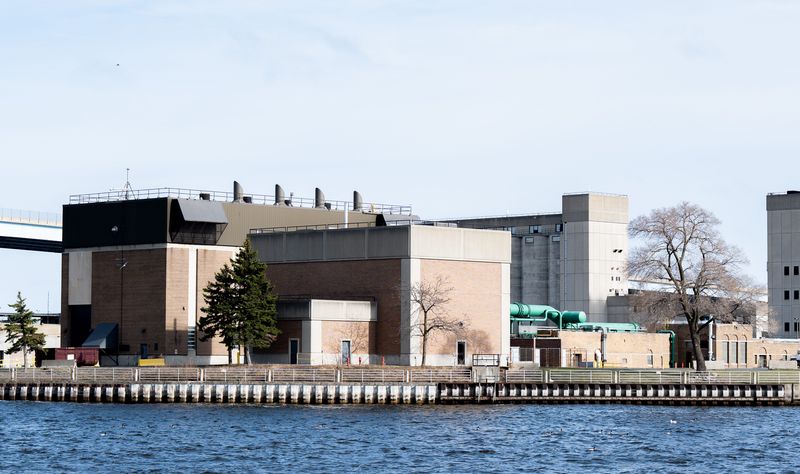
MMSD is one of the largest publicly owned wastewater systems in the U.S. that contract a private company to run their treatment plants. This means MMSD owns the system, but uses a private company that is responsible for day-to-day upkeep. The operator covers operation and maintenance of the Jones Island and South Shore wastewater plants, Deep Tunnel system, Milorganite fertilizer factory and regional sewer infrastructure.
The sewerage district first entered into a public-private partnership in 1998, when it entered a 10‑year contract with United Water Services to run its sewers and two treatment plant. The move was controversial, drawing concerns about accountability, public control and long-term costs. In 2024, MMSD’s governing commission weighed bringing operations in‑house but ultimately voted to keep using a private operator.
Shafer told the Journal Sentinel in April that privatizing the system has reduced repairs and costs while helping the city reliably meet permit limits and protect Lake Michigan on a daily basis.
A 2022 Wisconsin Policy Forum analysis found that privatization initially produced savings, but predicted that the cost benefits may diminish due to future contract changes.
A five-member committee of former MMSD commissioners, selected by the governing body chair and approved by Shafer, will recommend a new operator to the sewerage district’s governing body in the fall.
The committee will hold a public meeting on June 12. A decision is expected in the fall.
Caitlin Looby covers the Great Lakes and the environment for the Milwaukee Journal Sentinel. Contact: clooby@gannett.com. Follow her on social media @caitlooby.
Caitlin is an Outrider Fellow whose reporting also receives support from the Brico Fund, Fund for Lake Michigan, Barbara K. Frank, and individual contributions to the Journal Sentinel Community-Funded Journalism Project. Journal Sentinel editors maintain full editorial control over all content. To support this work, visit jsonline.com/support. Checks can be addressed to Local Media Foundation (memo: “JS Community Journalism”) and mailed to P.O. Box 85015, Chicago, IL 60689.
This fundraising effort is made possible through our partnership with Local Media Foundation, a verified 501(c)3 nonprofit organization (tax ID #36-4427750) and EnMotive Company, LLC, a subsidiary of USA TODAY Co., Inc. USA TODAY Co., Inc. is the parent company of this publication.
The JS Community-Funded Journalism Project is made possible through our partnership with Local Media Foundation, tax ID #36-4427750, a Section 501(c)(3) charitable trust affiliated with Local Media Association, and EnMotive, LLC, a subsidiary of USA TODAY Co., Inc. USA TODAY Co., Inc. is the parent company of this publication.
This article originally appeared on Milwaukee Journal Sentinel: Milwaukee wastewater contract bidder has ties with data company helping ICE
Reporting by Caitlin Looby, Mary Spicuzza and John Diedrich, Milwaukee Journal Sentinel / Milwaukee Journal Sentinel
USA TODAY Network via Reuters Connect