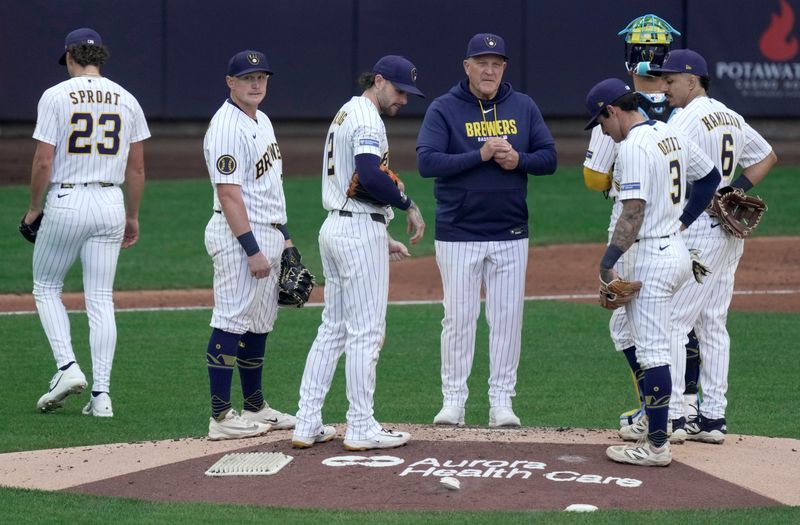
As Pat Murphy watches Brandon Sproat go through the ups and downs of his rookie season, a different young right-hander comes to the manager’s mind.
“We lived with some of this last year with Miz, too,” Murphy said.

Unfortunately, Sproat has also shown plenty that isn’t exactly dazzling.
Take, for example, his latest outing, May 24 during a 5-1 loss to the Los Angeles Dodgers at American Family Field, when he walked four, had far too many uncompetitive misses and faltered yet again the later he got into the game.
“Didn’t do my job again today,” Sproat said. “Four walks, it’s really what it comes down to.”
The outing was emblematic of how Sproat’s first two months in a Brewers uniform have gone: There is some good within, but it ultimately gets weighed down by the bad.
Through 10 outings, Sproat has a 5.84 earned run average, 5.54 FIP and an expected ERA hovering around 5.00. It’s left the Milwaukee Brewers with a decision to make – and one they’ve made without a hint of hesitation.
Sproat isn’t leaving the rotation any time soon.
“He’s so good when he’s good that it gives you hope,” Murphy said. “He’s done some great things for us already this year. He’s had a few great outings. In no way, shape or form are we considering getting him out of [the rotation]. We’re not ‘just sticking with him.’ This guy has a chance to be a high-end starter. He’s a rookie. Rookies are going to go through that.”
Sproat battling his sinker and middle inning struggles
The question about what to do with Sproat is a legitimate one.
Against the Dodgers, Sproat threw only 38% of sinkers in the strike zone, a rate that’s far too low in order to have success against a lineup that potent.
The sinker should be Sproat’s best pitch, but rather than using it as a bat-shattering base for the rest of his dangerous arsenal, he’s almost had to hide it at times, using his secondary pitches to mitigate the fact he can’t rely upon it heavily yet because of inconsistent command. Opponents entered the day batting .286 and slugging .452 against it.
The primary issue, though, is what’s happening to Sproat as the game goes on.
Sproat’s stuff consistently declines somewhere around the 75-pitch mark. After Sproat’s latest difficulties in the fifth inning against the Dodgers, opponents in their third plate appearance of the game against him are now 5 for 17 with five walks. He has yet to strike out a batter the third time through the order.
Sproat also allowed the first two Dodgers to reach base against him in the game-deciding fifth before being removed with his velocity down two ticks.
Having a starter who can’t work deeper than four innings with any consistency makes life more difficult on the rest of the staff.
Sproat believes the answer to being more effective later in the game is to be more efficient early – “Not walk guys. It’s as simple as that,” he said – but this trend has also ailed him when he’s thrown the ball with aplomb out of the gates.
Against the Cubs earlier in the week, he was masterful before running out of gas and ultimately being unable to get through five innings staked to an eight-run lead. Three starts prior to that, Sproat ran into a wall in the fourth after arguably his three most dominant innings yet against Arizona.
Getting to 89 pitches against the Dodgers was a step forward, but the questions still remain about how well he can sustain his velocity and stuff deeper into games.
“He’s got a lot of three-ball counts,” Murphy said. “He’s behind 2-0 a ton. But he’s throwing the ball good and he shows flashes of brilliance. That’s what rookies do.”
Reminiscent of Miz?
The way Murphy and the Brewers see it, this is quite similar to what Jacob Misiorowski went through last year. After returning from a short injured list stint in August, Misiorowski had a 6.23 earned run average over seven starts before being moved to the bullpen for the postseason.
Those lumps, quite clearly, were worth it for the Brewers and Misiorowski, who’s emerged a year later as one of the game’s premier starters.
Put cut and dry, Sproat’s numbers are not those of a winning pitcher right now. Murphy, too, has been quick to say the Brewers aren’t going to trot a pitcher out there regularly when he’s not ready. With Coleman Crow sitting at Class AAA and both Shane Drohan and Chad Patrick pitching well in leverage long relief roles – not to mention Brandon Woodruff’s coming return from the injured list – other options do exist.
But the Brewers’ decision with Sproat comes from a similar place of long-term belief as it did with Misiorowski. The flashes give them belief.
“If there’s a guy without that kind of stuff, a guy that will pop in and out of there because of an injury or something like that, now that guy has to be a little more efficient,” Murphy said. “But a kid like this has such upside. Sproat shows some brilliance.”
Even in the midst of some of his many middling outings, Sproat has, indeed, shown brilliance.
Against the Dodgers, he struck out seven without being at what anyone would describe as his sharpest. The start prior, he came out sitting 98 mph with his fastball and used it liberally to sit the Cubs down. His cutter was dynamite the outing before that, and in his first start in May in St. Louis the Cardinals couldn’t come close to squaring him up despite some erraticness.
Are these signs of progress? Or are they merely signs of what Sproat is naturally capable of?
To the Brewers, those two questions may be one in the same.
When you have an arm this talented, you commit until it either you can’t anymore or it turns for the better.
Murphy is expecting the latter.
“I think there’s huge upside for this kid,” he said. “And I’m excited as heck.”
This article originally appeared on Milwaukee Journal Sentinel: To start or not to start? That’s the question for Brandon Sproat, Brewers
Reporting by Curt Hogg, Milwaukee Journal Sentinel / Milwaukee Journal Sentinel
USA TODAY Network via Reuters Connect