(This story and its headline have been updated due to an inaccuracy.)
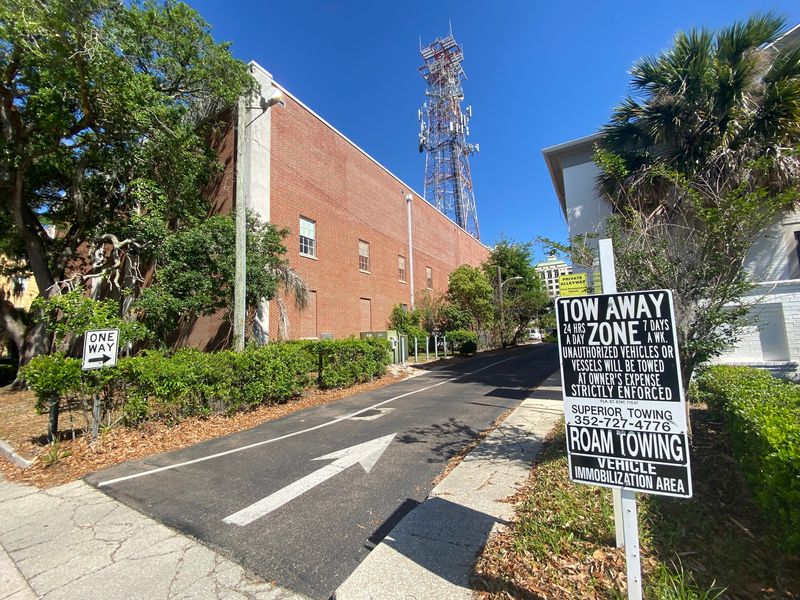
The Gainesville City Commission voted to direct staff to return with an ordinance eliminating roam towing, while also adopting a resolution to cap the immobilization rate.

With Commissioners Ed Book and Desmond Duncan-Walker voting in dissent, commissioners approved the measure 5-2 to block roam towing and booting, requiring businesses to request vehicle removals. While two additional votes will determine the future of roam towing, the seven-member board also voted unanimously to cap the immobilization rate at $80.
Several residents signed up to speak at the May 21 Gainesville City Commission meeting, some wearing light blue stickers with a white silhouette of a towing truck in support of removing the practices.
Calling Gainesville the “wild west” for roam towing, downtown Gainesville contractor Geoff Combs said he has been working trivia events at businesses such as Boca Fiesta since 2009 and has had at least three instances where he parked at venues but was still booted or towed. Combs added that he was on the right side of the situation but still had to pay to get his car back.
“Every single time I had to go to the ownership of those venues and go, ‘Hi, I got towed while working here,’ and they had to (help me) on my behalf and get my money back,” Combs said. “As my grandfather said, ‘Once is a happenstance, twice is a coincidence, three times is enemy action.’ This is predatory, there’s no other way to describe it.”
Also calling roam towing “predatory” and saying he is one of several victims, City Commission candidate Billy Rohan said he is not against towing altogether. Rohan added that the city is better than having people’s nights and trips disrupted by a roam towing violation.
However, several business operators who would be impacted spoke against the measure, saying the practices are essential enforcement tools.
Superior Towing’s Kevin Whitesides said roam towing and immobilization are not just another enforcement tool, but one of the only ways to do the job on certain properties within the city.
“Y’all have created parking garages that do not accommodate towing trucks at all,” Whitesides said. “If you do away with immobilization (and roam towing), they have no enforcement in that parking lot.”
Whitesides said if the commission voted for the ban, it would push things back “to the times” when incidents such as drive-by shootings and break-ins occurred.
Johnmichael Fernandez, director of local government affairs at the North Central Florida Apartment Association, said when residents sign a lease, it is a binding contract that often includes a guaranteed parking spot.
Representing multifamily housing providers in the region, Fernandez said roam towing and immobilization are the primary tools that allow onsite management teams to uphold those contractual commitments without requiring 24/7 staffing.
Additionally, Fernandez said it would create greater safety risks for residents — especially the elderly, those with disabilities, and parents with young children — to find alternative parking late at night if non-residents are not penalized for parking in restricted spaces.
Voting in favor of eliminating roam towing and booting, Commissioner Casey Willits shared an experience from about 10 years ago when he was visiting a friend during the summer and was roam towed “in a 90% empty lot.”
“It’s because roam towing existed, that’s why I was towed. Not because I was denying someone a spot. … I have this experience of it made absolutely no sense for my car to be towed,” Willits said. “All it did was make the tow company money.”
While acknowledging she is in the minority, Duncan-Walker said she is not against roam towing and has had positive experiences personally. She said she hears everyone’s perspective and wants to see improvements in how towing interactions occur in the future.
Mayor Harvey Ward said while the practice solves some problems, it remains a cultural issue in Gainesville. He added that he has spoken with mayors from other states such as Arkansas, Tennessee and South Carolina who do not use roam towing, but instead rely on call-in systems.
This article originally appeared on The Gainesville Sun: City leaders advance plan to end roam towing in Gainesville
Reporting by Elliot Tritto, Gainesville Sun / The Gainesville Sun
USA TODAY Network via Reuters Connect