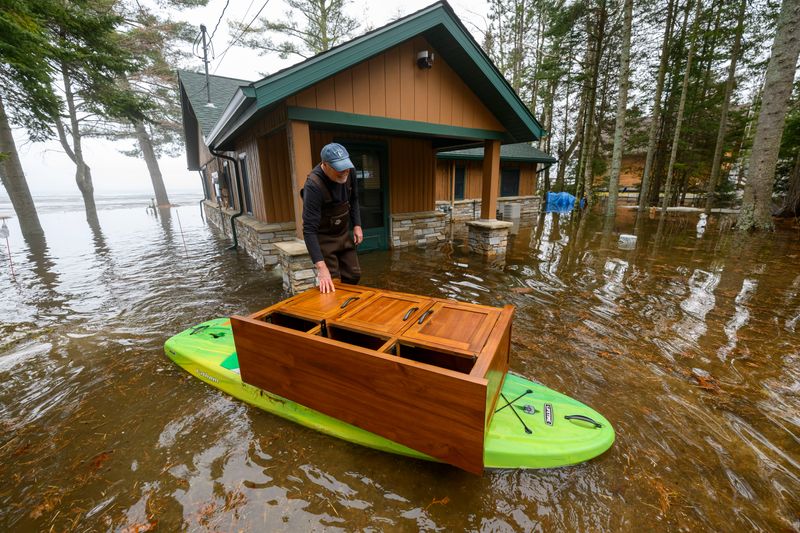
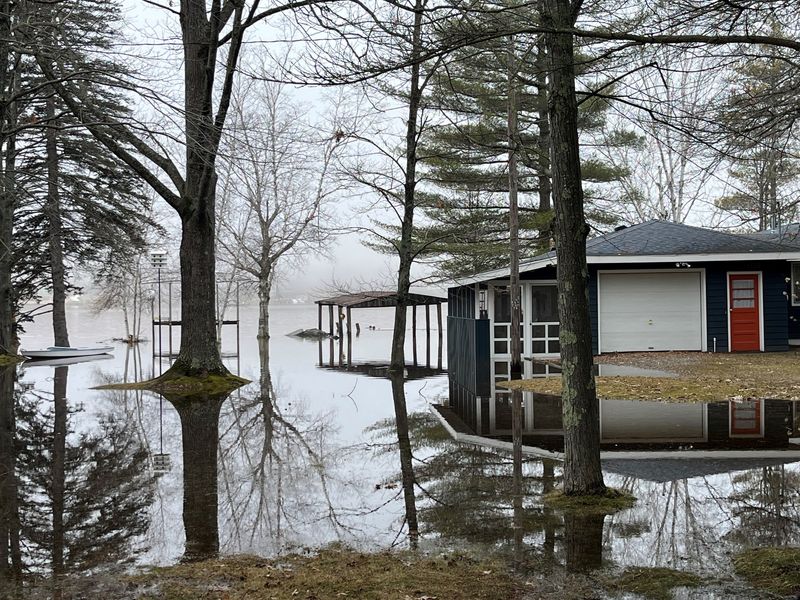
Indian River — Upstream from the beleaguered Cheboygan Lake and Dam Complex, homeowners along the inland lakes feeding into the Cheboygan River have watched their lakes, popular for summertime boating, slowly eat away at their shoreline property this week, eventually spilling water into and around their homes.
Major flooding across the northern Lower Peninsula, caused in part by water on a massive chain of inland lakes, is backing up into yards and homes. It is also washing out roads and bridges as officials seek ways to increase the flow from those upstream waterways and through the troubled Cheboygan dam.

A week of nearly daily rainstorms, coupled with a prolonged melting of winter snow and ice, has flooded northern Michigan rivers, creeks, lakes, field drains and ditches, sending water spilling over roadways and washing out numerous culverts and small bridges from Traverse City to Rogers City. The flooding caused countless road closures across multiple counties on Wednesday as overwhelmed road commissions worked to shore up eroded embankments and divert motorists on long detours.
“The ground is so packed right now that even when we’ve pumped a lot of these places out, the water is just seeping back in because there’s nowhere to put it,” said Chris DeBaeke, fire chief of the Markey Township Volunteer Fire Department on Houghton Lake.
For John Stencel, an Onaway homeowner on Black Lake, the lake straddling Cheboygan and Presque Isle counties, the water level inside his home Wednesday afternoon was at 6 inches and still rising. Melting snow and recent heavy rainfall combined disastrously with efforts to dam up Black Lake to reduce the water rushing toward the Cheboygan River, which winds into downtown Cheboygan on its way to Lake Huron.
“With the 3 inches of rain we had last night on top of everything else, everybody’s flooded, and it’s just compounded the problem,” said Stencel, who’s lived on the lake for 10 years.
Down the street, Stencel said, some homes had water nearly to their rooftops.
“When we looked into it (buying the home), we had to buy flood insurance,” Stencel said. “But this place on historical records has never flooded in the last hundred years. … My next-door neighbor has lived here for over 30 years and never seen the water this high.”
The Cheboygan County Sheriff’s Office said Wednesday the Kleber Dam, which controls the flow of water to Black Lake, had not been compromised, but said residents may expect additional flooding in the coming days.
“Recent rainfall over the past several days is expected to cause Black Lake water levels to continue to rise,” the sheriff’s office said Wednesday afternoon. “This increase in water levels may lead to additional flooding in low-lying areas.”
Some of Michigan’s largest inland lakes are flooding shorelines and homes
The waters feeding into the Cheboygan Lock and Dam Complex are made up of a sprawling system that includes Mullett, Black and Burt lakes — some of the largest inland lakes in Michigan — as well as the Black, Cheboygan, Indian and Sturgeon rivers.
At Burt Lake, water surrounded some homes and overflowed inlets and canals on Wednesday afternoon. Near the Sturgeon River, one home had water steadily rising along its side, buoying a stored kayak floating near the house.
During the last couple of weeks, as the snow and ice covering the lakes melted, water flow increased toward the Cheboygan dam, which was operating below capacity due to an idle hydroelectric unit, according to the Michigan Department of Natural Resources.
State and local officials are working to increase water passage capacity at the dam — and avoid a failure at the huge complex — by removing spillway gates, adding several pumps and building up one vulnerable side with sandbags and an aqua dam. If the Cheboygan dam does fail, officials hope to direct the flow to the southeast side, where it will cause less erosion than on the dam’s grassy northwest side.
But those efforts have not moved fast enough to prevent flooding for upstream residents.
On Black Lake, Stencel said, the Alvero Dam helped to hold back some of the water and give something of a reprieve to the Cheboygan dam downstream. But now that water is backing into homes and up shorelines.
At Mullett Lake, which is closest to the dam, similar flooding was visible at vacation and year-round residences perched at the lakeside as water levels continued to rise on Wednesday.
In the three years that Rob and Ellie Walls have lived on Mullett Lake in Cheboygan County, they have never seen anything like the steady encroachment of water up and over the banks of the 16,600-acre inland lake.
Their home, which sits across the street from the lake and at the edge of a canal, was still relatively dry on Wednesday afternoon. But the canal waters kept rising behind the Walls’ home and, down the street, a few homes essentially sat in the lake amid rising levels.
“Every day, it seems to get a little higher,” Walls said.
Last April, the northern Lower Peninsula was crippled for days by a historic ice storm that knocked out power to tens of thousands of residents. Last month, it was hit with a huge snowstorm. And, on Wednesday, with the Cheboygan dam on the brink and water levels still rising upstream, the area seemed to be destined for a record again.
”We’re making history every year,” Walls said with a laugh.
Overflowing waterways mean ‘Everybody is impacting everybody’
This week’s flooding across northern Michigan has tested the wherewithal of aging dams, rivers, canals and streams that connect multiple lakes that are popular for water sports and fishing during the warmer months of the year. The water management infrastructure spans multiple counties, adding an additional layer of coordination among state and local authorities responding to the crisis.
In Montmorency County, situated between Gaylord and Alpena, workers are trying to prevent their dams from breaking — not necessarily for themselves, but for their neighboring counties.
Sarah Melching, the emergency management director for Montmorency County, said her county has many streams and creeks that primarily flow into the Thunder Bay River, which flows into Alpena County.
Some of Montmorency County’s waterways are tributaries to the Black River, which flows into Black Lake and eventually makes its way to the Cheboygan River.
“Everybody is impacting everybody at this point,” said Melching.
The watershed in Montmorency County is managed by multiple dams, including ones between three successive lakes. The lowest dam in this series has eroded from moisture, which prompted crews to respond with sandbags Wednesday morning, Melching said.
On Wednesday afternoon, Melching was bracing for a forecast of rain.
“It’s just monitoring and assessing their dam structures,” she said.
Michigan DNR warns of lake shoreline erosion when floodwater subsides
DNR officials warned upstream residents Tuesday night that they should also be prepared for what is likely to occur in the inland lakes should the dam breach.
“It’s such a huge watershed that, if that were to happen, it would start to drain,” said Rich Hill, DNR Gaylord District supervisor. “Obviously, you would see higher levels in the Cheboygan River going out to Lake Huron. But it would take some time for those levels to significantly come down and for the river to start to come down. Think about the amount of water behind it.”
When asked more specifically about the effects on upstream lakes, Hill said consultants are still working to better understand the full impact.
“You will see a drop,” Hill said. “One of the things that is noted is that you will see increased currents up in the upper area as the flow will increase. If that were to happen, folks upstream would need to be cognizant, be careful around the banks and know that currents are going to increase. You could see shoreline erosion.”
eleblanc@detroitnews.com
MBryan@detroitnews.com
This article originally appeared on The Detroit News: Flooding soaks northern Michigan lake homes upstream from Cheboygan dam
Reporting by Beth LeBlanc, Max Bryan and David Guralnick, The Detroit News / The Detroit News
USA TODAY Network via Reuters Connect