For Teacher Appreciation Week, May 4-8, USA TODAY NETWORK-Wisconsin shadowed teachers and is sharing their stories with our readers.
What National Day is It? Fact of the Day. Question of the Day.

It’s all part of the fun way days start around 8 a.m. in Liz Schwabe’s transition program class at Whitnall High School. She works with students ages 18 to 21 who have disabilities and individualized education plans.
State law and the federal Individuals with Disabilities Education Act allow such students to continue receiving education from high school up to age 21 or until they receive a regular high school diploma. Schwabe’s classes focus on helping students learn life skills to help them become more independent.
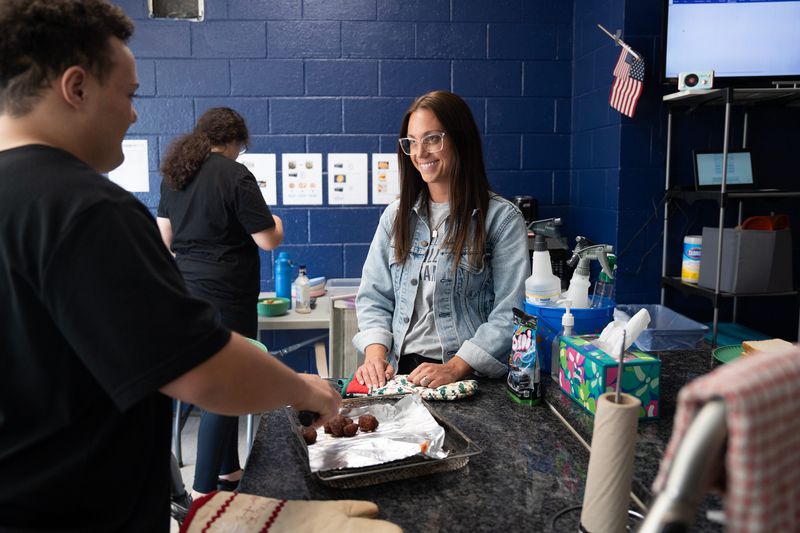
Her students gather around three tables put together in the shape of a “U” in Schwabe’s sky-blue classroom. A bulletin board with pictures of the members of the transition program sits at the back of the classroom, while the left side of the classroom has been made into an independent living skills area.
Focusing on the Fun Fact of the Day, students learned that bears can see blue, green and yellow, but that red and orange appear as shades of gray or brown. “We’ve learned a lot this year from Jax [student Jax Wiesner] about how animals can see more colors. Super cool,” Schwabe said.
“They each take their time in the morning and look up, practice researching and sharing out stuff and then Question of the Day just to get them thinking,” she said. It also gives students a chance to practice their communication skills.
The Question of the Day on April 16 asked students what they wanted to be when they grew up. Nayeli Morales wanted to be a stocker. Caleb Starczyk said he wanted to be a chef, and student Nathan Brown said he wanted to be a railroad engineer.
Friday planning, opening the cafe and preparing popcorn for delivery
On this day, a Thursday, students then jumped into their “Friday planning”: preparing a grocery list for themselves, the cafe they operate through the class and popcorn sales they do in the district. Students were tasked with budgeting for that list and planning a social outing for Friday. Schwabe and her staff usually plan to make Friday a day for students to go grocery shopping and go on a social outing to practice their social skills.
This week, the plan was to visit Cafe Hollander in Brookfield and then Big Putts Mini Golf in Waukesha. Students figured out how much money they would need to cover the cost of their meal and also practiced figuring out what time they would need to leave to make it to the restaurant at the designated time.
Once the planning was in the books, some of the students opened the cafe to sell coffee, breakfast and more. Students pick out seasonal flavors to add to the menu, take inventory of supplies and shop for them, budget and bank, bake, cook, handle money and customer service, take and fill orders – all with guidance from Schwabe and her staff.
The cafe is open during passing periods between classes from 9 to 10:30 a.m. and noon to 1 p.m. Monday through Thursday. During that first passing period, the breakfast sandwiches sold quickly.
Schwabe helped the students worked the cafe. She helped one of her students process a coffee order, which cost $3; the student was given $5 for the coffee.
Schwabe prompted the student to the next step, “So what are we missing?” The student pointed to change and Schwabe confirmed it: “There you go!”
Once the first passing period ended, Schwabe, who’s in her seventh year in her role, returned to her classroom, where a paraprofessional helped two students pack boxes of popcorn and put drinks in the fridge. On Thursdays, staff at all of the district’s schools may order popcorn and drinks, which is delivered by students.
Selling dirt cups, lunch time, delivering popcorn
With the first 1½ hours of cafe service complete around 10:30 a.m., the students went from selling food to others to getting lunch for themselves and preparing for the next hour of cafe service.
Some students threw pizza and chicken bites into the cafe kitchen’s air fryer. Others used the time to prepare for the next round of the cafe’s hours. Schwabe showed them how to make “dirt cups” with pudding, cookie crumbs, whipped cream, gummy worms and caramel drizzle.
Schwabe and her staff took a few minutes around 11 a.m. for their own lunch break. Gathering around the same table where students had sold cafe products enabled them to keep an eye on students eating lunch in the kitchen. At one point, a staff member prompted a student to check on another student to ensure lunch was going well.
The staff’s lunch break was also a chance for them to relax and chat with each other. too. Schwabe said staff can use the teacher’s lounge, her classroom or leave the building for their break.
“But we all love each other so we choose to just sit and hang. Right, Brin?” Schwabe said jokingly to one of the paraprofessionals.
Brin, who only wanted his first name used, said sitting at the cafe table is an option but said there are days when he’ll step away to eat somewhere else.
After lunch, students prepared the cafe for its second hour, from noon to 1 p.m., also open during the passing periods. Some students stayed at the cafe to sell the dirt cups and other items, while others left to make popcorn and drink deliveries, both at the high school and to other schools in the district.
Sign language, wrapping up the day
Once the cafe and deliveries wrapped up for the day, students returned to the classroom to write in their journals, reflecting on what they had worked on that day.
The day came full circle by going back to American Sign Language, going over signs for words such as “gold,” “home,” “cafe” and more. Schwabe said her students started learning an ASL word each day this school year.
“It’s been super cool to see the students start to use it at work [and] in the community as a form of communication,” she said.
Schwabe said she and her staff work with students with a wide variety of disabilities, including autism, Down syndrome, intellectual disabilities and behavioral disabilities.
“We have all the way from completely nonverbal to very verbal and [students who] can hold a job and things like that,” Schwabe said.
Schwabe said she and her staff want to provide diverse communication options to support their students’ varied abilities.
“This is our first year learning and implementing this, and it’s been amazing to see how it supports our students’ unique communication styles as we see them using it throughout the school day with staff and peers,” Schwabe said.
After a schoolwide tornado drill wrapped up at about 2 p.m., Schwabe’s students were done for the day. The rest of the school’s students continued on to their last period of the day, which runs until 2:46 p.m.
While her students’ day was over, Schwabe’s day was not, as there was still more work to do before she headed home at about 3 p.m.: paperwork, students’ IEPs, progress monitoring, planning for outings, phone calls, emails and lesson planning.
Schwabe said the transition program is important to help students learn to volunteer or hold a paid job in the community, find access to day programs or group homes and learn day-to-day life skills.
“It is super rewarding to watch the growth from when they first come in to when they leave. The independence, it’s crazy,” she said. “They’re very used to the academic world where you have somebody guiding you through every single thing, and we slowly start to release that where we can sit back and let them work and let them do things and the independence grows.”
Students are typically in the transition program for three years after typical graduation at age 17 or 18.
That independence carries over to outside of school.
“Their parents start to see it at home. They can implement what we do here at school and do it home,” she said.
Contact Alec Johnson at 262-875-9469 or alec.johnson@jrn.com. Follow him on X at @AlecJohnson12.
This article originally appeared on Milwaukee Journal Sentinel: Whitnall special education teacher helps teach students life skills
Reporting by Alec Johnson, Milwaukee Journal Sentinel / Milwaukee Journal Sentinel
USA TODAY Network via Reuters Connect