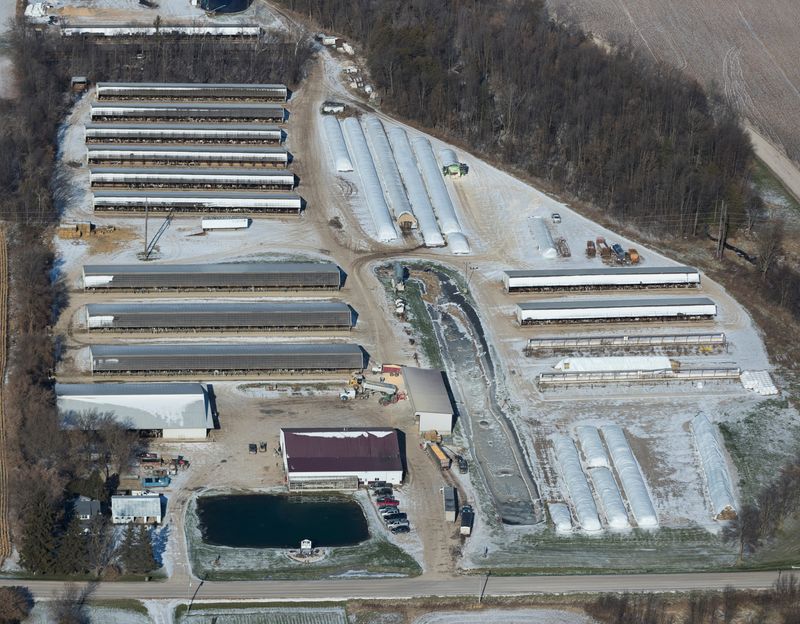
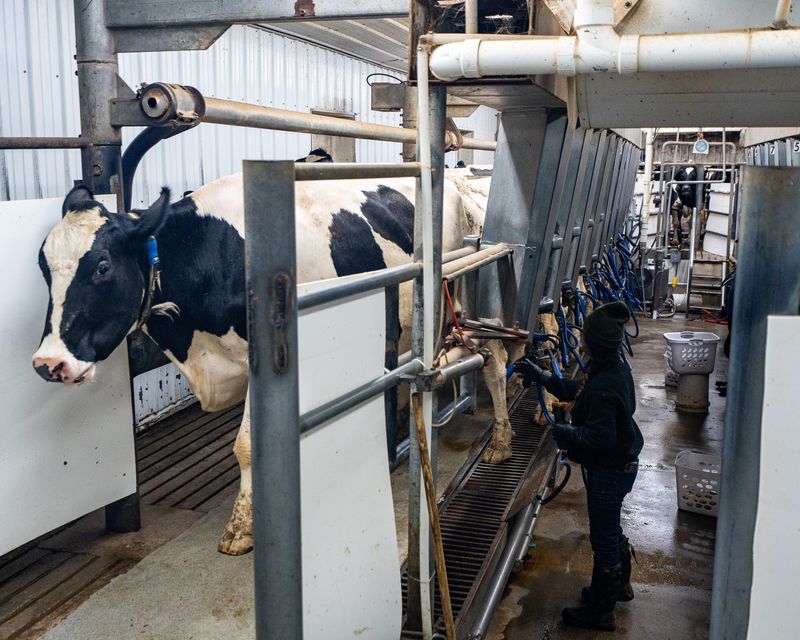
As more concentrated animal feeding operations in Wisconsin look to expand, researchers are raising concerns about how such expansion could harm drinking water and air quality for nearby communities.
Concentrated animal feeding operations, also known as factory farms, are large-scale agricultural meat, dairy or egg facilities where animals are kept and raised in confinement, according to the Wisconsin Department of Health Services. Instead of grazing or eating in pastures, fields, or on range lands, animals are given food.

The U.S. Environmental Protection Agency defines CAFOs as livestock operations where the animals are confined for at least 45 days in a 12-month period and don’t have access to grass or other vegetation during the normal growing season.
CAFOs dominate livestock production in the U.S., producing a large majority of the country’s meat, dairy and eggs. While only a small fraction of farms in the U.S. are CAFOs, it is estimated that around 99% of U.S. livestock is raised in them. These operations produce half of the nation’s animal waste, contributing significantly environmental and public health concerns, including water and air pollution.
In Wisconsin, a CAFO generally refers to a livestock operation with 1,000 animal units, with animal units based on the weight of the animals, according to DHS. Wisconsin currently has 293 permitted CAFOs, 134 of which are in the northeast part of the state, according to the Wisconsin Department of Natural Resources. Of those, the majority are dairy, but the state also has hog, beef, chicken and turkey CAFOs.
Large-scale dairy farms produce over 60% of the nation’s milk supply and are cheaper to run than smaller-scale farms. And other large-scale farms producing beef, turkey, pork and chicken are able to provide more affordable meat options to a larger number of people.
With more than 21,000 CAFOs in the U.S., these farms each can produce up to 1.6 million tons of waste annually, according to the National Institute of Health. CAFOs in Wisconsin produce roughly 33 billion pounds of waste annually — four times the state’s human waste.
Here’s what you should know about air pollution, water contamination and health risks associated with living near concentrated animal feeding operations.
Water contamination concerns associated with concentrated animal feeding operations
Researchers have found that CAFOs negatively impact water quality and health. The increased volume of waste produced at CAFOs can lead to water contamination through nutrient-rich runoff from over-applied manure, leaks from manure storage lagoons and seepage into groundwater.
The waste introduces pollutants like nitrate into drinking water and nearby rivers and lakes. Nitrate contamination has been linked to blue-baby syndrome, thyroid disease and colon cancer. Pregnant women and babies are the most vulnerable.
Roughly 90% of nitrate in groundwater can be traced back to agriculture, according to the DNR. Nitrate dissolves easily in water and does not adsorb onto the soil. It can readily be carried into the groundwater by rainwater and melting snow as it seeps through the soil and bedrock into the underlying aquifer. This impacts Wisconsin’s largest source of drinking water and is an economic loss to farmers, according to the DNR.
Data shows that generally accepted livestock waste management practices do not adequately or effectively protect water resources from contamination with excessive nutrients, microbial pathogens and pharmaceuticals present in the waste, according to the National Library of Medicine.
Blue Star Dairy, which is looking to consolidate its two farms into one and grow its herd by more than 60%, is projected to produce at least 45 million gallons of liquid waste each year after the expansion.
About 57% of 166 wells sampled in Arlington, Wisconsin, which houses one of Blue Star Dairy’s two farms, already have nitrate levels higher than the state and federal health standard of 10 parts per million in drinking water, according to data from the Center for Watershed Science and Education at the University of Wisconsin-Stevens Point.
Blue Star Dairy isn’t alone. Ridge Breeze Dairy, which currently runs a 1,700-cow dairy farm in Pierce County, plans to grow its operations to about 6,500 cows next year. This expansion would generate nearly 78 million gallons of manure and wastewater annually. A 2024 report found 14% of tested wells in the county exceeded the federal drinking water standard for nitrates.
New study finds air pollution and lack of insurance coverage linked to concentrated animal feeding operations
A new study from the University of Michigan found that an air pollutant linked to heart and respiratory issues, on average, were 28% higher near cattle feeding operations and 11% higher near hog operations compared to similar counties without animal feeding operations.
“It lingers in the air and can get really deep into your lungs and create scar tissue. It’s nasty stuff. There are really no safe levels of it,” said Benjamin Goldstein, an assistant professor at the University of Michigan School for Environment and Sustainability and a senior author of the study.
Animal manure is typically kept on site, which plays a significant role in air quality, according to the study. Aside from its smell, manure also contributes to dust and particulate matter that pollute the air. While the U.S. Environmental Protection Agency and the U.S. Department of Agriculture do collect some data on feeding operations, there’s variability and inconsistency in how that data is reported across the country.
Additionally, the study found that there was a higher likelihood of finding vulnerable and marginalized communities living near animal feeding operations, and that these communities were more likely to have lower levels of health insurance coverage and education. These communities were also more likely to have higher percentages of Latino residents.
Researchers used census data to analyze the sociodemographic makeup of the communities near feeding operations. And while the study doesn’t answer the question of whether an animal feeding operation is built in a certain community or whether a certain community settles around it, Goldstein says that doesn’t dilute the study’s take-home message.
“The meat you eat comes from somewhere. It takes up a lot of space and produces a lot of pollution,” Goldstein said. “And somebody else and place has to bear that pollution.”
Anna Kleiber can be reached at akleiber@gannett.com.
This article originally appeared on Milwaukee Journal Sentinel: Some factory farms are looking to expand in Wisconsin. That will mean more pollution, researchers warn
Reporting by Anna Kleiber, Milwaukee Journal Sentinel / Milwaukee Journal Sentinel
USA TODAY Network via Reuters Connect