GREEN BAY – Bigger isn’t always better, but in new Green Bay Packers defensive coordinator Jonathan Gannon’s defense, it’s ideal.
Since Jeff Hafley departed to become the Miami Dolphins head coach and Gannon was hired to replace him, general manager Brian Gutekunst has allowed his fancy for big defensive linemen to take over.

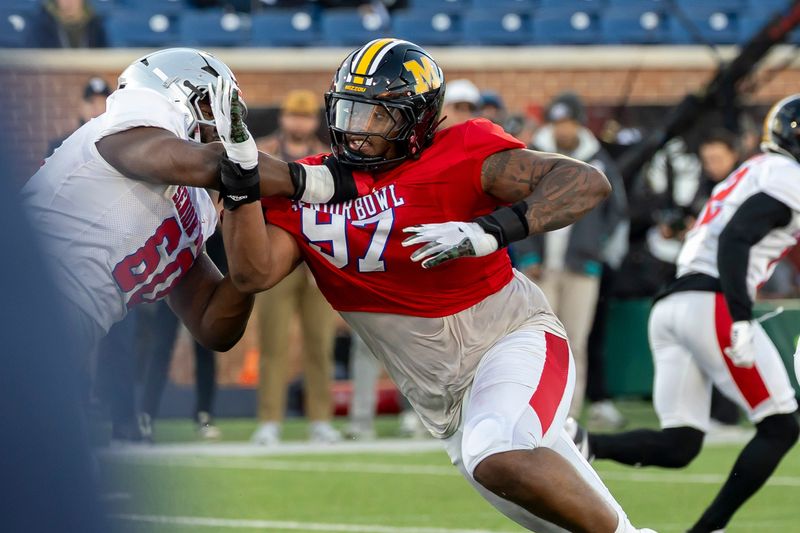
He swapped out 273-pound defensive tackle Colby Wooden (trade to Indianapolis) for 307-pound free agent Javon Hargrave, moved up seven spots to draft 313-pound nose tackle Chris McClellan of Missouri with the 77th overall (third round) pick and swapped 258-pound edge rusher Kingsley Enagbare for 256-pound fourth-round strongman (26 reps on the bench) Dani Dennis-Sutton of Penn State.
This is to go along with his attempt late last year to buffer the run defense with some big men off the street when teams were finding it easy to run through the Packers without injured Devonte Wyatt and Micah Parsons in the lineup.
Heading into this season, there is no shortage of bulk. Following the draft, the roster of interior big men looks like this:
It’s no secret that Gannon prefers big people along his defensive front. He used them in helping the Philadelphia Eagles get to the Super Bowl in 2022 and continued with a similar philosophy when hired as Arizona Cardinals head coach.
Gutekunst likes them, too, but his defensive coordinators also needed nimble inside pass rushers, and so he did his best to provide them. Aside from T.J. Slaton, selected in the fifth round in 2021, and Ford, selected in the seventh round in ’22, he didn’t draft many guys who were considered nose tackles only.
“Whether it was Jeff Hafley or it’s Jonathan Gannon, I’m trying to find the best, well-rounded football players that can do everything that they’re going to be asked to do,” Gutekunst said on Day 2 of the draft. “I think when you start getting too scheme-specific, as soon as you have injuries, you could be in bad shape because now he’s got to do something different because he’s a backup player [at a different spot].”
Gannon’s defense is multiple, which means he’ll use 3-4 concepts where there may be five men on the line of scrimmage, but will also use four-man fronts where Micah Parsons might be one and three big defensive tackles are the others.
In the NFC North, where the Chicago Bears and Detroit Lions have power run games and the Minnesota Vikings stress the defense with their wide-zone concepts, the Packers must be able to stop the run, even when they’re in passing personnel (nickel and dime).
Gannon hasn’t been made available to the media since his late-January hiring, so speculation about what he will run is based on his history in Arizona and Philadelphia. But Gutekunst acknowledged that he’s trying to provide him more size up front.
“I do think with what Jonathan is going to do, certainly adding big people was going to be important for us because I think we’re going to need a little bit more of them,” Gutekunst said. “But in general, I’ve never tried to allow the scheme thing too much into [choosing players].”
Since Gannon has arrived, according to coach Matt LaFleur, the coaches still are trying to match up personnel to the scheme.
A year ago, Hafley had a plan for the season, but then Gutekunst traded for Parsons and everything changed. Parsons is a generational pass rusher and Hafley did everything he could to help him get to the quarterback, while at the same time trying to allow his other players to do what they had trained to do all offseason and during training camp.
Hafley wanted to be a 4-3 defense with a lot of zone coverage in the secondary. But to keep Parsons free to rush the passer and to figure out a way to stop the run when Wyatt wasn’t in the lineup, he often brought a fifth defender – usually a linebacker – to keep teams from blowing his group off the line of scrimmage.
Even then, it didn’t work. In their final seven games, including the playoff loss to the Chicago Bears, the Packers allowed teams to rush for a combined 5.0 yards per carry. They just didn’t have enough players along the defensive front who could put up a fight against the most-physical offensive lines.
Asked how he envisioned what his defensive front would look like this year, LaFleur said they’re still working it out.
“I would say this, I think you always go into it with a vision, but certainly that vision can change based on your personnel,” he said after the draft was complete. “And I think that’s kind of what happened with ‘Haf.’ I anticipated being more four-down front in our base defense, and we got to a lot of odd spacing structures throughout the course of the season with the linebacker on the ball.
“So, we’re kind of working through that without giving away everything that we’re going to be, but we’re kind of working through that process right now. Certainly, everybody knows his background around the league, but I would say it’s pretty fluid in regards to which direction we could go.”
The addition of Hargrave, who played for Gannon in Philadelphia, and the selection of McClellan speak loudly about what Gannon has in store.
When the Packers selected McClellan, they saw a guy who, like Hargrave, could line up over the nose in a 3-4 base front, but his long arms, quick first step and six sacks as a senior, made them believe he could play end in a 3-4 and end or tackle in a four-man front.
“I think it’s partly his length, but he’s got a really good first step, and he’s got a disruptive way about him that when he presses an edge, he’s hard to handle,” director of football operations Milt Hendrickson said. “So, I think schematically, he’s just one of those guys that whether you’re a true odd front, or you want to play an even front, or a multiple front, he’s a guy that can fit in a variety of different ways.”
It’s similar to how Wyatt, Hargrave, Brinson and Brooks are going to have to play.
The Packers are not going to be just a big front. In addition to Parsons, they’ve got Lukas Van Ness, Barryn Sorrell, Brenton Cox Jr., and Collin Oliver, who can line up on the edge and create problems. Van Ness and Sorrell, who had a terrific game in the season-finale against Minnesota, may force Gannon to get creative with how he implements his big men.
There’s a lot of time before the Packers must line up for a game, but they have a chance to go into the season with a better chance to provide resistance against those teams who leaned on them so hard last year.
This article originally appeared on Packers News: Packers use draft, free agency to bulk up defensive line for new scheme
Reporting by Tom Silverstein, Milwaukee Journal Sentinel / Packers News
USA TODAY Network via Reuters Connect