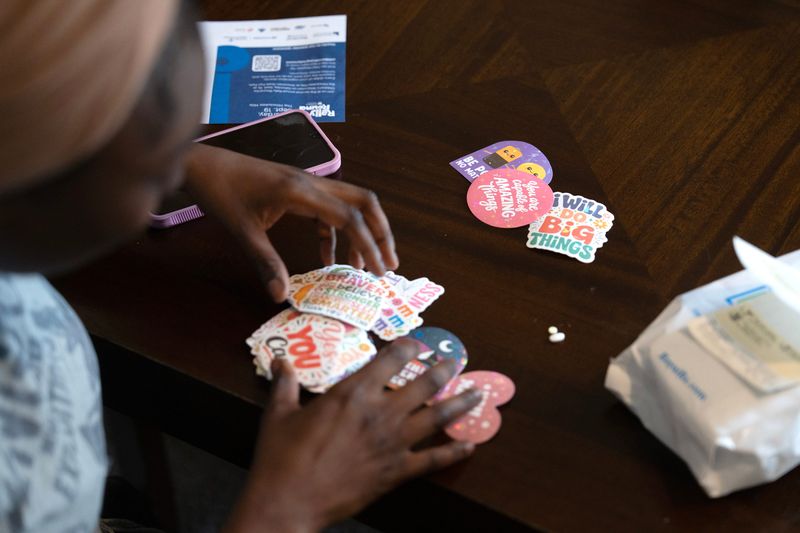
Sitting at a table at her cousin’s house, Shaniah Stewart picked out two stickers for her son and herself.

“He’ll probably want a boy one,” she said of her 4-year-old son. For herself, she picked one that read, “You are capable of amazing things.”
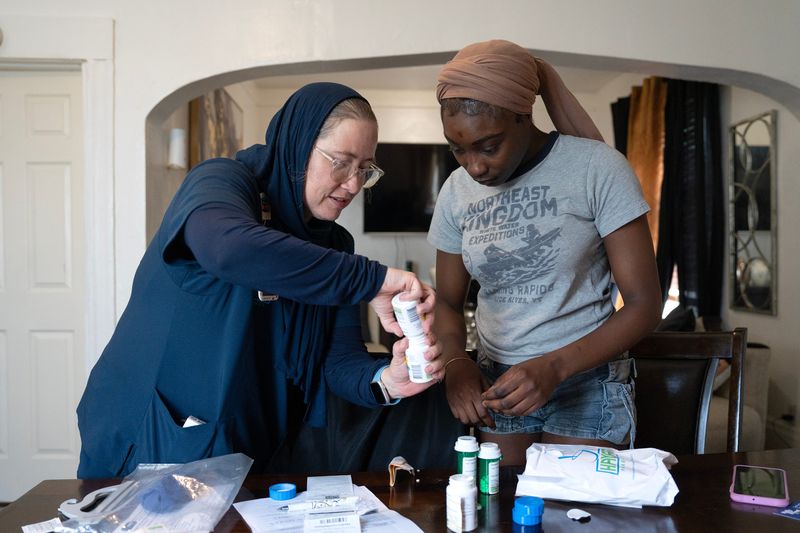
Then, it was time for her shot. Stewart turned around, exposing part of her hip. The nurse who brought the stickers, Mara Ahmad, held up a syringe with Stewart’s medication, a long-acting injectable that helps manage psychosis.
It was over in less than a minute.
Stewart is one of hundreds of patients in the Milwaukee area that Ahmad visits at home every month as part of Hayat Pharmacy’s at-home long-acting injectable program. Ahmad, 50, drives to people’s homes daily to administer the medications, which are often prescribed for psychiatric or substance use disorders.
The program first started during the COVID-19 pandemic in 2021, when Ahmad would bring vaccines and tests to people’s homes.
After the pandemic subsided, the pharmacy found a new purpose for the program – to provide care to people living with serious mental illnesses.
Since 2023, Hayat has seen a 39% increase in patients seeking such services. Now, according to the pharmacy’s clinical director Brian Bock, 95% of the pharmacy’s patients who are on long-acting injectables prefer to get their shots at home.
For Stewart, the monthly shot helps her manage her psychosis without having to worry about taking a pill every day.
Medical experts agree that long-acting injectables are often beneficial for people with serious mental illnesses. And bringing them to people’s homes makes them far more accessible for those who may have difficulties with transportation or staying on a daily schedule with oral medications and appointments.
“It’s a really patient-centered approach,” said Nina Kraguljac, a psychiatry professor at Ohio State University and the chair of the American Psychiatric Association’s Council on Research.
A young mom’s journey to get well
For Stewart, the long-acting injectables have helped her get healthy again, but it wasn’t always this way.
The 23-year-old was diagnosed with psychosis at the age of 20. Before she was consistently on medication, Stewart said she frequently heard voices – voices she thought were from God.
The voices sometimes told her to hurt herself or others. One of them, Stewart said, told her to burn herself and her son on the forehead.
“I love my son dearly,” Stewart said. “I just thought I was doing what was best for us because I thought it was God.”
Stewart lost custody of her son and ended up at a psychiatric hospital. At that time, she didn’t think she was in psychosis. She stopped taking her medications soon after leaving the hospital, and her symptoms worsened.
Research shows that over 60% of people with severe mental illnesses do not adhere to their prescribed medicine.
Stewart’s father, Cliff Gordon, said he tried everything to convince Stewart to take her medication. It was difficult, he said, tearing up. But he wanted to make sure his daughter was OK.
Eventually, Gordon heard about Hayat Pharmacy’s program and called to ask if someone could give his daughter her medication at home.
Stewart was skittish at first, Ahmad recalled. At first, her father was the one coordinating most appointments. But as Stewart saw improvements in her quality of life, and as the two built more trust, Stewart began to call Ahmad to set up her own monthly appointments.
A popular and expanding service
In-home long-acting injectable programs are popular, but still relatively rare due to their high cost, said Bock. It’s an extension of a treatment model known as Assertive Community Treatment, where people with serious mental illnesses receive community-based and often home-based care.
Recently, Hayat Pharmacy expanded its team of nurses and in-home services to other parts of southeast Wisconsin. It now provides services in Milwaukee, Waukesha, Washington, Ozaukee, Racine and Kenosha and serves over 400 patients.
To Ahmad, the program doesn’t just make medication accessible to clients. It also allows her to go into people’s homes regularly and observe their living conditions as an assessment of their mental wellbeing.
Patients are often apprehensive at the beginning, but she sees them get better over time and start to make appointments themselves, Ahmad said. She said people often start to see results after around six months of consistent medication.
“You’re more active. You’re more involved. If church is important, you’re going back to church or going to barbecues,” she said.
As the program becomes more well-known, Ahmad’s hope is that it helps reduce the stigma of mental illness.
“People in general, they think of illnesses like schizophrenia, and it’s scary. You only get to see the scariest in movies and things like that,” she said. “They don’t get to see when people are on medication.”
Stewart says the program has helped her get back on track. After getting her shot on June 30, Stewart even asked Ahmad to give her a ride to work. Since it was on Ahmad’s route, she obliged.
Stewart is now trying to prove to her father that she is ready to take care of her son again. For now, her father has custody, but she is still able to spend time with her son. She picks up extra shifts from time to time to support herself and her family. She is looking up recipes and learning how to cook as well.
The voices she once thought were God are gone now, but Stewart still believes that she has a higher purpose: to share her struggles, and inspire others.
“I felt chosen to be taken out of psychosis,” she said.
This article originally appeared on Milwaukee Journal Sentinel: Milwaukee pharmacy brings psychiatric treatment to people at home
Reporting by Eva Wen, Milwaukee Journal Sentinel / Milwaukee Journal Sentinel
USA TODAY Network via Reuters Connect



By Eva Wen, Milwaukee Journal Sentinel | USA TODAY Network