The face of homelessness in north Florida has changed – and the organizations working to end it are changing with it.
When Johnna Coleman became executive director of Big Bend Continuum of Care just before the COVID-19 pandemic upended lives across the country, she thought the nonprofit was on a promising path.

Six years later, she describes the work as the most difficult challenge of her career, as rising housing costs, service gaps and personal crises push more people toward housing instability.
“Homelessness has changed so much in the last four to five years. It’s just unbelievable how many people are experiencing homelessness, the reasons why they are experiencing homelessness and what it is going to take for them to get out of homelessness,” Coleman said in a July 14 presentation hosted by the Continuum and SIE CoLab, a non-profit social enterprise that works to help communities address urgent and complex challenges.
The Continuum’s 2026 Point-in-Time Count collected on Jan. 26 pinpointed 583 people experiencing homelessness across eight north Florida counties. It was the lowest level since 2022, but the actual total is likely much higher. The federally-mandated initiative brings together an army of volunteers for a single night of counting those living on the streets, in the woods or in emergency or cold night shelters.
After months of research and collaboration, teams of students, emerging leaders and longtime community advocates are exploring ways to strengthen services and better respond to the evolving needs of people experiencing homelessness. They also want to improve coordination among agencies and build broader public engagement around an issue that continues to be a visible and invisible problem across the Big Bend.
“In a rapidly changing world where complexity is increasing every day, we can’t keep relying on information and solutions from the past to make decisions about the future,” said SIE CoLab co-founder Linda Alexionok. “We must rethink how we do our work by fundamentally transforming how we address today’s complex challenges.”
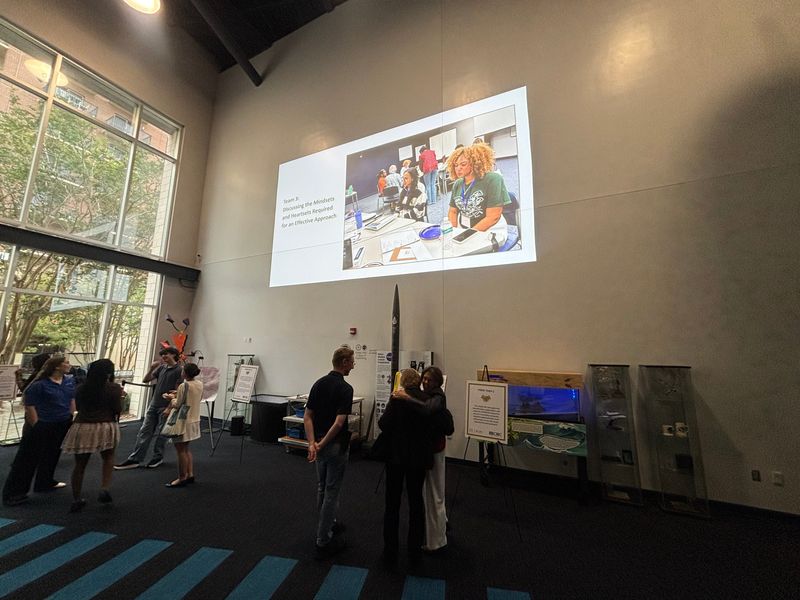
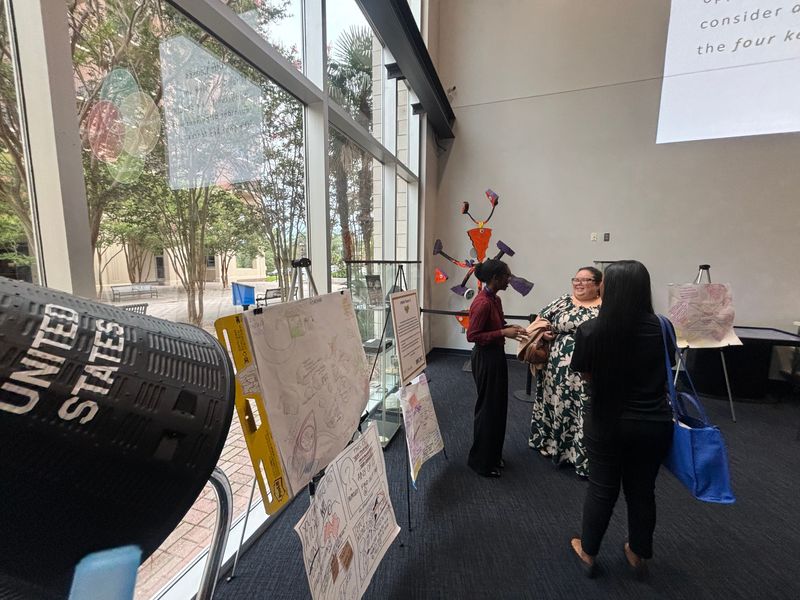
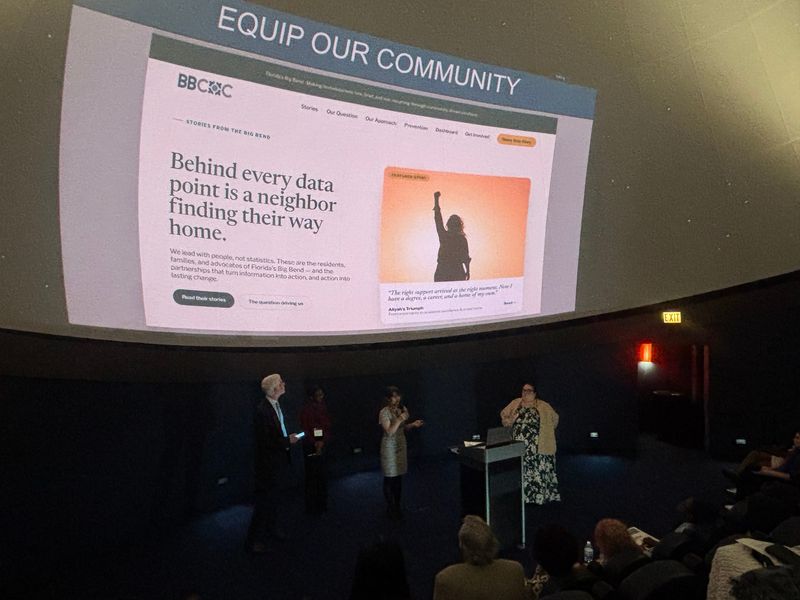
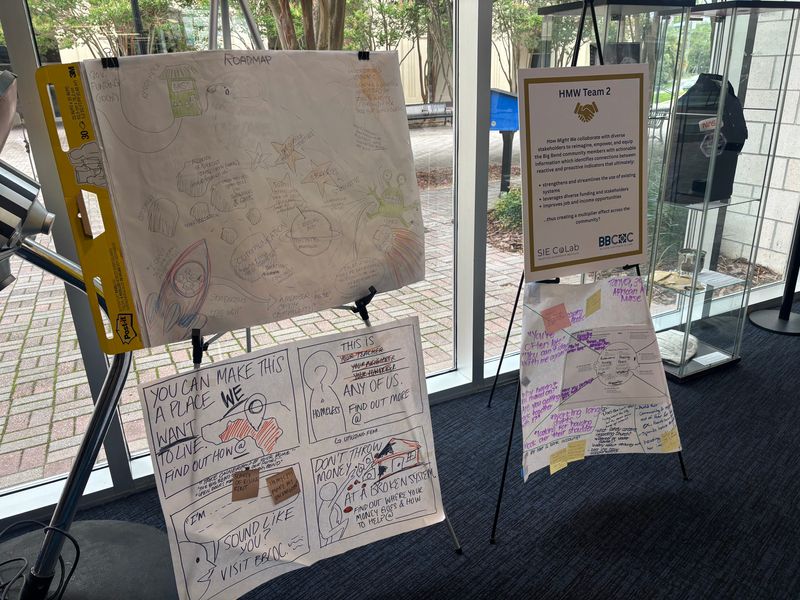
The results of that effort were presented July 14 when community, academic and civic leaders from across the region came together in the Challenger Learning Center of Tallahassee to talk about homelessness and how they get their arms around it.
Here’s what they found:
What homelessness looks like in Tallahassee and north Florida
Today, homelessness does not always look the way many people imagine.
Many working-age adults experiencing homelessness are employed while living in shelters, balancing work, bills and basic needs while making difficult choices between necessities like food, housing costs and other expenses.
Shelter providers have also seen an increase in demand following Gov. Ron DeSantis’ signing of a 2024 law prohibiting cities from allowing public sleeping and camping in certain areas.
The Continuum’s data dashboard offers a picture of the population.
Of almost 4,500 people served last year, 834 were children, 666 were survivors of domestic violence, 480 were veterans and 569 were chronically homeless. They overwhelmingly tend to be men and of the total served, 69% were Black, 28% were White and about 4% were Hispanic. Those under the age of 18 represented the largest share of the homeless population with the following age breakdown:
And 90% of those counted reported having at least one disability.
Connecting and navigating resources
For nearly a decade the Continuum has been at the forefront of ending homelessness in Florida’s Big Bend region.
The agency coordinates service providers, secures funding and develops long-term housing strategies while focusing on helping individuals and families move toward stable housing and self-sufficiency.
But what happens when even the organization on the front lines needs the community’s help?
The organizations partnership brought together three teams composed with “the potential of transformers (students),” “the vision of generators (emerging leaders),” and “the wisdom of stewards (seasoned professionals).”
With each team using their “How Might We” framework, one group explored better ways the Continuum could align and support established housing programs and services across the region.
In this approach, the Continuum would serve as a central hub that helps people navigate their concerns. This approach aims to improve collaboration across different agencies, providing resources to people on the brink of a housing crisis and making those services accessible at any moment.
Participants described a lack of support. For example, a single father was struggling to find housing after a run-in with the justice system.
The team came to the conclusion that, without agency coordination, people who are living under complex circumstances have been left out and “we are failing some of the most vulnerable in our community.”
Reimagining the board
Instead of just filling volunteer positions, a new approach looks beyond resumes to the heart of its leaders by intentionally building a board of directors that is grounded in lived experience, empathy and adaptive leadership.
“Every decision the CoC makes runs through the board. Who sits at that table influences the entire direction of the community’s response to the unhoused crisis,” said Jan Brown, a team member. “Traditionally, boards recruit from resumes and familiar networks.”
Redesigned applications would focus on hearts and mindsets along with traditional qualifications.
Mobilizing the community
The new approach is all about community engagement.
The campaign shifts the focus to making people more aware of the issue at hand and how deeply the community as a whole is impacted. They will use flyers, billboards and more, directing the community to the Continuum as a real-time data hub.
“Leveraging what exists and reformatting to increase engagement and impact in the way that people seek information, is a way that allows them to see themselves as a part of the community,” one team member said. “This requires a community effort. This requires everyone to be a part of the conversation.”
What’s next?
These humanity-centered approaches are only the beginning.
“These prototypes aren’t the finish line, they’re proof of a different way to work together,” said Bruce Manciagli, the SIE CoLab co-founder.
With the help of community leaders, organizations and advocates, the teams hope to test and grow these strategies to find what’s the most effective approach to serving and uplifting the homeless community.
How to help the Continuum of Care
If you need help or are on the brink of homelessness
If you are in need of immediate shelter or housing assistance here a few resources.
This solutions‑focused article is supported by a grant from Press Forward North Florida, an initiative of the Community Foundation of North Florida. To learn more and to support local journalism like this, visit cfnf.org/press-forward. Also, email Tallahassee Democrat reporter Kyla Sanford with story ideas at ksanford@tallahassee.com.
This article originally appeared on Tallahassee Democrat: A new reality of homelessness emerges across Tallahassee area
Reporting by Kyla A Sanford, Tallahassee Democrat / Tallahassee Democrat
USA TODAY Network via Reuters Connect
By Kyla A Sanford, Tallahassee Democrat | USA TODAY Network