For Teacher Appreciation Week, May 4-8, USA TODAY NETWORK-Wisconsin shadowed teachers and is sharing their stories with our readers.
When you step into Janeal Spring’s classroom at Appleton East High School, one of the first things you see is a light blue wall with several 1980s movie posters.

“I love the ’80s so much,” Spring said. “It’s just a nostalgic decade for me.” Of the movies on the wall, however, her favorite – and the poster closest to her desk – is for “The Breakfast Club.”
Appropriately, Spring enjoys working with “students a lot of people consider challenging,” she said, “building relationships, finding potential, pulling out their strengths.”
Spring has taught in the Fox Cities for over two decades. For much of that time, at least some of her day has been devoted to alternative education.
But after over a decade teaching math at Kaukauna and Appleton North High Schools, she said she wanted a new challenge. Now, she’s worked as a full-time alternative education teacher at Appleton East for four years.
Spring’s day is filled with helping high school students through challenges, whether personal or academic − work she finds “energizing,” she said.
“We’re all human and making mistakes,” she added, “and that’s true whether you’re 14 or 50.”
For Appleton teacher, day is filled with giving one-on-one support
When Spring arrives in her classroom each day, typically around 7:30 a.m., she starts by setting out some light breakfast: bananas, apples, juice, grain bars. Her students file in, around the time the first bell rings at 7:55 a.m. She greets each one by name. She gives her students a few minutes to settle in, put their cell phones in the numbered pockets near the door and get a snack.
On April 15, when a reporter visited her classroom, Spring starts off the first and eighth periods with a journaling session. She reminds the students she’s a mandatory reporter and that she’ll need to share what they’ve written if “someone is hurting you, you want to hurt others, or you want to hurt yourself.” Otherwise, she says, she will be the only one who sees what they write unless they give permission otherwise.
She gives her students a choice between two journal prompts: “What is worrying you the most right now and why?” or “What is your greatest strength, and how can you use it to empower yourself?” Then she gives them parameters: at least one six-sentence paragraph in 15 minutes, pen or pencil to paper. “Just respond to the prompt,” she said. “Don’t worry about grammar and spelling.”
She calls up each student and hands out their slim paperback journals. She starts a countdown clock and plays a calming movie soundtrack. Then, Spring circulates through the room, visiting each desk multiple times in the 15 minutes to ensure her students stay on task.
Once the time is up, the students turn in their journals and move to individual coursework. Many of them take out their Chromebooks and a green piece of paper, a weekly task sheet that tracks her students’ grades, priorities and goals.
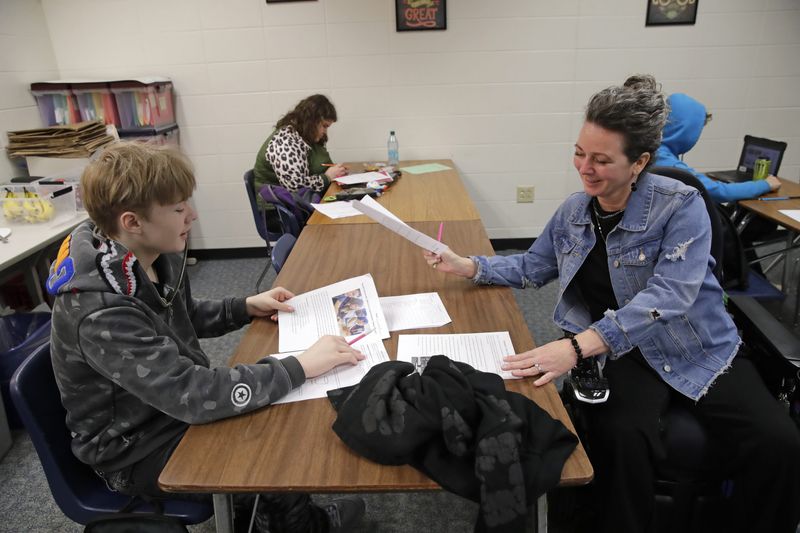
From there, Spring moves to the main part of her work: giving students one-on-one support in their coursework and class attendance. She keeps moving through the room, encouraging them to stay on task and helping them prioritize what they should tackle next.
She advises one student on how to improve their English grades, helps another use a pie chart to support an opinion and discusses another student’s chemistry homework.
She moves back through the desks and takes time to praise a student: “Now you’re cruising, nice job.” She compliments another on their colorful pencil case. As the period winds down, she checks that students have their homework organized for the day, doling out paperclips to help tame unruly papers. The students hand in their green task sheets as they leave for their next classes.
The second period, flex hour and third period, she told the Post-Crescent, is typically filled with meetings. Usually, she attends professional learning communities with other teachers or consults with school administrators, counselors, psychologists and social workers about which students need support and what pathways might work best for them.
She also works with students to help them recover credits and plans and preps materials for the 80 student mentors on the school’s freshman mentorship program, DREAM Team.
And she meets with individual students during flex time; they either can request to meet with her or she can ask them to visit.
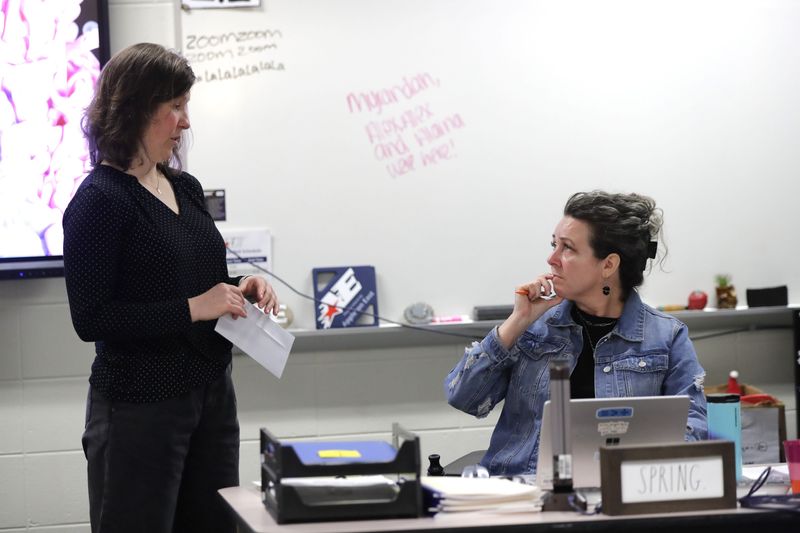
Today, Spring meets with East’s student success coordinator, Krista Olearnick, to organize an April 21 spring training for DREAM Team. During flex time, Spring’s assistant, East senior Macy Johnson, helps put together name tags for the training. Spring and Olearnick also work on writing a grant, due that day, for an apartment-sized refrigerator to put in Spring’s classroom.
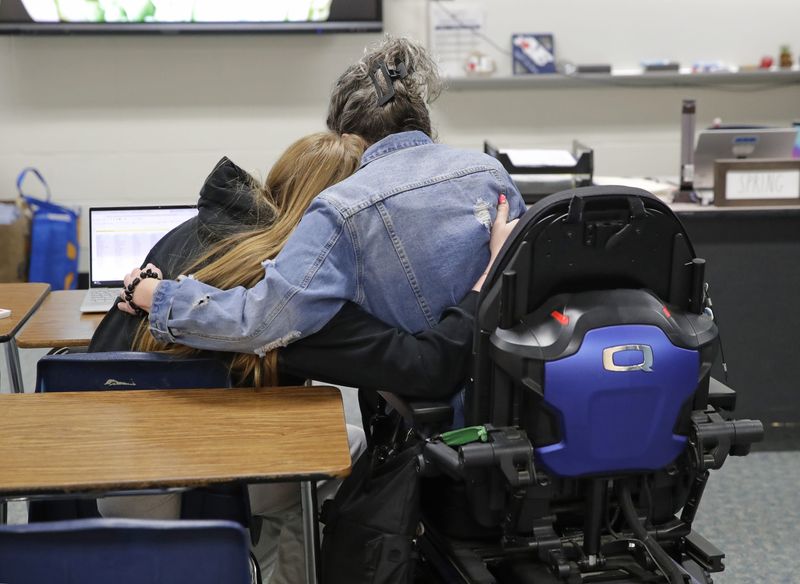
Since Spring uses a wheelchair, having that refrigerator would make morning setup easier for her, she explained to the Post-Crescent; she currently has to get fruit and juice from a refrigerator in another teacher’s room next door. She needs to apply for the grant because her total budget for the school year, for food and drinks to offer to 45 students each day, is $800. Besides writing grants, she relies on donations from food pantries and other organizations to make that money stretch further.
During fourth to sixth hours, Spring’s work follows a cycle: a 20-minute guided study hall for freshmen, then time to work at her desk and help other students. On her computer, Spring responds to messages from staff, checks her students’ grades and compiles reports on which students need support.
Other students come in for help on their coursework; they can also serve detention in her room if needed. A student stops by to work on recovering course credits; another spends 20 minutes with Spring working through a math problem about parabolas; another works through a question on probability.
She jokes to the last student, “The probability I’d kick you out of this room for dissing math? 100%.” She pauses, then corrects, “Actually, it’d be 1.”
Other students visit her room to eat lunch; she said her room is open to students who want to eat somewhere quieter than the commons.
The common areas are loud on a typical day, but that’s especially true April 15. East students are running a carnival to raise money for programming for the Adaptive Sports League and other special education programs. The commons are filled with students lining up to try their luck at games like Plinko and cornhole; others are selling bags of popcorn for 50 cents apiece; some are simply showing up to see what the fuss is about.
Spring takes a moment to join them. She hands a dollar to a popcorn seller, taking one bag for herself and telling the student to give the second to someone else. As she moves through the hallways, she greets students by name. In return, they pepper her with questions and quick updates on how they’re doing.
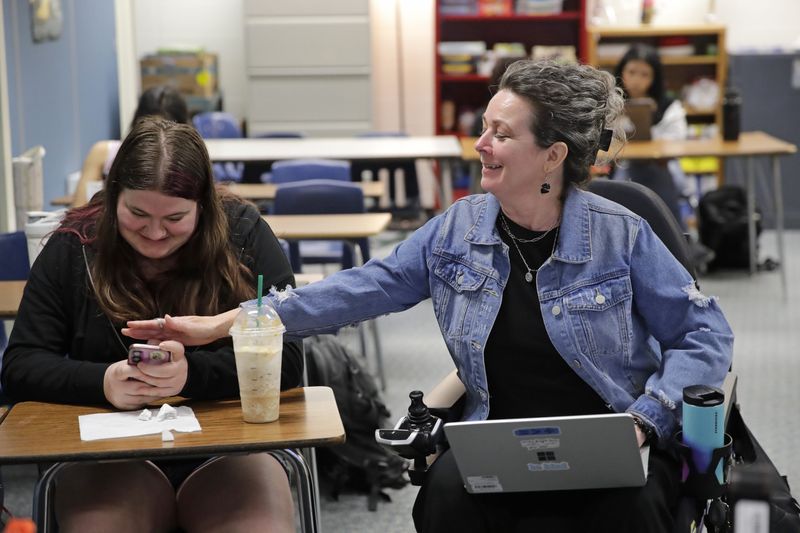
Throughout the day, many of Spring’s students seem to be continuing a conversation with her that they started long ago: about their grades, about a new girlfriend, about their job hunt, about managing their relationships with other teachers, about getting into their next school, about a book they might like.
During her time with DREAM Team, Johnson has gotten to know Spring and spoke warmly of her. “We all need a little Miss Spring in our lives,” she said.
Spring has some time over seventh hour to eat lunch and prepare for the eighth. Eighth hour is much like the first, except this group of students is more eager to go home for the day.
Spring’s students leave at 3:30 p.m., but her day isn’t over. She spends the next hour getting ready for the next day. She refills and puts away the snacks and drinks, finishes her emails and reports, updates slides for the next day, and grades students’ journals. She also finishes quarterly data reports to ensure any student struggling with classes is matched up with a teacher, counselor or other support system.
“We’re constantly making sure these supports are there for kids so they don’t fall behind,” she said.
She typically leaves school at around 4:30, but her work is still on her mind when she leaves. She said she narrates her to-do list to herself on the drive home, “thinking of the little add-ons.”
The idea, she said, is to “hit the ground running” the next day.
Rebecca Loroff is an education reporter for the USA TODAY NETWORK-Wisconsin. She welcomes story tips and feedback. Contact her at rloroff@usatodayco.com.
This article originally appeared on Appleton Post-Crescent: For this Appleton high school teacher, personal connections are key
Reporting by Rebecca Loroff, Appleton Post-Crescent / Appleton Post-Crescent
USA TODAY Network via Reuters Connect