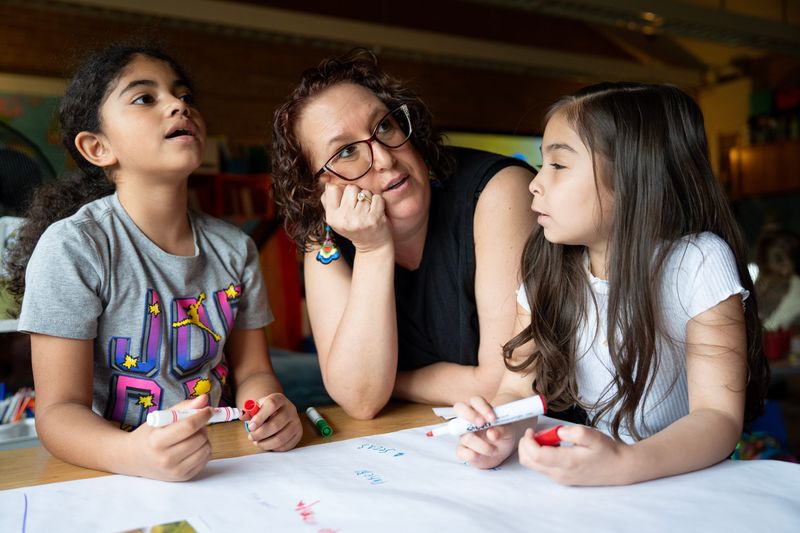
For Teacher Appreciation Week, May 4-8, USA TODAY NETWORK-Wisconsin shadowed teachers and is sharing their stories with our readers.
In a colorful and cozy classroom at the Milwaukee Spanish Immersion School in West Milwaukee, Toni Fink chants the words “ohana ohana” to her students, a Hawaiian word meaning “family” or “community.”

As they make their way to the reading nook, her second graders respond in Spanish with the phrase “somos familia,” or “we are family,” an idea that Fink tries to instill in them each day.
Fink, who grew up on Milwaukee’s south side in a largely Latino neighborhood, teaches primarily in Spanish. However, she has a diverse classroom with students from all different backgrounds.
Before students enroll at the school, Fink said that most have never spoken Spanish. Now, the only time they speak English in Fink’s classroom is at the end of the day for an English language lesson.
Fink said she does everything in her power to not only ensure her students have a strong grasp of the language, but that they also learn about Hispanic and Latin American cultures through history, food, music and more. It allows students to identify the similarities between those cultures and their own.
“Sadly, kids don’t know their heritage as much. When its Hispanic Heritage Month [Sept. 15-Oct. 15], we always talk about heritage, what it is, what it means, and where does it come from,” Fink said. “Then I always tell the kids, go home and find out.”
Students then return to school, having learned about their own heritage from their families at the start of the year, so throughout the school year they can compare what they learn to their own experiences, Fink said.
In one lesson, they discussed Latin American foods, including “empanadas,” savory or sweet pastries made from fried dough. Students were able to compare empanadas to their own cultural foods like pierogis or apple dumplings, Fink said.
Fink said she also played music made by Mexican musicians and polka music made by Polish and German musicians, and students were surprised to hear how similar the songs were despite originating in different parts of the world.
This blending of cultures is what contributes to the classroom’s feeling of a “family,” a space where students feel comfortable trying new things and asking tough questions, Fink said.
“It makes everyone feel connected,” Fink said. “It makes the world feel small in the best way possible.”
Additionally, in Fink’s classroom, students don’t have individual desks; instead, they sit together at tables with communal supplies to further foster that feeling of family, she said. There’s a heavy emphasis on group work, encouraging students to collaborate with one another and help each other through their daily activities.
However, to encourage their independence, Fink assigns each student a task in the classroom, whether that’s cleaning off desks after snack-time, handing out their school laptops or sweeping up at the end of the day.
Giving students specific tasks also encourages them to learn how to take care of shared spaces, Fink said.
“That just goes back to the idea of being responsible,” Fink said. “It takes down the feeling of being competitive because everyone has to be equally contributing.”
Across the hall from Fink’s classroom is Nora Murguia’s second-grade classroom.
Murguia is Fink’s former student; she credits her time in Fink’s classroom as her inspiration for pursuing a career in education. Fink’s emphasis on building an inclusive classroom community has stuck with Murguia throughout the years, and she adopts the same practices in her own classroom.
“She taught me to see the student as a whole,” Murguia said. “It’s not just their grade or their reading score; it’s the experiences they come with that they can share with us, and their culture … you have to incorporate a lot of their experiences or identities in order for them to feel wanted.”
Whenever a student makes a comment that makes others feel excluded, or a question about a sensitive topic is brought up, Murguia said, Fink is always willing to take a moment to open the floor for productive conversation, reminding them to ensure all students feel welcome in their class.
“She’s so quick to completely stop teaching and start teaching what really matters,” Murguia said. “When we were in her class, it felt like those conversations made us all equals.”
Alyssa Salcedo covers Silver City, Layton Park and Burnham Park for the Journal Sentinel’s Neighborhood Dispatch. Contact: asalcedo@usatodayco.com.
Neighborhood Dispatch reporting is supported by Zilber Family Foundation, Bader Philanthropies, Journal Foundation, Northwestern Mutual Foundation, Greater Milwaukee Foundation, and reader contributions to the Journal Sentinel Community-Funded Journalism Project. Journal Sentinel editors maintain full editorial control over all content. To support this work, visit jsonline.com/support. Checks can be addressed to Local Media Foundation (memo: “JS Community Journalism”) and mailed to P.O. Box 85015, Chicago, IL 60689.
The JS Community-Funded Journalism Project is made possible through our partnership with Local Media Foundation, tax ID #36-4427750, a Section 501(c)(3) charitable trust affiliated with Local Media Association, and EnMotive, LLC, a subsidiary of USA TODAY Co., Inc. USA TODAY Co., Inc. is the parent company of this publication.
This article originally appeared on Milwaukee Journal Sentinel: Bilingual teacher helps students celebrate cultural similarities
Reporting by Alyssa N. Salcedo, Milwaukee Journal Sentinel / Milwaukee Journal Sentinel
USA TODAY Network via Reuters Connect