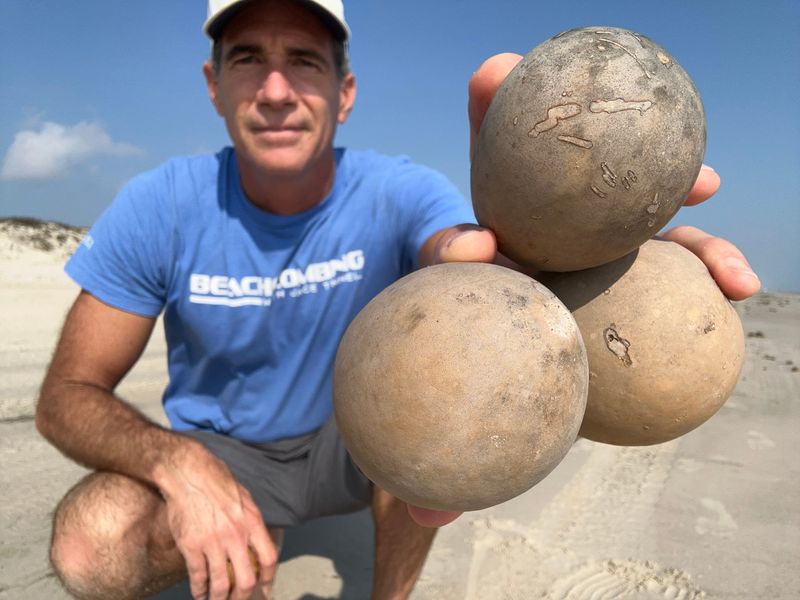
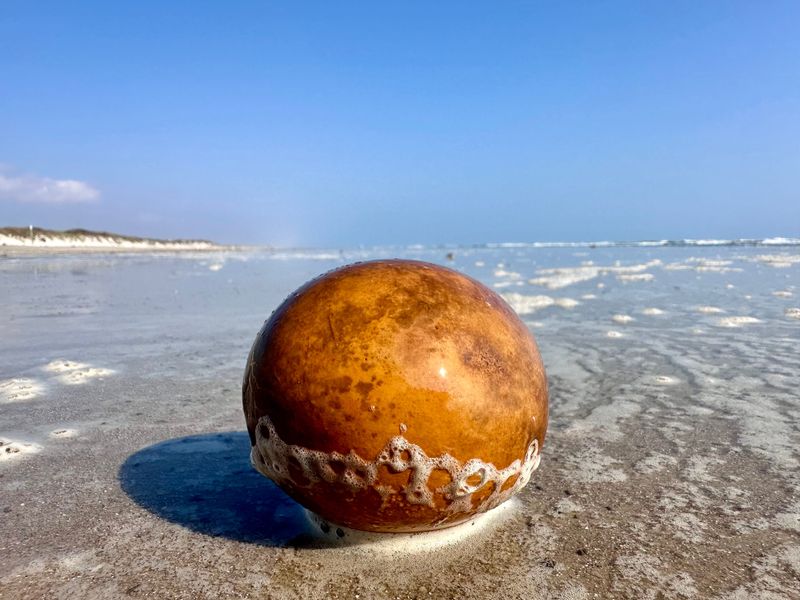
Walking the high tide line after a stretch of calm weather, I recently noticed something unusual mixed in with the wrack. Among the debris were several small, hollow, pumpkin-like objects, lightweight, woody and oddly familiar. These weren’t marine at all. They were buffalo gourds.
Buffalo gourds come from a native vine (Cucurbita foetidissima) that grows across Texas and much of the Southwest. When the vine dies back, it leaves behind hard, durable fruits roughly 3 to 5 inches wide. Over time, these gourds find their way into creeks, rivers and floodwaters, eventually being carried all the way to the coast.

What makes buffalo gourds such effective travelers is their buoyancy. Once dried, they float extremely well and can drift long distances before washing ashore.
Fresh gourds start out green or yellow, but the ones found on beaches are usually pale tan, beige or light brown, often sun-bleached and mottled from weeks or months of exposure. Their tough shells allow them to persist on beaches long after other organic material breaks down.
Finding several buffalo gourds clustered together often tells a story. It can be a sign of a recent freshwater pulse, heavy rains upstream flushing river systems and carrying inland plants out to sea. Look closely and you’ll often find them tangled in wrack alongside driftwood and other vegetation.
Historically, Indigenous communities made practical use of buffalo gourds, crafting utensils, containers, rattles and even soap from the plant. The seeds inside were once used for food and oil extraction. I chopped one open with an ax and the seeds were dry and greenish in color.
One important note for curious beachcombers: Buffalo gourds are not edible. They contain saponins, a natural soap-like compound that can upset your stomach. Best to admire their journey, without taking a bite.
Jace Tunnell is the director of community engagement for the Harte Research Institute at Texas A&M University-Corpus Christi. His Beachcombing series appears on YouTube (@HarteResearch), Facebook (facebook.com/harteresearch) and Instagram (@harteresearch).
This article originally appeared on Corpus Christi Caller Times: This is how a pumpkin-like plant ends up washing ashore on Texas beach
Reporting by Jace Tunnell, Harte Research Institute / Corpus Christi Caller Times
USA TODAY Network via Reuters Connect