Let us discuss two shorebirds that are not always seen along shorelines.
Both birds are fall and spring migrants through the Rolling Plains although one was reported as a nesting, summer resident of northcentral Texas and southwestern Oklahoma in the 1890s. The second bird was a widespread nester on the Rolling Plains and prairies in the past, but its numbers were significantly reduced by the beginning of the 20th century.

Both birds have some unusual habits, distinctive calls and striking appearances. These birds are the long-billed curlew and the upland sandpiper.
Far from shore: Long-billed curlew
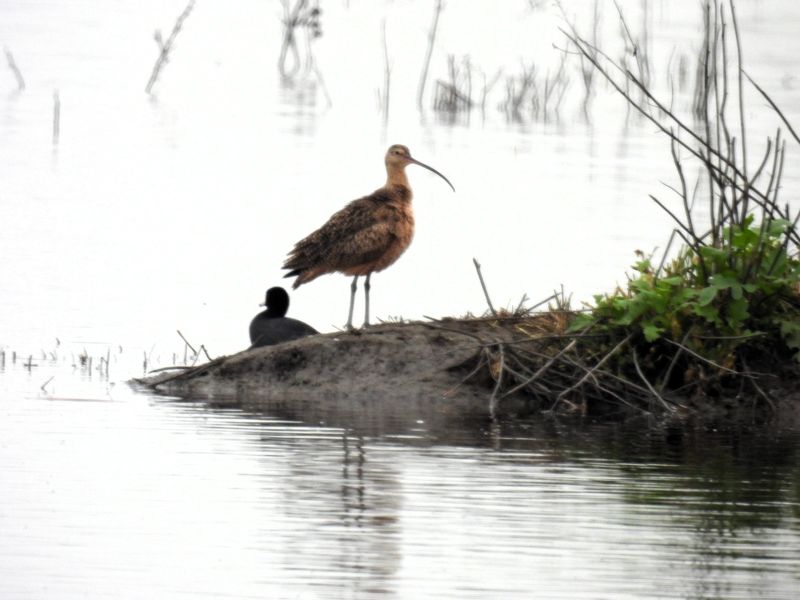
The long-billed curlew is the largest shorebird of North America. Its body length is approximately 23 inches, and it has a thin, arching, down-curved bill with a length ranging from 5–8 inches. The lower bill is pink at its base. Long-billed curlews are called sickle-bills because of the size and shape of their bills.
The curlew’s head is surprisingly small and its overall plumage is a marbled cinnamon brown dorsally grading to buffy colors on wings and belly. The curlew’s plumage becomes darker as its feathers wear. Lighter colored, outer feather margins wear away faster than the more central, darker feather areas. This weathering process gives birds with older plumage a somewhat textured surface appearance.
Whimbrels are sometimes mistaken for long-billed curlews. But curlews are larger, lack the dark eye and head stripes of whimbrels and have cinnamon-colored underwing coverlets compared to the whimbrel’s noncontrasting underwing colors.
Female curlews are larger and have longer bills than male curlews whereas juvenile curlews have relatively short bills compared to adults.
Curlew calls
Curlews are named for their distinctive call or song described as a clear “curleee” or short, rising “coooLI” sound. Their alarm calls are a series of short, sharp and repeated “whit-whit-whit-whit-whits.”
During spring mating season, usually extending from May through June, male curlews perform undulating display flights and call loudly over nesting areas. Preferred nesting habitats are usually located in shortgrass prairies and grazed pasturelands with short vegetation.
Nests are simple ground scrapes lined with grasses and other debris. The nest is often located close to a rock, shrub or other objects, and females usually lay four eggs that are brooded by both parents. Curlew chicks are precocial and may undertake their first flights within 30–45 days.
The present-day breeding range of long-billed curlews extends from southern Canada southward through much of the Great Plains and Great Basin regions and occasionally into the Oklahoma and northern Texas panhandles. Wintering populations migrate to coastal regions of Texas, Louisiana and along the Florida, California and Pacific Northwest coastlines as well as coastal and inland regions of Mexico.
A long bill for dinner
Long-billed curlews forage while walking over grasslands, agricultural fields and mudflat areas. Insects, spiders, small amphibians and occasionally other bird’s eggs are preferred food items. Curlews also feed upon small berries and utilize their long bills to probe for mollusks, crayfish, shrimp, crabs, marine worms and other invertebrates within wetland and coastal habitats.
The curlew’s long bill is pressure and touch sensitive and functions as a sensory probe and tweezers for efficient extraction of small, burrowing prey.
Upland sandpipers
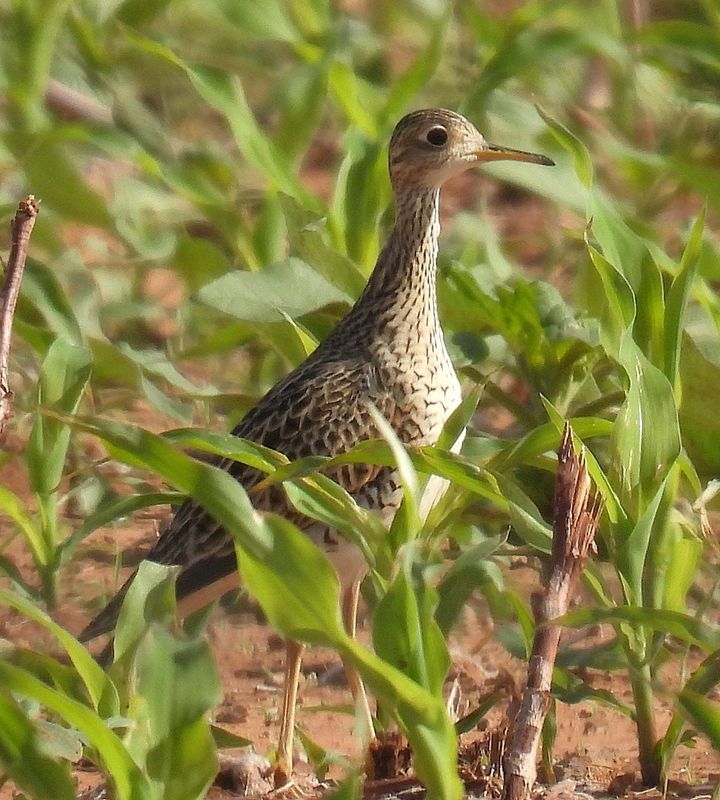
Upland sandpipers have long, yellow legs, long thin necks, small, dove-like heads and thin, straight bills that are dark above and at the tip with a contrasting yellow below. Wings and tail are long, and upland sandpipers have large, dark eyes.
Dorsal plumage is a mottled, brownish color, and the throat and belly are white. These birds have a habit of raising and spreading their wings as they alight upon the ground, fenceposts and other objects, thus exposing darker, chevron-shaped markings upon their sides and breast.
That whistle
Flight calls are described as strong “qui-di-di-du” notes, and their breeding ground songs are described as a tremulous twitter ending in an unusual “wolf-whistle.”
Whereas long-billed curlews prefer short or mixed grass habitats and areas of bare ground as nesting sites, upland sandpipers prefer nesting in taller grass habitats containing minimal bare ground and woody vegetation.
Nest construction, number of eggs, brooding duties, and brooding duration are similar to the long-billed curlew, and, if successful, the precocial young are capable of first flights in approximately 30 days. Upland sandpiper breeding regions extend from parts of Alaska to southern Canada and the northern Great Plains and eastward to the upper Midwest and Northeastern United States.
Long flights
Migrations are lengthy and, during migratory periods, upland sandpipers are often sighted near ballparks and other park areas, agricultural fields and near airports. The birds spend winter months in the southern pampas and llanos grasslands of Argentina, Brazil, Columbia and Ecuador.
An indicator species
The upland sandpiper is rather unique because it spends almost all of its time in upland, prairie habitats and tends to avoid wetlands. Researchers consider its affinity to prairies so strong that the bird is classified as an indicator species, and absence of upland sandpipers indicates that a prairie is in poor condition.
Upland sandpiper food items include insects such as grasshoppers, beetles, weevils, cutworms, moths and ants. Centipedes, millipedes, spiders, ticks and earthworms are also consumed in addition to various forb seeds, wheat, rye and berries. Upland sandpipers may also forage for grubs and other insect larvae within recently harvested potato fields.
Why these birds are only passing through these days
Both of these once abundant prairie dwellers were almost completely decimated by market hunting after the demise of passenger pigeons. But passage of the 1917 Canadian Migratory Birds Convention Act and 1918 United States Migratory Bird Treaty Act provided reprieves for long-billed curlew and upland sandpiper populations.
Although not federally listed as endangered species, both are listed as species of concern by several states and are probably most threatened by continuing habitat loss.
These unusual shorebirds are worth the search effort but are only passing through our immediate area on journeys to other regions. Their spring migration periods will largely conclude by late May or early June. Therefore, keep your eyes peeled for these prairie nesters.
Jim Goetze is a retired professor of biology and former chairperson of the Natural Sciences Department of Laredo College with an avid interest in all aspects of the natural world. He can be contacted at gonorthtxnature@gmail.com.
This article originally appeared on Wichita Falls Times Record News: Two unusual shorebirds to spot in the Rolling Plains | Opinion
Reporting by Jim Goetze, Wichita Falls Times Record News / Wichita Falls Times Record News
USA TODAY Network via Reuters Connect