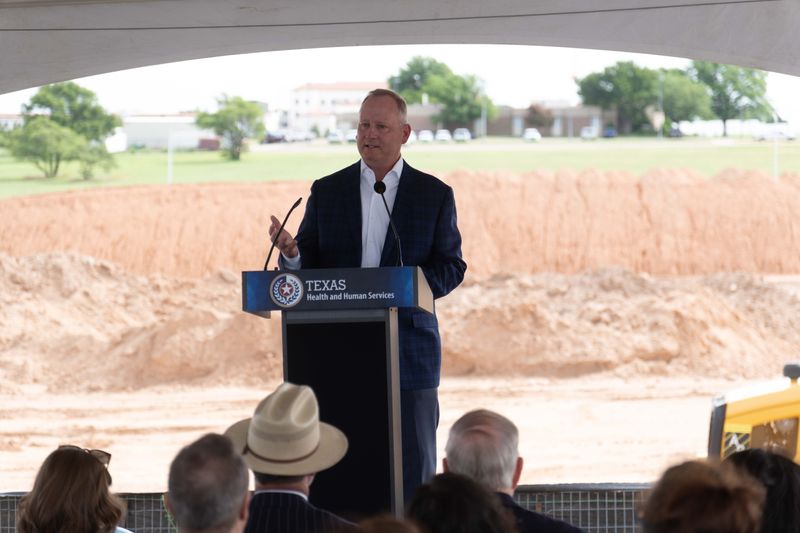
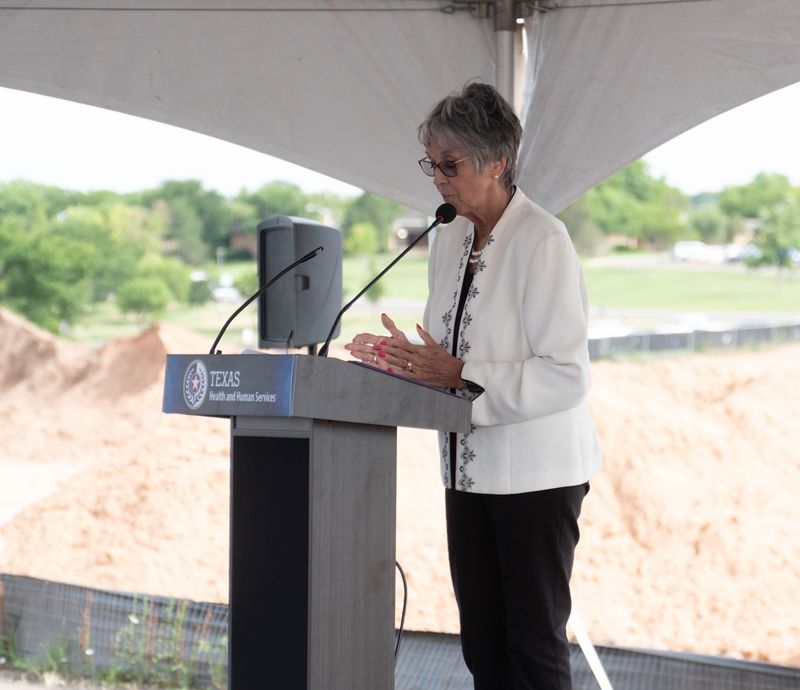
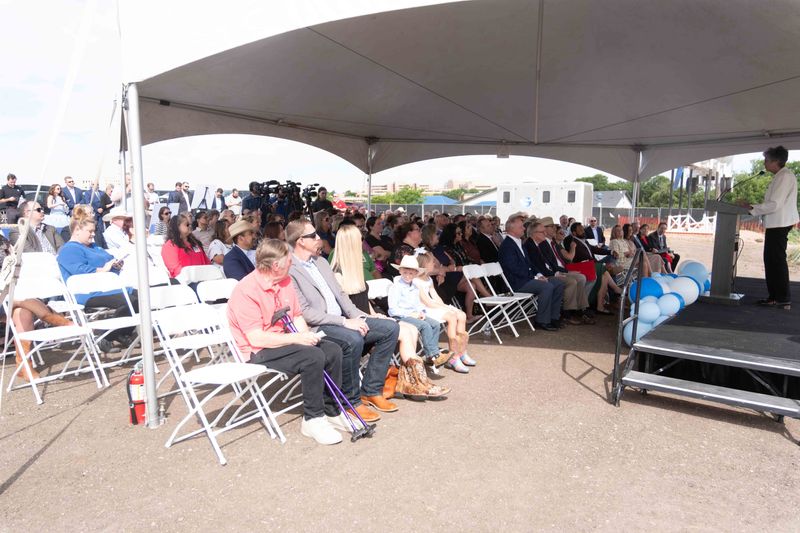
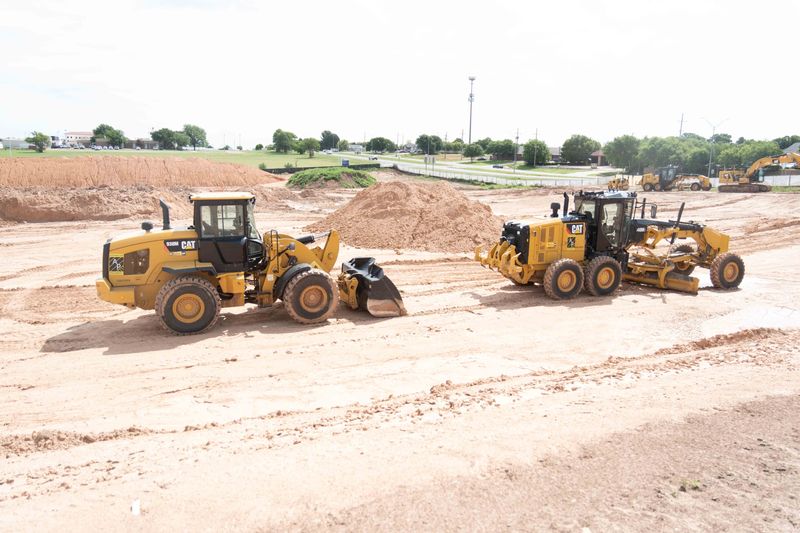
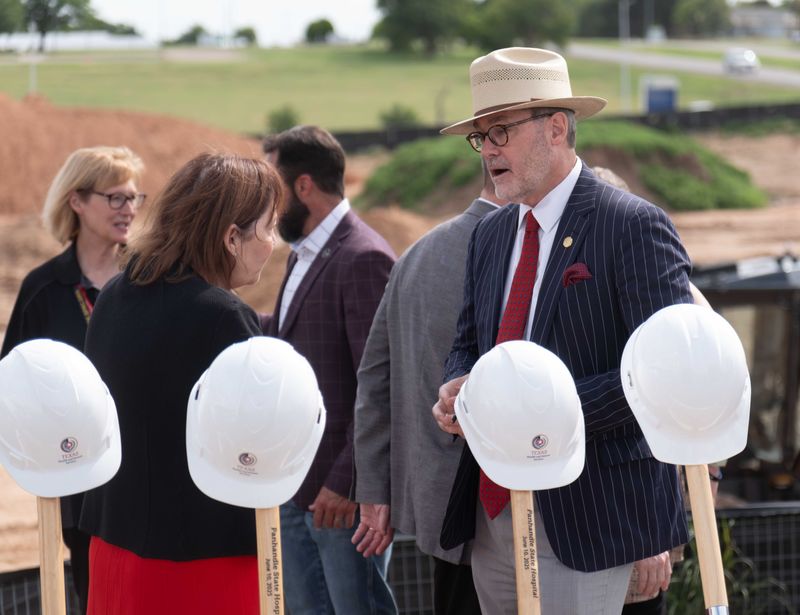
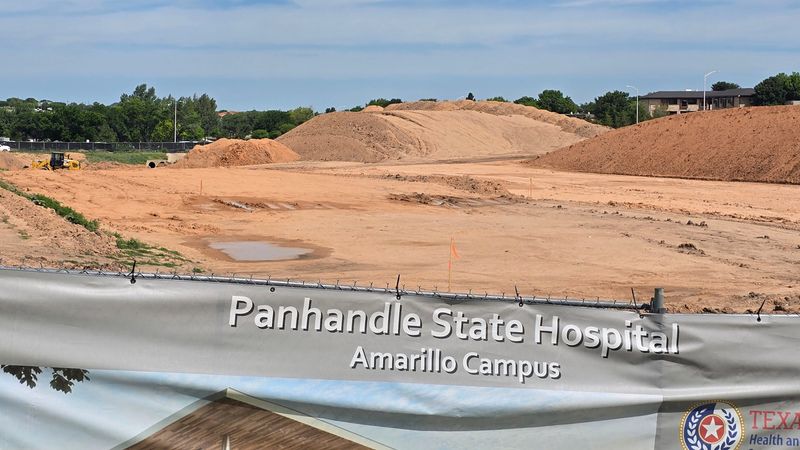
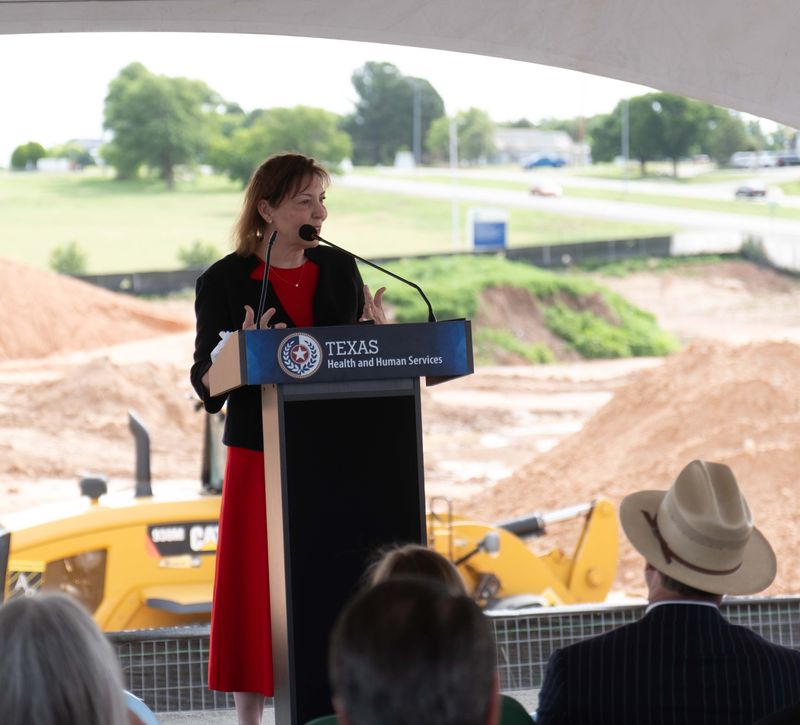
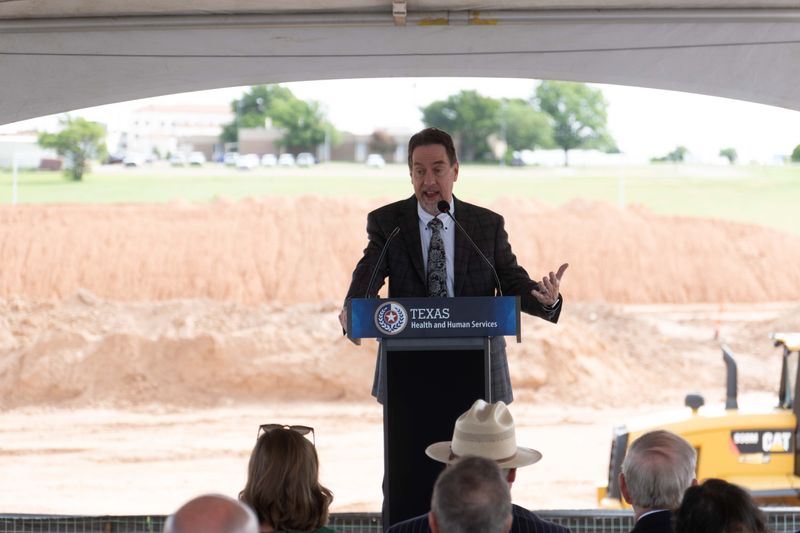
State and local leaders broke ground Tuesday on the long-awaited $159 million Panhandle State Hospital — a milestone years in the making for improving mental health care access in the Texas Panhandle.
Located at 6610 W. Amarillo Blvd., the 75-bed, non-maximum-security psychiatric hospital will include 50 forensic beds for individuals found incompetent to stand trial. The facility is expected to open in fall 2027 and bring up to 400 new jobs to the Amarillo area.

“This project really has only come together because of the effective collaboration we’ve had between the city, the county, the state and the Texas A&M University system,” said Scott Schalchlin, deputy executive commissioner of the Health and Specialty Care System. “You’ll find the people in Amarillo are the easiest to work with in the entire state.”
A decade-long effort pays off
Former State Rep. Four Price, who represented Texas House District 87 from 2011 until January 2025, was among the most vocal champions for the project. Price did not seek reelection, but his legislative legacy includes years of work on mental health reform — including foundational steps toward building the Panhandle facility.
“When I first began my service in the Texas Legislature, I was appointed to the Sunset Advisory Commission,” Price said. “We were tasked with reviewing and transforming the state’s health and human services agencies — and part of that meant evaluating the condition and functionality of our state hospital system.”
That review confirmed what Price had already been hearing from law enforcement, judges, and health providers across the region.
“We knew the Panhandle desperately needed a facility like this,” he said. “But the study also showed needs statewide. Many of our state hospitals had been built in the late 1800s as prisons. We couldn’t address everything at once — we had to line up the political will and the funding over multiple sessions.”
The $159 million appropriation in 2023 finally brought the project to life. Price said the region’s geography was central to the case for a new hospital.
“Law enforcement and judges were transporting people across the state just to find a bed. That wasn’t just inefficient — it was dangerous,” he said. “This hospital will solve that problem and provide treatment much closer to home.”
‘I felt like I’d won the lottery’
Potter County Judge Nancy Tanner, a longtime advocate for mental health infrastructure, said the need for this facility is evident in the strain it has placed on local systems — especially the county jail.
“Our jail has been over capacity for years, and many of the inmates shouldn’t be there — they need mental health treatment,” Tanner said. “This hospital will finally give us a place to send them.”
Tanner said she conducts mental health commitment hearings nearly every day and frequently finds there are no available state beds.
“We keep people at local facilities like the Pavilion or Oceans, but eventually they’re released, go off their meds, and I see them again. It’s a cycle,” she said. “This hospital will break that cycle.”
After state officials arrived in Amarillo last summer with renderings and a formal plan, Tanner said she knew the effort had finally paid off.
“I’ve been disappointed before,” she said. “But this time, it was different. I felt like I’d won the lottery.”
Responding to local concerns
While the project has drawn broad support, Tanner acknowledged she’s received a few concerns about the hospital’s location — especially due to the inclusion of forensic beds.
“I had someone email me worried that one of these patients might escape and harm someone,” she said. “But I reassured him — we’ve never had an escape from our jail, and we won’t have one here either.”
She said the hospital’s placement in the medical district was deliberate and necessary.
“This is exactly where it needs to be,” Tanner said. “It’s close to the VA, the Texas Panhandle Centers, the Pavilion, and other critical providers. This location puts it right in the network of care — and that makes all the difference.”
A facility built to heal
Christy Carr, associate commissioner for state hospitals, said the new facility is designed to promote long-term recovery through therapeutic spaces, private bedrooms and bathrooms, natural light, outdoor courtyards, a gym and a chapel.
“When someone is in crisis, the environment matters,” Carr said. “We’re building a space that helps people recover with dignity and stability.”
Carr emphasized that 50 of the hospital’s beds will serve forensic patients — those diverted from jail due to mental incompetence — which will reduce strain on both law enforcement and the court system.
“Bringing care closer to home improves outcomes, helps families stay connected, and ensures we have partnerships in place for aftercare,” she said.
Carr also noted that the facility will improve wait times for psychiatric evaluations and care, helping to prevent individuals in crisis from languishing in emergency rooms or correctional facilities.
“It’s about faster access to appropriate care,” she said. “When someone needs mental health services, every day matters. This facility helps meet that need in real time.”
Workforce pipeline through WT
To meet staffing needs, West Texas A&M University’s College of Nursing and Health Sciences is helping train mental health workers. The hospital is expected to hire between 300 and 400 employees.
“We want to ensure this hospital is fully supported,” Schalchlin said. “WT’s foresight in building this workforce will benefit the entire region.”
Sen. Kevin Sparks (R-Midland) said the Legislature also approved $4 million to support WT’s mental health education programs.
“West Texans know how to work together — and we act,” Sparks said. “This project proves that.”
Justice system impact
State Rep. John Smithee (R-Amarillo) said the hospital marks a turning point for law enforcement, which has long lacked appropriate options for people in crisis.
“For too long, jails have been forced to act as mental health facilities,” Smithee said. “This will give people access to the care they truly need and reduce pressure on our jails and court system.”
Amarillo Mayor Cole Stanley called the hospital a symbol of broader coordination among regional providers and agencies.
“There are so many moving parts — law enforcement, hospitals, the Texas Panhandle Centers, Cenikor — all of them will benefit from this facility,” Stanley said. “This is a big step forward for our city.”
Part of a statewide strategy
The Panhandle State Hospital is one of several mental health projects included in a $2.5 billion statewide initiative led by Gov. Greg Abbott and the Texas Legislature since 2017. The initiative aims to replace outdated facilities and expand access to inpatient psychiatric services across Texas.
Lt. Gov. Dan Patrick, who was not present at the groundbreaking but spoke later during a press conference at Rick Husband Amarillo International Airport, credited Tanner for initiating the project with a direct request during his 2022 visit.
“If I hadn’t asked what Amarillo needed, I don’t know if we’d be standing here today,” Patrick said. “You’ve got to speak up. The need was real — and we acted.”
Construction is expected to begin immediately, with the facility slated to begin serving patients by late 2027.
This article originally appeared on Amarillo Globe-News: Panhandle State Hospital breaks ground in Amarillo
Reporting by Michael Cuviello, Amarillo Globe-News / Amarillo Globe-News
USA TODAY Network via Reuters Connect