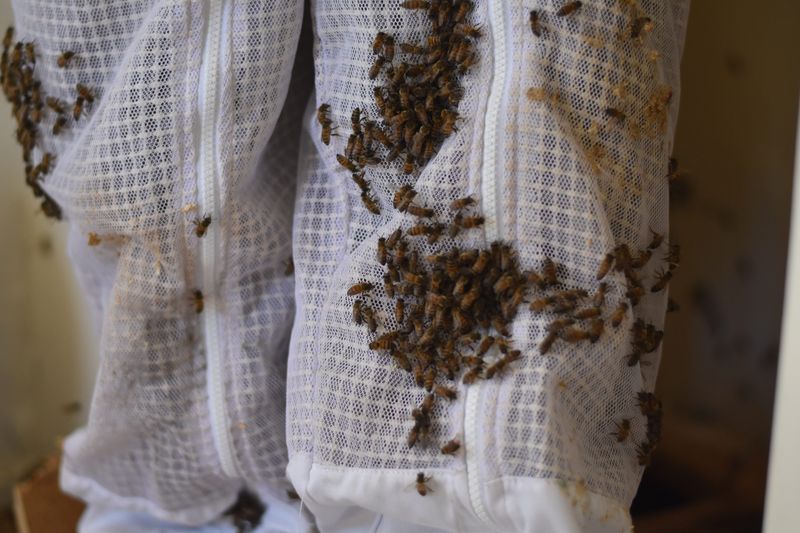
Africanized honey bees, often referred to as “killer bees,” are now found in 13 states and are slowly spreading northward, attacking people, livestock and pets along the way.
In the last three months alone, a man mowing his property died after a bee attack, three people were taken to the hospital after tree trimmers disturbed a colony, hikers ran a mile to get away from an agitated hive and a woman and bees spooked by a lawn mower swarmed three horses. The horses later died from “thousands” of stings, their owner said.

Scientists say the bees’ temperament is a defense mechanism to ward off predators – and note that because honey bees die after stinging, they are sacrificing themselves to protect their colony. But to unsuspecting humans, killer bees sure seem aggressive, spiteful and terrifying.
They’ve been known to follow their victims for up to a mile – even following cars and trucks – and can sting through regular beekeeping gear. In the attack on the Texas horses, owner Baillie Hillman said, “they didn’t give up.”
There’s no national database of deaths related to bee stings, but a 2023 study by the Centers for Disease Control and Prevention found that on average, 72 people die a year from hornet, wasp and bee stings.
“In Texas, every year there’s at least four big (Africanized bee) attacks that make the news,” said Juliana Rangel, a professor of apiculture (beekeeping) at Texas A&M University, where they’re widespread in the wild.
How dangerous are Africanized honey bees?
Africanized honey bees don’t have more or more potent venom than Western honey bees. “The stings feel the same,” Rangel said.
What differentiates them is the number that a colony sends out to attack. While each bee can only sting once before it dies, a colony of Africanized honey bees will send out proportionally more bees in a defensive response, leading to more stings.
“If I’m working around one of my European honey bee colonies and I knock on it with a hammer, it might send out five to 10 individuals to see what’s going on. They would follow me perhaps as far as my house and I might get stung once,” Ellis said.
“If I did the same thing with an Africanized colony, I might get 50 to 100 individuals who would follow me much farther and I’d get more stings. It’s really an issue of scale,” he said.
Africanized honey bees are also much more sensitive to potential threats. “You could be mowing a lawn a few houses away and just the vibrations will set them off,” Rangel said.
There are multiple reports of people cutting into colonies when trimming trees, clearing brush, or doing landscaping. In some cases, tree trimmers set off an attack merely by throwing a rope over a branch.
In toxicology, researchers speak of the LD50, the lethal dose required to kill 50% of those exposed to it, Rangel said. For honeybee stings, it’s calculated at about nine stings per pound of weight. So half of the people who weigh 150 pounds might die if they got 1,350 stings. That’s unlikely with Western honey bees, but it can happen with Africanized bees.
In 2022, an Ohio man suffered 20,000 bee stings while cutting tree branches. He survived but only after being put in a medically induced coma.
The bees have found a natural home in the Southwest, in part, because the landscape is much like the arid and semi-arid parts of Africa they’re originally from. Feral colonies are common in southern California, Nevada, Arizona, New Mexico and especially Texas.
They’ve also been seen in southwest Arkansas, southern Utah and about two-thirds of Oklahoma, said Allen Szalanski, a professor of entomology at the University of Arkansas.
What should you do if you encounter an Africanized honeybee hive?
Because of their highly defensive nature, if you encounter aggressive bees, the best response is to leave – fast.
“Get away as quickly as possible. Don’t jump in water, don’t swat with your arms. Just run away as as fast as you can,” Ellis said. “You might want to pull your shirt up around your nose and mouth to protect against stings that could cause swelling of your airway.”
In general, the biggest threats are to tethered or penned livestock and pets that can’t get away as well as humans using heavy equipment who accidentally get too close to a hive without being able to hear the angry buzzing of the bees.
Once you’ve evacuated the area, call for professional help. “If you’re in a rural area, it’s very likely these bees have been Africanized,” Rangel said.
Nobody should try to deal with a colony on their own “just to save a few bucks,” she said. “You don’t want to mess with them.”
This article originally appeared on Wichita Falls Times Record News: Africanized honey bees are in Texas. How dangerous are they?
Reporting by Elizabeth Weise, Wichita Falls Times Record News / Wichita Falls Times Record News
USA TODAY Network via Reuters Connect