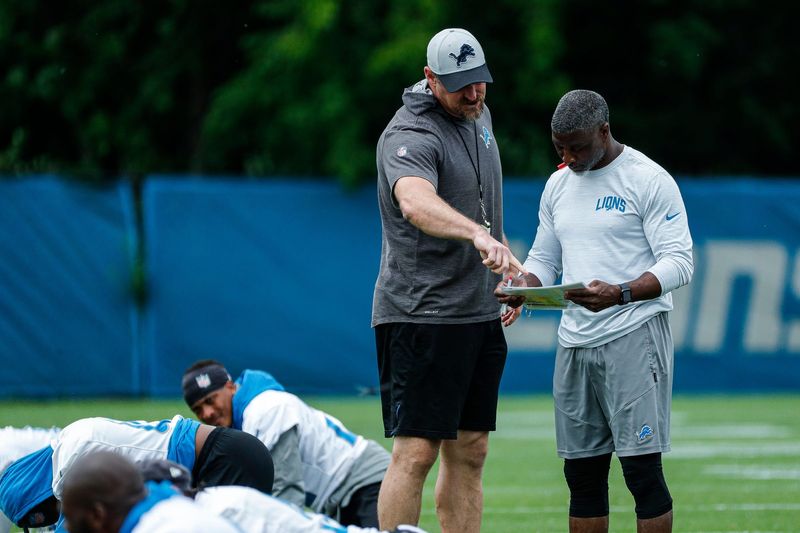
The 2022 Detroit Lions paired a high-powered offense with a defense that couldn’t stop anyone, though they ultimately finished second in the NFC North despite clear deficiencies. A lot of similarities can be found when compared to the 2025 Dallas Cowboys campaign, and hopefully the Lions turnaround in 2023 is a precursor for what the Cowboys will enjoy in 2026.
The two Year-2 versions share more than surface-level commonalities: defensive scheme, statistical performance, offseason priorities, draft approach, and reliance on development from young edge rushers. All of it helps put things in perspective as to why there’s optimism around a Cowboys defensive rebound.

Under then defensive coordinator Aaron Glenn, the Lions leaned on hybrid fronts, shifting between 3-4, 4-2-5, and 4-3 looks to generate offensive line confusion pre-snap. The secondary leaned heavily on man coverage, with zone concepts mixed in, with its safeties staying in single‑high looks.
Cowboys defensive coordinator Christian Parker plans to install a similar system in Dallas, though with a greater emphasis on zone coverage from the cornerbacks and safeties, masking coverages before the snap.
A statistical comparison between the two Year-1 units reinforces the connective tissue. In 2022, Detroit ranked 28th in points allowed and dead last in total yards surrendered. Their struggling secondary finished near the bottom of the league in passing defense, while the run defense was just as ineffective.
Dallas’ defense last season performed at a comparable level, and in some cases, worse. Ranking near the bottom of the league in points allowed, total yards, passing yards allowed, and run defense. Neither unit could consistently get off the field.
Breakdowns of the two teams in critical situations tells the same story.
Detroit ranked near the bottom of the league on third down, fourth down, and in red-zone defense; areas where Dallas also struggled, often performing worse than the Lions had. Detroit was able to correct those issues the following season after key roster additions and internal development, particularly from a young edge rusher entering his second year in Aidan Hutchinson.
Detroit targeted one of its biggest weaknesses, the secondary, by adding Cameron Sutton in free agency, then used the draft to address versatility and athleticism with Brian Branch and Jack Campbell. Dallas has followed a similar blueprint, adding Jalen Thompson in free agency to the secondary, then drafting Caleb Downs, a versatile nickel safety who can be used much like the Lions used Branch. They also added an edge rusher, Malachi Lawrence, and traded for an athletic linebacker in Dee Winters to address comparable needs.
The Lions were relying on a Year 2 leap from Hutchinson, and he delivered. His improved sack and pressure totals, combined with better coverage behind him and improved defensive line play, helped Detroit improve across the board. That growth led to more defensive stops, giving the offense more possessions, and it ultimately helped propel the Lions to a division title and an NFC Championship appearance.
Dallas is hoping for the same jump from Donovan Ezeiruaku, who flashed potential as a rookie but struggled with consistency. They already have proven players on the defensive line in Quinnen Williams, Kenny Clark, and Jonathan Bullard. With added help from new additions Downs, Winters, Thompson, and Lawrence, the Cowboys believe their defense can take a similar step forward.
When piecing everything together, the scheme similarities, offseason priorities, and statistical parallels, it’s easy to see a path where Dallas finds a way to recreate Detroit’s model. The Cowboys don’t need a dominant defense to succeed; they just need enough improvement to create stops. Enough to complement their offense and alter the trajectory of the unit, the same way Detroit did.
This article originally appeared on Cowboys Wire: How the 2026 Cowboys are borrowing the Lions’ 2023 blueprint
Reporting by Terence Watson , Cowboys Wire / Cowboys Wire
USA TODAY Network via Reuters Connect