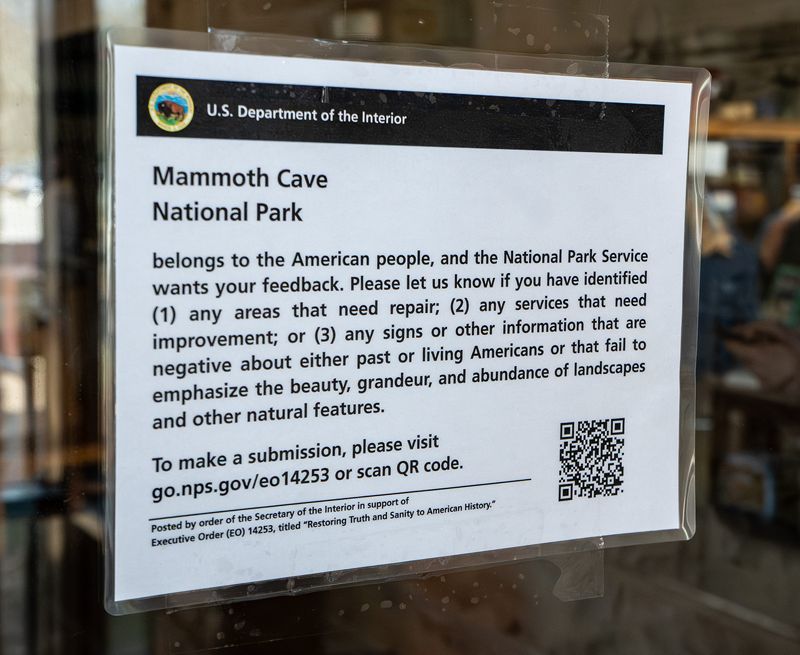
Last year, under executive order from President Donald Trump, the National Park Service placed small but controversial signs in its hundreds of parks, monuments and other properties.
The signs asked visitors to identify “any signs or information that are negative about either past or living Americans or that fail to emphasize the beauty, grandeur, and abundance of landscapes and other natural features.”

In Kentucky, almost no visitors did so. Instead, a flood of feedback mostly skewered the Trump administration for its cuts to national parks and environmental protections, or commended the efforts of park staff.
The Courier Journal reviewed more than 700 comments submitted to the administration from June 4, 2025 to Jan. 14 across five Kentucky-based National Park Service units, including Mammoth Cave National Park. The submissions were released by the agency in May.
About 80% of those comments either criticized the Trump administration and the premise of the executive order or voiced support for national parks, staff and conservation.
Out of more than 200 submissions advocating for national parks, some complimented the work of specific park rangers by name, or told staff to “hang in there.” Since Trump retook the White House last year, the National Park Service has lost roughly a quarter of its staff to layoffs and resignations.
Other comments were sarcastic, or mocked the premise of the order itself. One Mammoth Cave visitor commented: “Dangerous Exposure to Beauty: We were exposed to jaw-dropping vistas and peace of mind without warning. No signs were posted alerting me that I might start re-evaluating my life choices halfway through the hike. Unacceptable.”
The National Park Service, responsible for stewarding 85 million acres across all 50 states, has historically enjoyed overwhelming and bipartisan support in public opinion. As of 2024, 76% of Americans viewed the park service favorably, including 75% of Republicans — more than any other federal agency — according to a Pew Research Center survey.
The administration’s order on national park signage has faced criticism and legal challenges from public lands advocates, historians and others who argue it amounts to censorship of American history. In June, a federal judge issued a scathing, 63-page order for the administration to restore exhibits it had removed.
The Trump administration “seeks to share a limited history by ordering the removal of all signs, displays, and interpretive exhibits at National Parks that do not align with its preferred narrative, thereby telling half-truths,” wrote District Judge Angel Kelley, who was appointed by former President Joe Biden. She cited the agency’s removal of exhibits on slavery at Independence National Historical Park, in Philadelphia, and signage on climate change at Fort Sumter, threatened by rising seas in the Charleston Harbor.
“Not only does this undermine the integrity of the National Parks; it sets a dangerous precedent of censorship and sanitization,” the order said.
In Mammoth Cave National Park, the agency appears to have flagged for review numerous signs and historical markers related to slavery, the Jim Crow era and Indigenous history, The Courier Journal reported. Jerry Bransford ― a fifth-generation guide of Mammoth Cave whose enslaved ancestors were among the cave’s earliest explorers ― previously told the paper he would consider it “a great disservice to the American public” for such history to be removed.
The White House defended the president’s order as “honoring our country’s extraordinary heritage and restoring a sense of national pride” in a statement to The Courier Journal.
“The President has put an end to the radical left’s divisive and inaccurate characterization of our nation’s history, which infiltrated our national parks and museums, and is restoring truth and sanity,” said White House spokesperson Taylor Rogers.
In a statement, the Department of the Interior, which oversees the park service, said it was implementing the president’s order “to review interpretive materials to ensure accuracy, honesty, and alignment with shared national values.”
National Park Service staff “were asked to identify materials that might warrant clarification,” the department said. “Elevating an item for consideration does not mean it violates the Order, and it does not mean it will be changed. In the vast majority of cases across the system, flagged materials remain unchanged.”
Exhibit panels in the Mammoth Cave visitor center were removed under the order, and a publication of Cumberland Gap National Historical Park was discarded, according to a court filing. The National Park Service did not respond to The Courier Journal’s June 22 questions about what specific content was removed, or why it was found to be in violation of the Trump administration’s order. In both cases, the agency said the content was “unrelated to beauty, abundance, and grandeur of the natural landscape.”
Beyond Mammoth Cave, visitors to other National Park Service sites in Kentucky similarly pushed back against the order, with varying degrees of derision.
Submissions at the Abraham Lincoln Birthplace National Historical Park, near Hodgenville, included: a claim of “false advertising,” in the absence of a reenactment of Lincoln’s birth; a comment that “Donald trump ate my dog”; a script excerpt from the 2007 animated film “Bee Movie”; and an accusation that “information about Lincoln’s birth was obviously faked, as it did not depict the baby with a stovepipe hat at any point.”
Another Lincoln Birthplace visitor deemed the signage “entirely too honest. Words like slavery, division, and civil war appeared with alarming frequency, harshing the nostalgic buzz I was cultivating from the log cabin and gift shop. I came to the birthplace of Lincoln to feel good about America and our heroic President Trump, not to be reminded that our national story is one long, slow-motion moral reckoning.”
“… In short, the signage at your park made me feel things, and I would prefer not to,” the visitor continued. “History is supposed to be a tranquil, uncritical hobby — like bird-watching, but for dead people. Please consider rewriting your displays with a tone more befitting a bedtime story: fewer facts, more moral certainty, and absolutely no mention of ‘ideological contradictions.'”
Numerous properties stewarded by the National Park Service were established to remember history of injustice and brutality in the U.S. Examples include the Emmett Till and Mamie Till-Mobley National Monument in Mississippi and the Trail of Tears National Historic Trail, which runs through Kentucky in part.
National park units offer an accessible venue to share this history with the public, free from the stuffiness of a textbook. To ensure the information is accurate and approachable, the agency has long partnered with outside experts, including groups like the Organization of American Historians, which has spoken out against the Trump order.
Beth English, the organization’s executive director, said in a previous interview with The Courier Journal that removal and revision of historical markers on slavery and other subjects risks a dangerous flattening of American history.
“What you lose are the people, the struggles, the progress, the pitfalls,” she said. “All of that is lost, and so you lose the texture. You lose the depth and the complexity of what the past is really all about.”
Many visitors to Kentucky’s public lands and landmarks shared the same sentiment.
“All history is important, good and bad, convenient and inconvenient. American history is complex, but doesn’t need revision,” a Mammoth Cave visitor told the administration. “Keep American parks public and accessible to all. Our national parks are what makes us great. Invest in the natural beauty of America. Investment in history is an investment in our future.”
A full spreadsheet of comments received by the National Park Service is available here.
Connor Giffin is an environmental reporter for The Courier Journal. Reach him directly at cgiffin@courier-journal.com or on X @byconnorgiffin.
This article originally appeared on Louisville Courier Journal: Trump order on ‘negative’ history in Kentucky parks is scorned, mocked
Reporting by Connor Giffin, Louisville Courier Journal / Louisville Courier Journal
USA TODAY Network via Reuters Connect
By Connor Giffin, Louisville Courier Journal | USA TODAY Network