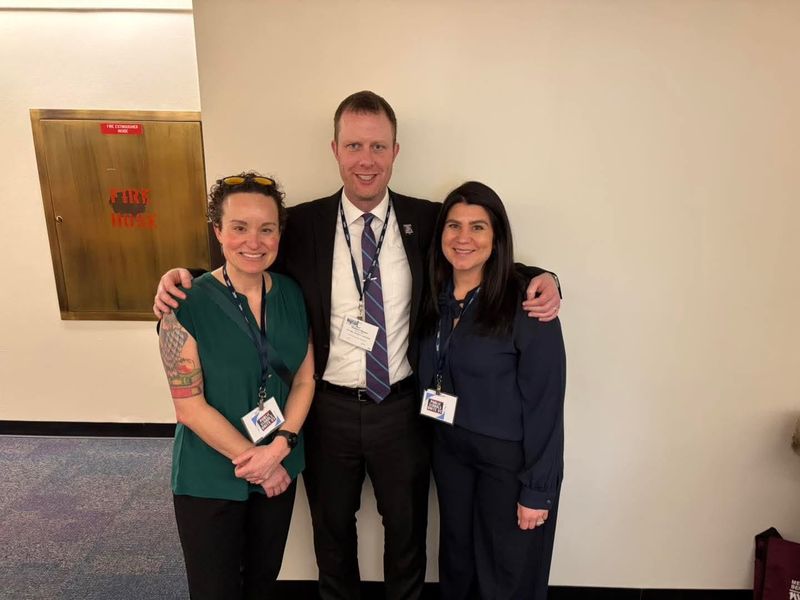
When Bethany Hamilton began her teaching career in New York 14 years ago, she wasn’t really thinking about retirement, despite all the state pension system changes that were unfolding at the time.
Hamilton, then in her late 20s, was just starting out. She had recently graduated with a master’s degree in English education from Bard College after spending some time in nonprofit work, had yet to start a family of her own and loved her teaching job.

Her parents were of retirement age and had spent their careers working for state agencies — a Tier 3 correction officer and a Tier 4 Department of Environmental Protection employee — that Hamilton said had retirement systems with “great payoff.” The potential challenges of reductions in New York’s Tier 6 pension program, which took effect only a few months prior to the beginning of her career in the classroom, had yet to be felt by anyone.
Now, at age 41, newly married and raising a family of her own in the Hudson Valley town of Saugerties, Hamilton has awakened to the pension reduction impacts. She’s having to consider what the future looks like not only for her, but for her two children as well.
“We really have been sold this message over time that yes, public service may not make as much as the private sector,” Hamilton said, before adding, “however, the big reward is that you dedicated your life so now you have this really secure retirement.”
“And with the changes made to Tier 6, we don’t really have that,” she added, referring to the pension system cost-cutting overhaul in 2012.
Asking young teachers to commit to a “subpar” pension system
Many Tier 6 members, including Hamilton, are today pushing for new reforms to their pension system in the state budget. And Gov. Kathy Hochul and several state lawmakers have said they’re on board with making changes.
Currently, Tier 6 members, or any full-time, permanent, 12-month employees of New York state or a participating employer who joined the state’s retirement system on or after April 1, 2012, must pay more of their salaries into the pension system than other tiers and face heavy penalties if they retire before age 63, according to New York State United Teachers (NYSUT).
This is causing a “massive teacher shortage,” Hamilton says. For example, the school district where she currently teaches 10th and 12th grade English — Tri-Valley Central School District in Grahamsville, Sullivan County — has been in search of a math teacher with special education experience for over a year.
And Hamilton asserted the staffing problem can be directly linked to the shortfalls of the Tier 6 system, laying out the seemingly prohibitive career calculus involved:
Why would you get higher education?
Why would you go that route when at the end of it all, it doesn’t really pay off?
“You’re asking teachers to commit to a subpar system anyway, and they have to work almost a decade longer than the teachers before them,” she added.
NY pension reforms would provide ‘light at the end of the tunnel’
Those in the Tier 6 system pay 3-6% of their salaries into the pension system the entire length of their career and their contributions go up as their pay increases. Comparatively, the contributions of those in the Tier 4 system are capped at 3% and end after 10 years and they have the option to retire at age 55 without any penalties.
There are currently 780,000 public workers enrolled in Tier 6, NYSUT says, and reporting by THE CITY earlier this week revealed around a third of New York legislators currently serving are Tier 6 members, raising questions about potential conflicts of interest among those considering approving the changes.
A proposal brought to Hochul and the Legislature by union groups earlier this month would allow Tier 6 members to retire at age 55 if they’ve put in 30 years in the public sector and, depending on their income, only have to contribute a maximum of 5% to their pensions.
Hamilton acknowledges that many Tier 6 members will work past 55, but says it’s important to give them the option to retire then.
“Knowing that there is this light at the end of the tunnel, knowing that at 55 I can go and still be secure is sometimes enough to give you that boost that you need or want to keep going,” Hamilton said.
Opposition to Tier 6 changes outlines cost impact on New Yorkers
At the same time, the push for changes to the state’s Tier 6 pension system has drawn heavy opposition from local government and watchdog groups across the state. They say the cost differential would be high and burden the state, local governments, school districts and New York property taxpayers.
Taxpayers could be facing a $1.5 billion annual price tag under the proposal, numerous media outlets have reported, and the plan would add an additional $242 million to the $3.4 billion the state already projects it will spend on pensions next year. On the local level, New York City’s pension costs would increase by $328 million, school districts would have to pay $480 million more and local governments would have to pay $407 million, according to Gothamist.
State officials have said they’re “assessing what we can afford.” Hamilton’s response to that stance? Taxing the state’s billionaires would help.
“We’re all taxpayers,” Hamilton said. “My response as a teacher, as a parent, as a taxpayer, is we do our fair share. They need to do their fair share too. And that would more than compensate for what we would need to make a fixed Tier 6 happen.”
Another element to consider is the fact that the system hasn’t been in place long enough for those in Tier 6 to experience its end-of-career effects. But Hamilton already knows she won’t be able to retire early or leave the profession — the latter of which she’s considered — as she has two kids to put through college and her husband’s job doesn’t come with certain financial benefits like health insurance or a pension.
“This is about being able to plan my future so that my kids don’t have to worry about it, just like my parents have been able to do,” Hamilton said.
Emily Barnes covers state government for the USA TODAY Network-New York with a focus on how policy and laws impact New Yorkers’ taxes, communities and jobs. Follow her on Instagram or X @byemilybarnes. Get in touch at ebarnes@usatodayco.com.
This article originally appeared on Rochester Democrat and Chronicle: Why NY teachers warn staffing shortages loom without pension reform
Reporting by Emily Barnes, New York State Team / Rochester Democrat and Chronicle
USA TODAY Network via Reuters Connect