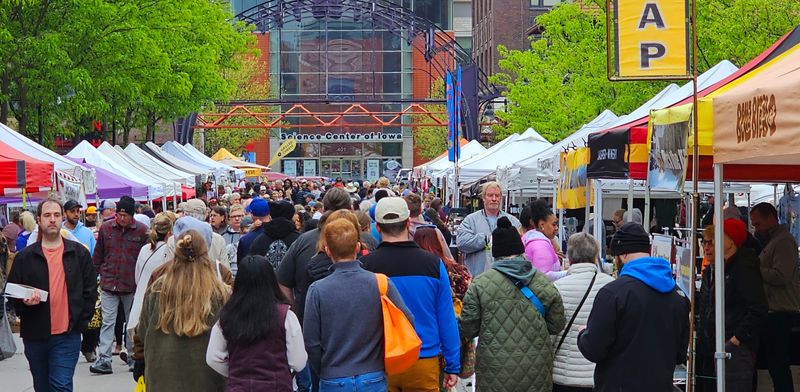
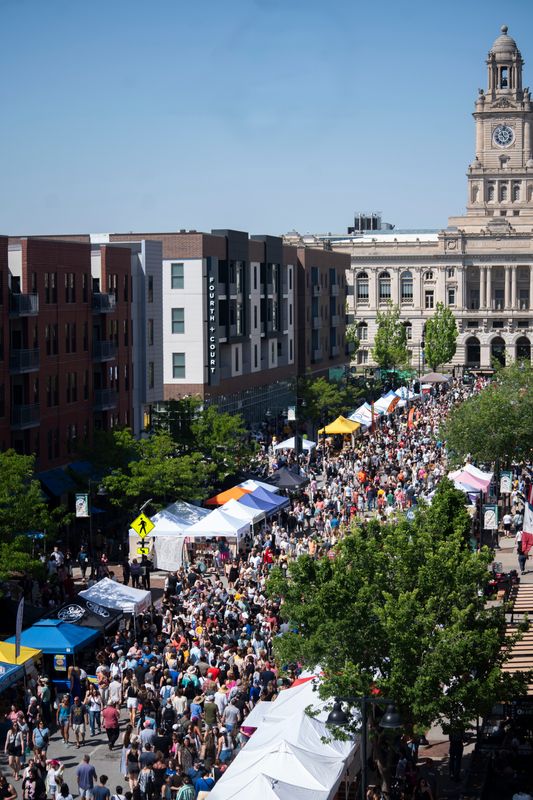
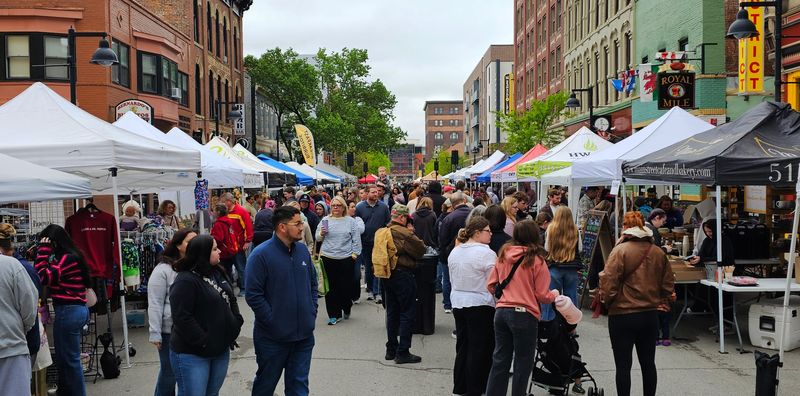
Every spring, the Downtown Des Moines Farmers’ Market performs the same small miracle: overnight, the city relearns how to wake up early. At 6:45 a.m., Court Avenue is a choreography of pop-up canopies and folding tables, the air still cool enough to feel borrowed. By 8, it’s a full-throated gathering — parents steering wagons through the crowd, runners still sweating, chefs scanning the produce with professional focus, tourists marveling at the scale of it all.
This year’s season opens May 2 and runs through Oct. 31, and it’s bigger than ever: 305 vendors spread across 12 downtown blocks, including 43 first-timers. Many of the newcomers are food businesses using the market as a low-risk, high-reward way to say hello to Des Moines, testing recipes, learning what sells out first and finding out in real time what kind of city this is on a Saturday morning.

Coming off the market’s 50th season, market manager Elizabeth Weyers says 2026 feels like a pivot point, familiar in rhythm, but different in momentum.
“I think we’re kind of entering a new era,” Weyers said. “We’ve passed a milestone together, and now we’re entering this new milestone we’ve never been in before. We’re all kind of in it together.”
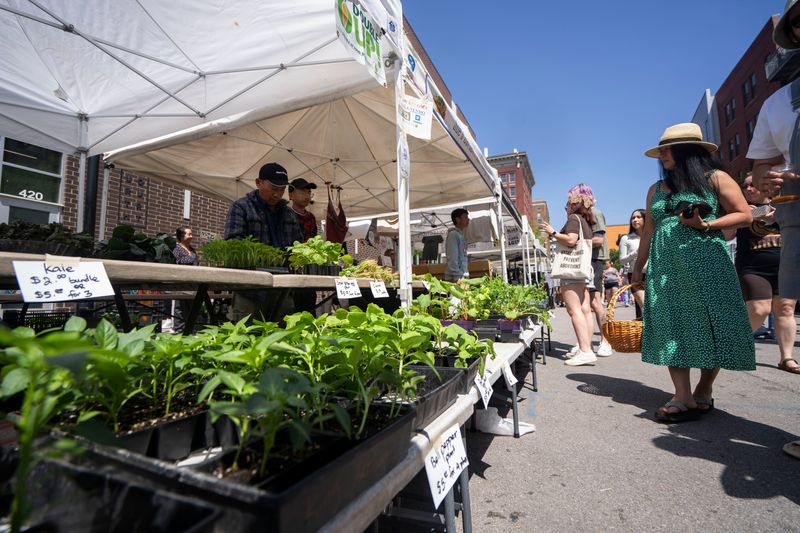
Part of it is a return to roots: a renewed emphasis on agriculture. This season includes 75 produce and agriculture vendors, more than in recent years, a shift Weyers attributes to a growing interest in homesteading and cooking at home, even for people without backyards.
“We’re trying to put a big focus on agriculture and farms,” she said, noting the ways people are learning to grow and cook more at home, even from apartments.
If the farmers’ market has always been a mirror of how Des Moines eats, this year it feels especially tuned to the present moment: local, curious, a little indulgent and deeply communal.
And, let’s be honest: most of us are here for breakfast.
What to try at the market in 2026
Think of the Downtown Farmers’ Market less as a shopping errand and more as a choose-your-own brunch — one that requires walking shoes and patience.
Go early for bread (always bread)
By 8 a.m., the serious carb aficionados are already circling the baked-goods stalls, eyeing crusty loaves, glossy cinnamon rolls, laminated pastries that crackle audibly when torn apart. The smart move: buy more than one thing. Future You will be grateful.
The breakfast sandwich arms race continues
Every year, someone raises the bar with fluffier eggs, thicker bacon, better bread. Expect meat-forward versions heavy on Iowa pork, vegetarian riffs built around local greens and cheeses and sauces that are doing more than one job at once. Eat it standing up. Drip on your shirt a little.
And if you’re wondering what people ask about most?
“The No. 1 question we get is, ‘Where are the breakfast burritos?’” Weyers said.
Breakfast at the market can mean burritos and bowls, tacos and pupusas, Lebanese plates, and baked goods that count as a meal.
Coffee, but specific
Cold brew is served dangerously strong. Hot coffee is poured fast and without ceremony. Seasonal syrups can skew herb- or spice-forward rather than cloyingly sweet. The market remains one of the best places in the city to remember that coffee is an agricultural product first and a lifestyle accessory second.
This is a sneaky-good year for drinks
Beyond coffee, keep an eye out for fresh-pressed juices that lean fruit-forward instead of “green detox,” sparkling lemonades and shrub-style drinks built for summer heat, plus locally produced teas and botanical beverages designed for slow sipping while people-watching.
Weyers has noticed a particular beverage trend accelerating among younger marketgoers:“We have a lot of matcha vendors this year,” she said.
Produce dictates the menu
Early in the season, shoppers can find asparagus, radishes, garlic, green onions, leafy greens and herbs. If you’re expecting strawberries and tomatoes on opening day, you might be a week or two early — strawberries typically arrive later in May, depending on weather and whether growers are using tunnels or greenhouses.
A market that represents the whole state
The Downtown Des Moines Farmers’ Market isn’t just a Des Moines showcase — it’s an Iowa one. This season includes vendors from 43 Iowa counties, with strong representation from western, eastern and southern Iowa. A handful come from nearby states such as Nebraska and Illinois, but the market prioritizes Iowa-based businesses.
Some stands are multigenerational constants. Thill’s Produce, for example, has been part of the market since its founding in 1976, with multiple generations now working the booth.
“You can see the grandparents, the kids, the grandkids, everybody helping out,” Weyers said.
Longtime staples also return, such as Ebersole Cattle Co., Pupusas — El Salvador, Iowa Coffee Co. and Big Sky Bread.
New vendors, returning favorites and the curated chaos of it all
One reason the market stays fresh is that it’s built to. The lineup is curated through an annual application and vendor jury process: every vendor re-applies each year. Returning farmers and agriculture vendors are prioritized, while a rotating panel of sponsors, partners, community members and vendors reviews new applications.
Among this year’s new or notable additions:
Mae’s Bagels, filling what Weyers calls a long-standing “bagel gap” at the market.
Bee Anchored, a honey vendor planning to bring a live beehive display — secured in a protective case — on select days.
Ice Lab, an Italian shaved ice food truck that feels destined to become a summer staple.
Whatcha Smokin? BBQ, a popular barbecue name in central Iowa making appearances as a prepared-food vendor.
ManilaBoy, a former market favorite whose family stepped away during COVID and has now moved back to Des Moines to reopen the stand.
Food trucks, too, have become a bigger part of the ecosystem — rotating alongside fan favorites like Whip Delight, best known for Dole Whip.
Spark DSM: the market as an incubator (and a crystal ball)
While the market isn’t broadcasting a full roll call of new food vendors just yet, one pipeline matters more every year: Spark DSM, an entrepreneurial program that helps small businesses get a foothold at the market and beyond.
This season, 22 Spark DSM businesses will participate. They typically receive four to five market dates plus table space, signage and setup support — and often get additional opportunities to vend at major events like the World Food & Music Festival, Out to Lunch and the Winter Market.
If you’ve ever wondered how Des Moines learns what it’s about to love, it often happens here, one Saturday morning line at a time. Past Spark participants have turned into fan favorites and full-time vendors, including Nadia’s French Bakery, which started in the program’s first cohort and now has a bakery on Grand Avenue in Des Moines.
“We see people continuously coming back, which is great,” Weyers said of Spark graduates who convert into full-time vendors.
A few Spark names to watch this year (for the sheer pleasure of eating your research):
Muddy Puddles Ice Cream: If the Downtown Farmers’ Market is about joy, Muddy Puddles is pure serotonin — small-batch scoops built for immediate gratification while you wander and drip just a little. The market is the proving ground: test flavors, watch what sells out, turn casual cravings into something sustainable.
Tacos del Robert: Street-forward, focused, and meant to be eaten standing up with both hands. Hot tortillas, bold fillings, no unnecessary explanation, the kind of vendor the market rewards, and the kind of line that quietly becomes a ritual.
Matcha Luv: A vendor that speaks directly to the market’s evolving drink culture: less sugary, more intentional, deeply photogenic but serious about flavor. It’s a stop that pairs naturally with a pastry loop through Court Avenue, and a small signal of where Des Moines’ palates keep heading: globally curious and happy to sip something grassy and green at 8:30 a.m.
That sense of experimentation is part of the market’s charm. Some vendors will sell out by 9:30 a.m. Others will tweak recipes week by week, responding to feedback in real time. A few will grow into brick-and-mortar businesses you’ll later swear you “knew back when.”It’s all very present tense.
Making abundance reachable (and putting leftovers to work)
The market is also leaning into accessibility in practical, concrete ways. SNAP, Double Up Food Bucks, Produce Rx and WIC/FMNP benefits are accepted, a quiet but meaningful reminder that abundance only counts if people can reach it.
The market runs a centralized SNAP system through its Market Resource Tent: shoppers swipe their EBT card, receive market-specific tokens and can use them with eligible vendors—without each vendor needing to maintain their own SNAP license. That structure allows more stalls, including those selling items like honey or spices, to participate in SNAP for eligible goods.
The market’s Double Up Food Bucks program matches SNAP spending up to $15 per day on fresh produce, effectively doubling the value of SNAP dollars for fruits and vegetables. And the Produce Prescription program lets health care providers prescribe vegetables; recipients receive vouchers and redeem them at produce stands.
“We hear a lot of people say, ‘We had no idea we could use this down here,’” Weyers said. “Now we’re doing multiple transactions a day.”
And when the market winds down each Saturday, surplus food doesn’t have to go to waste. Since 2009, the market has partnered with DMARC on Meals from the Market, sponsored by John Deere. Volunteers collect leftover goods vendors are willing to donate and deliver them to the DMARC Food Pantry Network, donations that translated to around 16,000 meals last year, with an even higher goal set for this season.
The footprint, the Fifth Street extension and how to survive your first Saturday
The market will use the same footprint as last year, including the vendor stretch along Fifth Street near the courthouse. That extension began as an experiment, one that organizers weren’t sure would work. It did.
“We had a lot of great feedback from vendors,” Weyers said. “We were fully prepared for vendors to say they didn’t want to be down there anymore, and I think every vendor down there asked to be back.”
With many shoppers parking in that direction and walking in, it’s become a natural gateway into the main streets, an on-ramp rather than an afterthought.
For first-timers, Weyers’ advice is simple and deeply practical:
Come early. Crowds build quickly, especially on nice days. Early shoppers get the best shot at bread, baked goods and the most popular breakfast vendors.
Be patient. Strollers, pets, coffee lines — it’s a lot of people in a compact footprint.
Talk to vendors. “This is their livelihood,” Weyers said. “They’re so passionate about what they do. Connect with them.”
Bring a bag. Reusable bags, backpacks and carts are your best friends.
Wear comfortable shoes. Twelve blocks is a commitment.
Plan your route — loosely. Regulars have favorite loops, but wandering is half the fun.
Skip the dog, if you can. The market is dog-friendly, but crowds and heat can be stressful for pets.
And yes: it’s rain or shine.
“Sometimes the rainy days are a little fun, if it’s not opening day,” Weyers said.
Where to find the Downtown Des Moines Farmers’ Market
(This article was updated with new information.)
Sign up for our dining newsletter, Table Talk DSM, which comes out on Wednesday mornings with all the latest news on restaurants and bars in the metro. You can sign up for free at DesMoinesRegister.com/tabletalk.
Susan Stapleton is the entertainment editor and dining reporter at The Des Moines Register. Follow her on Facebook, Twitter, or Instagram, or drop her a line at sstapleton@gannett.com.
This article originally appeared on Des Moines Register: Downtown Des Moines Farmers’ Market opens May 2 bigger than ever
Reporting by Susan Stapleton, Des Moines Register / Des Moines Register
USA TODAY Network via Reuters Connect