IndyCar drivers and teams were penalized for Chevrolet engine issues for the first time last weekend at the Grand Prix at Road America in Elkhart Lake, Wisconsin. Alexander Rossi and Santino Ferrucci had their engines changed after Friday’s practice session, leading to six-spot grid penalties for the race since their cars had surpassed the allotted four engines in a season.
Rossi and Ferrucci’s cars, along with the Arrow McLaren cars of Pato O’Ward and Nolan Siegel, underwent what a Chevrolet spokesperson called “precautionary engine changes” before Saturday due to a supplier issue in valve coatings that seven Chevrolet cars experienced at the Detroit Grand Prix at the end of May.

“If you can imagine the valve sitting in the guide with a wrong coating, over time, you get to see the valve chuck off the seat,” General Motors president Mark Reuss said on Fox at the Detroit Grand Prix. “And so it becomes fatigue.”
These issues have caused two penalties, and with more engine replacements to come, Chevrolet — which provides engines for 12 of the 25 cars in the series — will have multiple other cars given grid penalties.
Why teams replaced engines after Friday’s practice
At the Bommarito Automotive Group 500 on June 7, rookie Caio Collet was in sixth place before the engine of his No. 4 AJ Foyt Racing Chevrolet failed due to its fatigued valve coating. Collet was 24 laps away from the first top 10 finish of his career, but instead, his day at World Wide Technology Raceway ended in heartbreak and a 22nd-place finish.
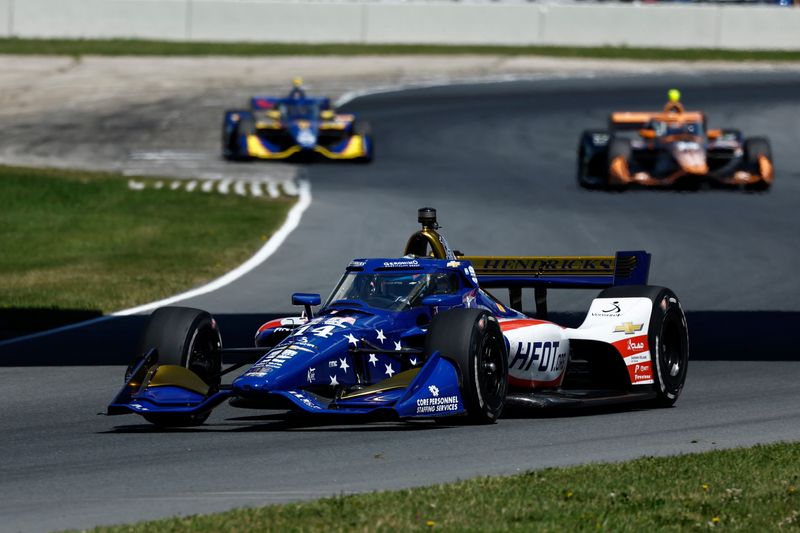
Collet’s failure is why AJ Foyt Racing decided to replace the engine on Ferrucci’s No. 14 Chevrolet after the first practice session of the weekend, despite knowing that a grid penalty was coming. Ferrucci’s engine had reached a similar mileage as Collet’s did at WWT Raceway, and rather than risk a failure during the Grand Prix at Road America, the team got ahead of it and took the penalty. Ferrucci started the race 13th and finished ninth.
“(Chevrolet feels) like now that batch is pretty much run through,” AJ Foyt Racing president Larry Foyt told IndyStar. “So we’re getting into engines that they feel have been fixed and are good to go.”
Ed Carpenter Racing went through a similar decision-making process when changing Rossi’s engine and deciding to go over the engine limit on its No. 20 car. Rossi — who had the 21st-quickest qualifying time — started the Grand Prix at Road America 25th and finished sixth.
“Obviously not happy about it, but nor are they,” ECR co-owner Ed Carpenter told IndyStar. “The reality is, I’d rather take a six-place grid penalty and give ourselves some insurance that we’re not going to have a different type of problem in the race.”
Chevrolet believes it is toward the end of the batch of bad valves — which have a private, unknown supplier — although it’s unclear exactly how many more engines will be affected.
Collet, O’Ward, Siegel, Christian Lundgaard (Arrow McLaren), Scott McLaughlin (Team Penske), David Malukas (Team Penske) and Sting Ray Robb (Juncos Hollinger Racing) are other Chevrolet drivers whose cars are on engine No. 4 heading into the Indy 200 at Mid-Ohio. Meanwhile, Honda has only two drivers — Louis Foster (Rahal Letterman Lanigan Racing) and Marcus Armstrong (Meyer Shank Racing) — who should be on their fourth engine by Mid-Ohio.
Is this a cause for concern going forward?
Chevrolet teams remain optimistic that the issues won’t continue once the bad batch is run through. The hope is that, although others will serve grid penalties (and Ferrucci and Rossi will likely serve another due to mileage), no more failures like the one that affected Collet will occur.
“It really doesn’t change anything on our end,” Foyt said of taking on a grid penalty this early. “I feel like if we still felt like there was an issue going on, then maybe we would limit mileage or limit some running. But we don’t think that’s the case anymore.”
“I think we all feel confident that it’s not something that’s going to persist through the end of the season,” Carpenter said. “We’ve just got to manage this until we get these specs that we’re on right now out.”
The excess engines won’t change how teams and drivers approach races and qualifying, even if a car is close to another replacement. Given the fact that most Chevrolets will either surpass the engine limit or come close to it, taking one of the grid penalties won’t put a car at that much of a long-term disadvantage (although some tracks, like Road America, are more favorable for making up positions than others).
This is just something that Chevrolet teams will have to deal with throughout this season, and the teams seem to have accepted that.
“It doesn’t affect the way you race,” Foyt said. “We’ll still run all the miles we can and push as hard as we can, knowing in the back of our minds there’s probably one more engine penalty coming down the road. But that’s just racing. It’s not going to change what we’re trying to do and get the best finishes that we can.”
The hope on all sides is that Chevrolet won’t receive any more faulty valves and that whichever cars may have the last of the bad batch get ahead of it, as AJ Foyt Racing and ECR did. As the summer continues, the expectation is that engine failures caused by valves don’t remain a problem.
Zion Brown is IndyStar’s motorsports reporter. Follow him at @z10nbr0wn. Get IndyStar’s motor sports coverage sent directly to your inbox with our Motor Sports newsletter. Subscribe to the YouTube channel IndyStar TV: IndyCar for a behind-the-scenes look at IndyCar and expert analysis.
This article originally appeared on Indianapolis Star: Despite Chevrolet engine valve failures, IndyCar teams ‘feel confident’ they won’t continue
Reporting by Zion Brown, Indianapolis Star / Indianapolis Star
USA TODAY Network via Reuters Connect
By Zion Brown, Indianapolis Star | USA TODAY Network