The Indiana Department of Natural Resources has proposed a new rule that would allow more hunters to trap bobcats, raising the hackles of some who say the move is premature based on too little evidence.

The trapping quota would rise from 250 to 400 bobcats in a season and open up avenues for hunting. The season begins on Nov. 8 and ends Jan. 31 but will close earlier if the 400-cat quota has been met.
This 60% increase from the initial 2025 season has caused ripples across animal activism agencies in Indiana. Humane World for Animals Indiana State Director Samantha Chapman said the new rule has little merit based on current DNR bobcat population data and that proposed models detailing the future population changes don’t represent healthy management of bobcats in Indiana.
“Increasing a quota without having adequate data and an adequate number of bobcats in this state really is reckless and irresponsible in terms of wildlife management,” she said. “(Humane World) has been asking for an actual study with data to understand how many bobcats exist within the wild.”
The data in question comes from an interim regulatory rule analysis published by the DNR paired with the Natural Resources Commission on April 22. The document cites increases in nuisance permit requests from 14 in 2018 to 34 in 2025 from landowners asking permission to dispose of bobcats and says the overall bobcat population in southern counties has expanded such that it “is sufficient to withstand a regulated harvest.”
“Indiana is seeing an increase in negative interactions with bobcats across the 40 counties with high-quality bobcat habitat, with both increased accidental vehicle collisions and a 140% increase from 2018 to 2025 in permit requests to take bobcats that are killing livestock,” DNR spokesperson Holly Lawson said in an email.
But Chapman maintains that the state’s population data does not constitute a complete study of bobcats to warrant a change of hundreds in the yearly quota, especially considering there has only been a single season of trapping in Indiana.
This data is collected through volunteer hunter sightings during the annual Archer’s Index and turned into projection models that predict the number of bobcats in Indiana.
“It’s really important to understand that there’s never been any type of actual population count, it’s all been based on a model,” Chapman said. “I think the thing that’s most concerning now is that we’re a year later here, and we really still don’t have any physical data, it’s all based on projections.”
The DNR maintains that the Archer Index and its longstanding methods are sufficient to predict bobcat populations with enough accuracy to justify the rule change.
“DNR and other wildlife agencies make decisions on wildlife population management based on data such as research, surveys and statistical indices, such as the Archer’s Index,” Lawson said in the email. “This is the consistent data approach DNR uses for harvest management across species. Population models are used by DNR for setting quotas for species such as bobcats and river otters. The bobcat population model will continue to be updated through future research efforts.”
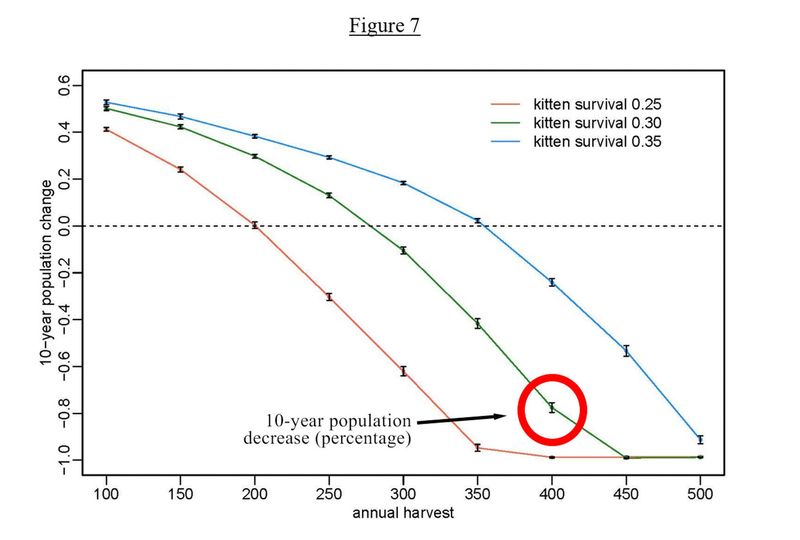
Based on other scientific literature paired with population models developed by Purdue in conjunction with the DNR, the state’s analysis reveals a final harvest prediction trend that shows the overall population declining in Indiana by 80% after 10 years at a 400-pelt quota each year.
A request earlier this week to speak with Purdue experts was unsuccessful.
Chapman couldn’t believe it when she saw the numbers.
“It’s really disturbing that our Department of Natural Resources would not rely on data when they’re seeking rule proposals that would really significantly impact Indiana’s ecosystem and the future of it,” Chapman said.
With Lawson and the DNR saying the updated policy is targeted “to responsibly manage and decrease Indiana’s bobcat population following the population model while still maintaining a strong bobcat population in Indiana,” the state’s rulemaking decisions and data analytics seem to be at odds with one another. Where one promises responsibility and management, the other shows a steep population decline in the next decade.
Public opinion on the issue sides with Chapman. In a January 2024 study conducted by the Remington Research Group, 71% of Hoosiers opposed the recreational trapping of bobcats and 75% opposed bobcat trophy hunting. More than 60% of surveyed Hoosiers agreed that non-lethal deterrents to bobcat interactions should be pursued over recreational trapping as a means to reduce negative human interactions with them.
“A majority of Hoosiers value wildlife alive, and that the agency really is tasked with balancing all of those interests on behalf of all Hoosiers,” Chapman said. “It’s not catering to special interests; it’s serving taxpayers and Hoosiers who live here.”
A June 24 story published in the Indiana Capital Chronicle reported that two members of the Indiana Natural Resources Commission have resigned in protest against “’stifling’ citizen input curtailing the board’s role working with the Department of Natural Resources.”
“Since the appointment of Alan Morrison as director of DNR, it has become apparent that an agency that thrived on transparency and engaging the public to foster sound public policy has become a cabal in which citizen input has been stifled,” citizen member Bart Herriman said in a June 12 resignation letter to Gov. Mike Braun cited in the Chronicle.The story includes allegations that DNR Director Alan Morrison has been posting preliminary rule approvals himself, rather than consulting with the commission first, and that board members cannot make changes to his proposed rules and would have to attend public hearings to provide input.
One of Morrison’s rulings was the April decision to increase the bobcat quota.
“The current department leadership has seen fit to destroy public trust, push forward resource management decisions based on whims and not science, eliminate transparency and terminate all communication or engagement with the commission,” Bryan Poynter, the former chairman of the NRC, told the Chronicle.
Despite no specific future research efforts described or answers for conflicting data, the DNR maintains that its process for rulemaking and data collection methods for population modeling are sound.
Chapman is still not convinced.
“The DNR should really consider all opinions and interests, not just the interests of a few,” Chapman said. “They’re catering to special interests, and that’s really what it comes down to. It doesn’t make sense, it’s not supported by data, it’s not supported by any science.”
This article originally appeared on Lafayette Journal & Courier: Indiana DNR faces heat over new bobcat hunting plan
Reporting by Elijah Greene, Lafayette Journal & Courier / Lafayette Journal & Courier
USA TODAY Network via Reuters Connect
By Elijah Greene, Lafayette Journal & Courier | USA TODAY Network