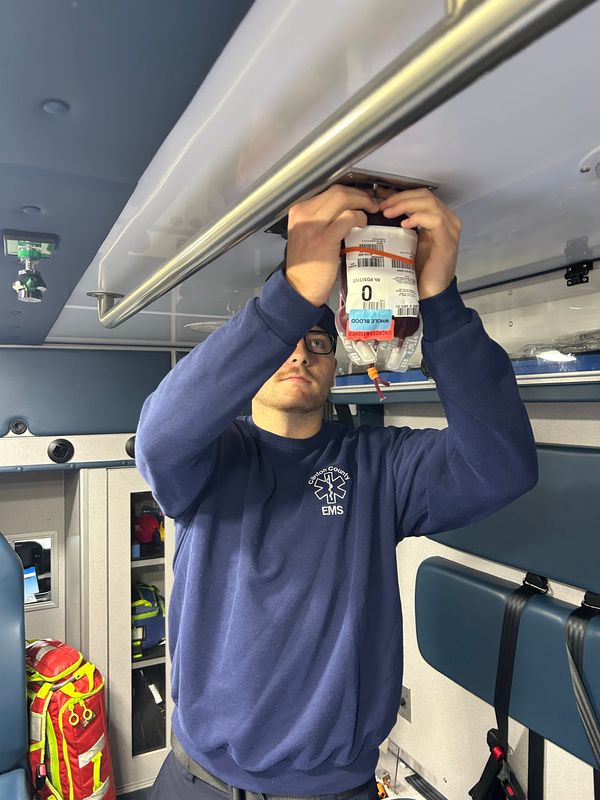
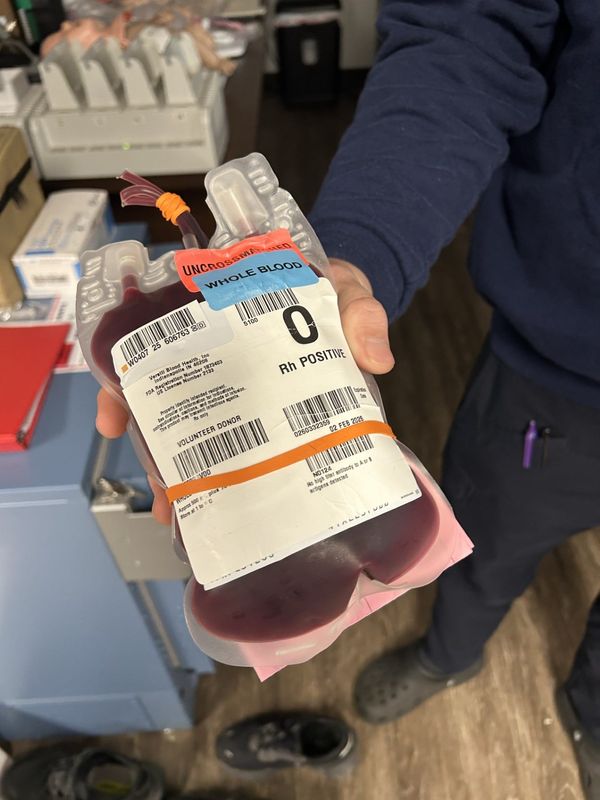
With a recent partnership with Eskenazi Health, the Clinton County Emergency Medical Services began carrying whole blood on its ambulances earlier this month, one of only 12 services in Indiana to take this leap.

“The research has become increasingly more strong, showing that for every one-minute delay in administration of whole blood, there is a 2% increase in mortality,” said Clinton County EMS Director Steven Deckard, who has attempted to make this shift happen for the past three years.
The introduction of whole blood or blood components will improve Clinton County’s reaction times for patients with traumatic blood loss or serious medical emergencies.
The bag of whole blood that now hangs inside the rigs contains all components of the blood already in the patient’s body, including red blood cells, plasma and platelets. Compared to previous methods of using saline as a standard fluid replacement, this quickens patients’ improvement.
“Our goal is just to make sure we can deliver the best practice of medicine to patients in a timely fashion, and this aligned with that vision,” said Deckard, who realized whole blood components will save more patients and, with accessible new units of whole blood outside ambulance bays, will not slow down response times.
Eskenazi Health serves as the blood supplier and oversees the regulatory requirements for the program, ensuring proper storage, tracking and stewardship, officials said in a news release. Whole blood has a limited shelf life — typically 21 to 35 days — so units are rotated every seven to 10 days to ensure safety.
Although Clinton County has made the switch, the Tippecanoe County ambulance service still uses saline and tourniquets in its seven rigs. But officials say they are also considering the change.
“That is something that our medical director, Dr. (Nathan) Marcinkowski, is looking at because, as the community grows and changes, we see an increase of severe injuries in the prehospital setting,” said the director of Tippecanoe Emergency Ambulance Services, Darrell Clase.
TEAS recently added new portable ventilators and Zoll AEDs, which are cardiac monitors. With these changes, Clase said he is happy with where the service is now.
“We want to make sure that we are at the forefront and able to bridge the gap between prehospital care … and getting patients to the hospital with the best care that they can receive in the prehospital setting,” Clase said.
This article originally appeared on Lafayette Journal & Courier: Clinton Co. EMS ambulances now carry whole blood in the field
Reporting by Ava Westendorf, Lafayette Journal & Courier / Lafayette Journal & Courier
USA TODAY Network via Reuters Connect