(This story was updated with new information.)
DELAND − Attorneys defending two clients convicted of the same crimes − participating in the 2004 murders of six people and a dachshund with knives and baseball bats in Deltona − are taking different approaches to convince a judge not to resentence them to death.

Troy Victorino, 48, and Jerone Hunter, 39, have spent nearly 21 years behind bars. They were both convicted in 2006 and sentenced to death for their roles in the Deltona Xbox slayings, but a 2016 Florida Supreme Court ruling led to the resentencing phase.
Also known as the Deltona Massacre, it was the deadliest mass murder in Volusia County history, according to the State Attorney’s Office.
Earlier this year, a jury heard life or death arguments from defense attorneys and the State Attorney’s Office, and voted once again to recommend capital punishment for both Victorino and Hunter. However, the decision ultimately rests with Volusia Circuit Judge Dawn Nichols.
Beth Sammons, defense attorney for Victorino, and Garry Wood, who represents Hunter, both presented more evidence in an effort to mitigate the crime.
While Sammons read letters from both Victorino and his brother attempting to show how much he has matured over his two decades in prison, Hunter’s case took center stage during the July 25 hearing.
Wood argued Hunter was just 18 years old at the time of the killings, had been dominated by the older and much larger ex-con Victorino, and that racial bias played a role in why Hunter − a Black man − initially got the death penalty while two non-Black codefendants received life in prison.
The lawyers are required to submit sentencing memos to the judge by Aug. 25.
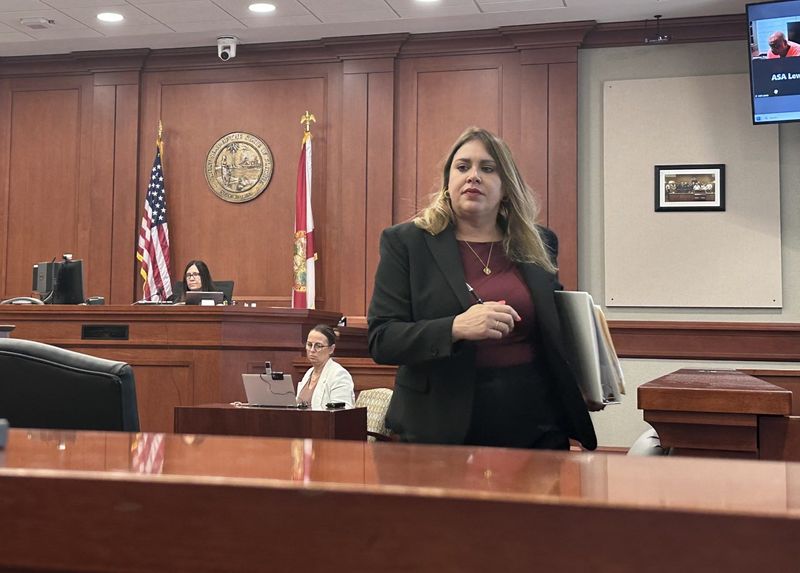
Nichols asked the attorneys, including Assistant State Attorney Heatha Trigones, when they hoped to hold the final sentencing date. The consensus was sometime in September.
Who were victims on Telford Lane in Deltona?
Victorino, Hunter, Michael Salas and Robert Cannon broke into a home on Telford Lane sometime around 1 a.m. on Aug. 6, 2004, and slaughtered Erin Belanger, 22; Michelle Nathan, 19; Roberto “Tito” Gonzalez, 28; Jonathan Gleason, 17; Francisco “Flaco” Ayo-Roman, 30; and Anthony Vega, 34. Most of the six were coworkers at a Burger King about 2 miles away.
What was the motive in the Xbox murders?
Victorino had been squatting in a home owned by Belanger’s grandmother, and when she called the sheriff’s office to evict Victorino, he was told he could not return to collect his things, including an Xbox game console. Hunter − then 18 and living with Victorino at the time − testified that Victorino wanted revenge and planned the attack.
Why was Deltona Massacre case back in court?
In 2006, Victorino and Hunter were convicted and received death penalties, while codefendants Salas and Cannon received life sentences.
The Florida Supreme Court determined in 2016 that the state’s capital punishment law − allowing people to be put to death even when a jury did not unanimously recommend it − was unconstitutional. Volusia Circuit Judge Randell Rowe III then overturned the sentences of Victorino and Hunter.
The Legislature changed the law in 2023, lowering the requirement for a death recommendation from a unanimous vote to a minimum of eight jurors. But Victorino and Hunter still needed to be resentenced.
In May, jurors recommended death for both Victorino and Hunter.
However, the process didn’t end there.
On July 25, the judge presided in a continuation of what’s known as a Spencer hearing, as sanctioned by the Florida Supreme Court, where defendants can present additional evidence. Earlier, Victorino’s mother, Sharon, and several other witnesses testified on his behalf.
While attorneys for both Victorino and Hunter offered additional evidence during the hearing, Victorino was not present. He appeared via Zoom from Union Correctional Institution in Raiford.
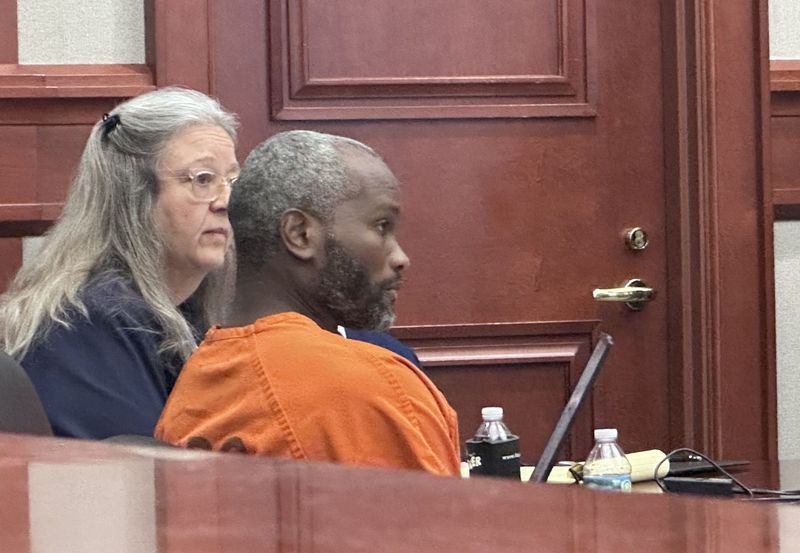
Hunter, though, was seated at a defense table wearing an orange jumpsuit.
His attorney, Wood, argued that Hunter was nearly 10 years younger than Victorino, just 18 years old and 66 days. Hunter was also far smaller than Victorino.
While Hunter’s attorneys haven’t made their closing arguments as to why he shouldn’t be put to death, they suggested part of their case will be that he suffered trauma as a child growing up in a home where his twin brother died at a young age and his father regularly abused his mother.
Aunt witnessed routine domestic violence in Hunter’s boyhood home
Hunter’s aunt, Mary Boncek of Valdosta, Georgia, testified that she lived with the family in South Florida for a time and witnessed the beatings of Hunter’s mother, which resulted in black eyes, bruises on her arms and legs, and even a broken leg. Some of the beatings occurred in front of Hunter, she testified.
“She never pressed charges,” Boncek said. “She always denied.”
Boncek testified that in that environment, as a 2- or 3-year-old, Hunter was having bad dreams and nightmares.
When his brother died, Hunter’s personality changed.
“He was a happy baby. Things changed. Always shaking his head.”
It looked like Hunter was talking to somebody, she testified.
Doctor: Hunter doesn’t understand consequences
Wood had a Tampa-based neuropsychologist, Dr. John Dsurney, examine Hunter and testify as an expert witness.
Dsurney said he gave Hunter a battery of tests over two days and many of the results were normal, but he demonstrated one “significant” weakness.
“It really is more in the abstract, an ability to understand abstract concepts and to see the larger picture and be able to understand how the individual’s actions may influence other occurrences down the road,” Dsurney said. “Not just the long-term consequences … but also to be able to understand how things might transpire.”
He used an example of frying a turkey, which poses dangers if the equipment isn’t used properly.
“It’s not just a matter of doing it properly, but it’s being able to anticipate the things that could go wrong,” Dsurney said.
Hunter apologizes: ‘I made the most horrible choice’
Hunter himself read a letter expressing remorse.
“In the last two decades, words can’t give meaning to how sorry I am for my role in the unnecessary killings,” he said. “I don’t know how it got to that point.”
He described his 18-year-old self as “young, weak-minded.”
“I made the most horrible choice,” he said.
In prison, Hunter said he has worked on spiritual growth and meditation, aiming to become a better person.
“Not everything that was presented is true,” he said, “but no matter the details, six people lost their lives and other lives were destroyed,” Hunter said. “There’s no going back from that.”
This article originally appeared on The Daytona Beach News-Journal: Will Troy Victorino and Jerone Hunter, convicted of Deltona Xbox murders, get death?
Reporting by Mark Harper, Daytona Beach News-Journal / The Daytona Beach News-Journal
USA TODAY Network via Reuters Connect