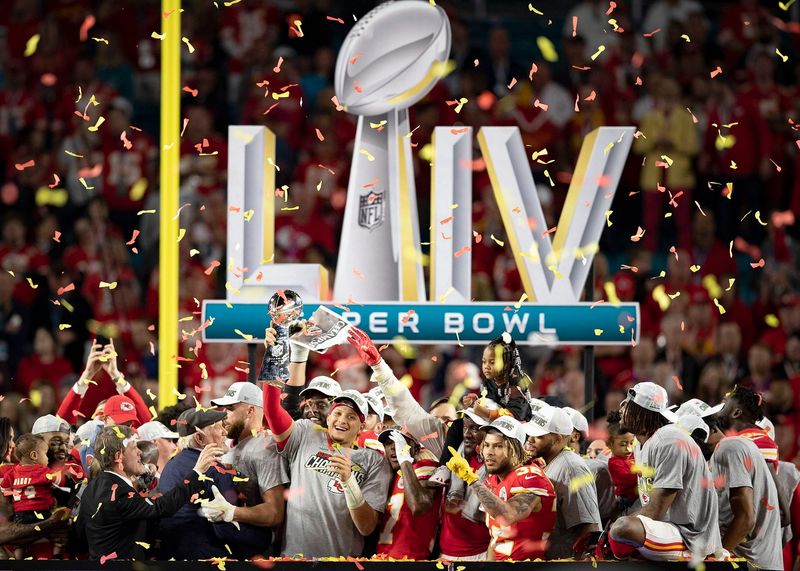
Before we get too far into the weeds of this Super Bowl rotation brouhaha, we should focus on one line Stephen Ross said when he casually dropped the news that we shouldn’t get our hopes up of seeing another Roman-numeraled game in Miami anytime soon.
“It’s in their best interest to have one here,” Ross said.

For decades, this was not open for discussion. If you were going to stage a celebrity death match of Super Bowl cities, it would be Miami in one corner and New Orleans in the other.
South Beach vs. the French Quarter.
Cuban coffee at Versailles vs. beignets at Cafe du Monde.
Best of all, you didn’t have to choose one. You could have both, since those cities were in the unwritten rotation of landing a Super Bowl every handful of years, possibly because they always deliver.
Then came the era of the NFL using stadiums as a bargaining chip to select Super sites. If you build it, we will come. Miami didn’t have to build a stadium from scratch to land the 2020 game and thus end an unprecedented 10-year gap between hosting, but the canopy over Hard Rock Stadium stands as a reminder of the heavy lifting required to get us back on the map. Ross, the Dolphins’ owner, shelled out half a billion dollars to upgrade the stadium.
NFL wants to lay out its Super ‘demands’
Now look. The NFL is doing NFL things. Namely, asking for more.
It’s not enough to have a stadium just so in early February. The NFL also wants to dictate what a stadium is up to well beyond that.
“At this point they don’t believe we meet all the requirements and the demands,” Ross said, according to The South Florida Business Journal.
Those demands include room for hospitality around Hard Rock Stadium — room that is limited because the site now hosts the Formula 1 Miami Grand Prix and the Miami Open tennis tournament.
Take away these events and you’d eliminate many of the barriers keeping us out of the Super Bowl rotation. Except those events aren’t going away. Nor should they. They’re annual events, sure things, providing economic impact in South Florida. They provide jobs. Scrapping them for a chance at landing a Super Bowl once a decade would be as logical as blowing a paycheck on lottery tickets.
And it’s not just a matter of space. It’s also time. Transforming Hard Rock Stadium from a Super Bowl venue to the Miami Open venue is more involved than you could imagine. Start with the considerable time to construct the main court inside the stadium. By one estimate, a concrete base requires nearly a month of curing before additional coatings can be applied and it begins to look like, you know, an actual tennis court.
This year’s Super Bowl was on Feb. 9.
The Miami Open began March 14.
Making the impossible possible?
That’s not to say adding an occasional Super Bowl back on the facility’s docket is impossible. The breakneck pace Hard Rock Stadium is enduring in 2026 precludes use of the term impossible: the college football title game in January, Miami Open in March, Miami Grand Prix in May and the FIFA World Cup starting in June.
“I like to say that they pull off the impossible every day,” said Katharina Nowak, president of the Grand Prix.
That might be the opening for a truce in this stalemate. The NFL wants to snap its fingers and wish for the impossible? Maybe the NFL has come to the right place.
The one thing that is impossible to imagine is the Super Bowl saying no mas to Miami for good. This is where Joe Namath became Joe Namath. It’s where the Pittsburgh Steelers beat the Dallas Cowboys 35-31 at a time when Super Bowls were snoozers. It’s where Peyton Manning got that monkey off his back and then where everybody outside of Indianapolis became a Saint for a day to cheer on New Orleans’ revival after Katrina. And it’s where Patrick Mahomes and the Kansas City Chiefs left the San Francisco 49ers wondering what just happened.
And that’s in addition to a week of sun and surf and all the beautiful people on South Beach.
Hey, we’ve got nothing against Los Angeles or Atlanta or Las Vegas, the next three Super hosts.
It’s just making sure the NFL doesn’t lose sight of which two cities built this event into what it is.
This article originally appeared on Palm Beach Post: Many reasons why the NFL can’t drop Miami from Super Bowl rotation
Reporting by Hal Habib, Palm Beach Post / Palm Beach Post
USA TODAY Network via Reuters Connect