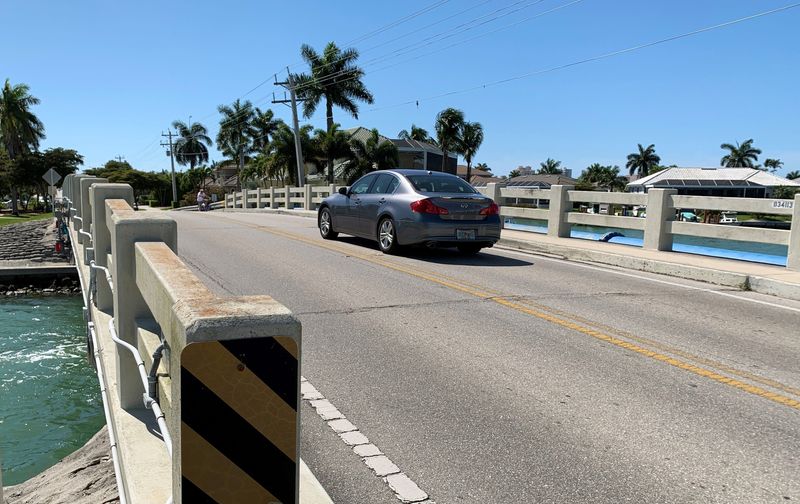
Marco Island residents will vote in August on whether to approve a $23 million bond obligation to pay for road and bridge repairs that were put off for years to keep property taxes low.
The Marco Island City Council decided on the 20-year bond amount at a regular meeting Monday, May 4. The city needs more money than the $23 million for the bridges that need to be replaced, road paving and mixed-use paths, but councilors said they didn’t think voters would go for $34 million, the other option they considered.

Vice Chairman Rene Champagne argued for the $34 million ask, but his motion for approval died for lack of a second.
“The real need over the next 20 years is about $100 million, so if you do $23 million, you’re doing five of those bonds to $100 million. If you do $34 million, you’re cutting it by a third,” Champagne said. “So, you’re avoiding higher construction costs for the next small one. Repeated borrowing, you’re going to incur repeated borrowing and insurance costs. The infrastructure continues to deteriorate while you’re focused on a small bond.”
Chairman Darrin Palumbo said the residents need to see alignment by the council and be conservative on spending.
“I don’t think the numbers are scary. I think the citizens are not going to hand it to us,” Palumbo said. “The 23 (million) has the highest chance of getting approved.”
What will Marco Island get if residents approve bonds?
The council unanimously approved a $23 million bond referendum.
What’s the need and what will $23 million pay for versus $34 million?
These are among the many needs for Marco Island after eight years of property tax rollbacks by previous councils.
In September 2025, the council – with its then chairman and now deceased councilor Erik Brechnitz absent – voted 4-2 to implement a slight tax rate increase for Fiscal Year 2026 and let voters decide on capital improvement spending. This year’s property tax, or millage, rate is 1.267 mill, up from 1.2400 this year. Councilors in July had considered a 34% increase to1.6680 mill.
In January, the council narrowed the focus of a bond referendum to transportation needs, leaving out water issues and parks and recreation improvements.
According to a city analysis, $34 million bond over 10 years would have paid for the following:
The $23 million, if approved by voters, will support the following projects over ten years:
How do general obligation bonds work?
General obligation bonds are debt instruments often used for financing long-term capital projects such as infrastructure, parks and public safety facilities.
The bonds are backed by what’s called the “full faith and credit” – specifically the ad valorem (property) taxing power – of the issuing local government, in this case Marco Island.
Basically, what that means it that repayment of those bonds is secured through mandatory, voter-approved property taxes. In Floida, these bonds require referendum approval. They offer high security to investors, generally leading to lower interest rates.
Council also approved an ordinance to upgrade the city’s water treatment plant
On water issues, residents took it upon themselves to force the city council to take action – either by allowing a referendum or passing an ordinance to update the Marco Island’s reclaimed water plant to Advanced Wastewater Treatment (AWT).
A citizen petition to force Marco Island to upgrade its wastewater treatment plant was certified by the Collier County supervisor of elections to go to voters Aug. 18. Councilors ended that Monday night by unanimously approving an ordinance agreeing to the AWT upgrade.
Councilors agreed AWT wouldn’t solve all of the city’s water woes – waterways on state impairment list and gunky canals – but it is an important next step.
How to pay for the upgrade hasn’t been determined.
This article originally appeared on Marco Eagle: $23M bond referendum: Marco voters will decide; option to pay for repairs
Reporting by J. Kyle Foster, USA TODAY NETWORK – Florida / Marco Eagle
USA TODAY Network via Reuters Connect