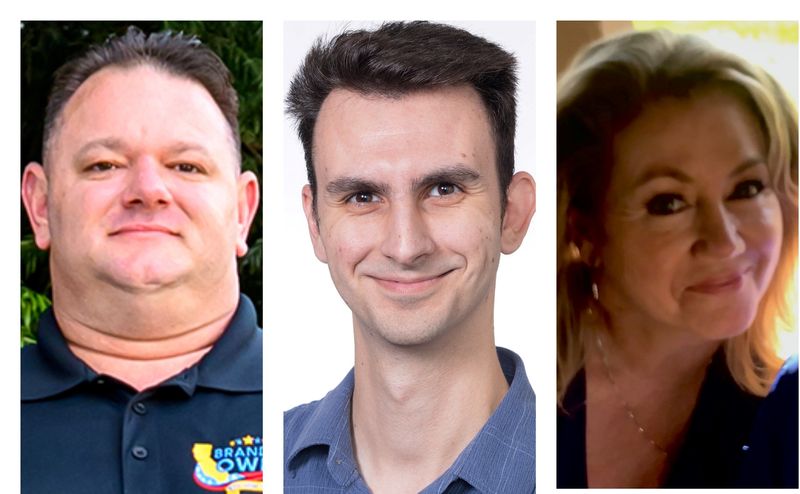
Three candidates for California State Assembly District 9 outlined their positions on water policy, crime, infrastructure and transportation, environmental issues and working across party lines during a forum at San Joaquin Delta College ahead of the June 2 primary election.
The forum, held on April 18, was organized by the San Joaquin County Civic Alliance, a coalition of community organizations dedicated to civic engagement and voter education across San Joaquin County.

The forum featured Republican Brandon Owen, Democrat Matthew Adams and Republican Tami Nobriga. Incumbent Republican Heath Flora and challengers Democrat Matthew Perez and Republican Jim Shoemaker did not attend.
The candidates presented contrasting visions for the district, which includes part of Sacramento and its southern suburbs. The district extends south through San Joaquin and Stanislaus counties and into parts of Amador and Calaveras counties.
Candidates outline priorities
Adams, a teacher and community organizer from Woodbridge, said he lived in the district his entire life and cares about it. He said housing affordability, education funding and healthcare access are central to his campaign, along with delivering for district residents.
“For too long, corporations have been at the center of our discussions and our political power in this district as our incumbent has been bought by corporations and has been refusing to actually listen and care and show up for the people that matter in this district, which is the actual people that vote,” Adams said.
He said California needs more affordable and multifamily housing development and proposed state-level reforms to incentivize construction and address homelessness, which he said has increased in the region.
Nobriga, who describes herself as a conservative Christian, said she was called to run for office to “save our children and our future and take California back.”
“I want to make sure that our children are safe and I want to make sure that we don’t have to worry about them in their schools as well,” Nobriga said. “The number one thing that I will do when I’m elected is make sure that child traffickers go to prison for life, no parole.”
She said her other top priority would be reversing California’s elder parole law, which allows violent criminals aged 50 and older to be considered for early release.
Owen identified himself as a Herald resident, husband of 21 years and father of three boys. He emphasized transparency and said if elected, he would launch a website allowing district residents to vote on issues he would address in the Assembly, with the results guiding his decisions.
“I want to be your voice,” Owen said. “I’m ready to fight for you and represent this district in a way that has never been done before.”
Water policy and drought management
Candidates offered differing approaches to drought and water allocation policy.
Nobriga said voters need to elect honest leaders who will prioritize refilling reservoirs rather than delaying action due to needed repairs or new construction.
“We have people that run our water regulations and our farming regulations that don’t know anything about it,” Nobriga said. “That’s the number one problem that we have in California. People are assigned that don’t know what they’re doing.”
Owen said the region’s water problems stem largely from an aquifer that is not being adequately replenished by rainfall, calling it “a major issue that we can address.”
He argued that excess winter water released from dams could instead be redirected to recharge the aquifer by pumping it into areas where it can seep into the Cosumnes River and more naturally refill the water table.
Owen also called for reevaluating policies that restrict recreational use of riverways. Those rules, he said, should be managed “in a way that would be more beneficial for water storage.”
Adams said California should increase investment in rainwater collection and wastewater reuse while also balancing agricultural demands.
“Eighty percent of all water that is used in California is used for agricultural purposes,” Adams said. “We shouldn’t be taking any water away from our agriculture. We need to be charging our water tables and increasing our water storage naturally.”
Criminal justice and Proposition 36
The candidates also debated California’s approach to criminal justice, including Proposition 36’s impact on policy.
The 2024 ballot measure increased penalties for some drug and theft crimes. It allows certain repeat offenses to be charged as felonies and, in some cases, requires treatment or prison.
Owen criticized current policies as too lenient, arguing that crimes such as petty theft have been minimized.
“When you look at a cellphone theft, we’re talking about identity theft,” Owen said. “We’re talking about theft of your family’s addresses and information. We’re talking about a lot of other things because that’s a computer device in the pocket.”
Owen said fines and jail time should be increased, and the state should take a harsher approach to penalties when determining what constitutes a petty crime and a misdemeanor.
Adams pushed back, saying that punitive policies alone do not address root causes of crime.
“If you treat people like criminals, they’re going to act like criminals,” Adams said. “We need to make sure that we nip these problems in the bud before they actually begin, invest more in education, invest more in mental health and invest more in drug rehabilitation.”
Adams also noted that once a crime is on one’s record, it becomes harder to get a job or rent a home. He reiterated that penalties should not be increased but that more help should be provided.
Nobriga said, first and foremost, Californians needed to “back the blue.” She said law enforcement should be better supported and that more officers were needed.
“A lot of them are leaving because we don’t back the blue,” Nobriga said. “Prop. 36 was a great bill and we voted for it in huge numbers. The problem is it’s not being funded even though we voted for it. That’s one of the problems we have in California. We vote something in and then it never happens because it’s never implemented.”
Nobriga also emphasized stricter enforcement and criticized policies such as no-bail reforms, arguing they reduce accountability for offenders.
Infrastructure and transportation
On transportation issues, including congestion on Highway 99 and Interstate 5, Owen said one problem on Highway 99 is construction practices and state regulations. He argued California’s policies on materials and chemicals used in roadwork contribute to inconsistent road quality between counties.
“If you just drive from Sacramento County, cross over to another county, you will realize that it’s in a different county because the roadways are done completely differently,” Owen said. “We need to address the construction of our roadways as a priority because our roads are falling apart due to our construction practices, not necessarily because of traffic.”
He also criticized freeway ramp projects, saying Caltrans is targeting certain “hook ramps” as dangerous and shifting costs to local governments. He said smaller cities cannot afford multimillion-dollar interchange projects.
“We do need to investigate the policy that Caltrans is imposing on local cities and local governments because those policies are restricting their ability to perform their duties in an adequate manner,” Owen said.
Adams said investment has been focused too heavily on highways rather than rural roads, particularly outside Stockton and Sacramento.
“The further you get away from Stockton, the further you get away from Sacramento, the worse the roads get,” Adams said.
Adams said more funding should go toward local road repairs and rural communities in areas such as Manteca and Waterford. He also argued that reducing congestion requires alternatives to driving.
“If we do more investing in our buses, or investing in any sort of rail system set up in our county, giving people a way to travel without cars, that’s something we should really invest in more as our budget continues to expand,” Adams said.
Nobriga said the core problem is mismanagement rather than lack of funding.
“If we get people that actually know what’s going on in these areas, then we omit the problem,” Nobriga said. “The city managers aren’t managing. They’re not doing their jobs. So there again, it’s misappropriation of funds, and it’s not having the right people doing what they need to do.”
Nobriga said that to improve roads and infrastructure, leaders need to invest in the people doing the work and ensure the right people are in those positions.
Invasive golden mussels and water systems
When asked about the spread of the invasive golden mussel, which threatens water, infrastructure, agriculture and ecosystems in the Delta and Central Valley, Nobriga said she was not fully familiar with the issue but acknowledged it is a growing problem.
Nobriga said California has regulations on water systems because of the Delta smelt, which she believes may be overly restrictive. She suggested a more practical approach focused on bringing in experts.
“I would certainly put people in there that know what they’re doing to stop it and eliminate it completely because it keeps growing and growing,” Nobriga said.
Owen said his experience working with the California Department of Fish and Wildlife gives him direct knowledge of invasive species enforcement, including quagga mussel inspections.
Owen said the spread is largely caused by contaminated vessels moving between waterways. He argued that California should strengthen inspection protocols at ports and incoming boats, and consider sanctions on countries whose vessels introduce the mussels into California’s waterways.
“The only way to prevent this and to stop this is by looking at the boats coming into our ports,” Owen said. “Those mussels are without a doubt coming from other countries. We have got to stop that.”
As a former middle school science teacher, Adams said he would draw on lessons about the food chain, ecosystem balance and biodiversity to understand the impact of invasive species.
Once something is lost, it is much harder to restore, Adams said, adding that aquatic ecosystems are deeply interconnected.
“The local problem right now is affecting the San Joaquin Delta, but it’s soon going to be a problem with all the waterways across California if we don’t nip this in the bud now,” Adams said. “This is yet again another area that we can point to Sacramento and say we need to focus more on our Valley, we need to focus more on our issues, because what is happening here will happen everywhere.”
Crossing party lines
On working across party lines, the candidates offered sharply different interpretations of what bipartisan cooperation looks like and where they would draw the line.
Adams pointed to protecting the Delta and opposing the Delta tunnels as an example of successful bipartisan cooperation. He said the District 9 representative needs to remain firm on the issue.
Adams acknowledged Republicans have heavily discussed changing voting laws, but said he would not support major changes.
“I’m not willing to budge on changing a lot of our voting laws,” Adams said. “Mail-in voting works. It’s been very successful in this state. I would not be looking to roll that back in any form or capacity. It’s great that we have a lot more people voting in our state. We need a lot more people to be voting in our state.”
Nobriga said elected officials often stick with their parties because they are following party direction, but she disagreed with that approach.
“I believe that we need to vote and we need to act in a way that’s better for everybody,” Nobriga said. “It doesn’t matter what party. If it’s the right thing to do, we need to vote for it. That’s all there is to it.”
Owen said he was not willing to act unethically, immorally or illegally.
“Any topic that comes up with ethics, immorality or illegality, I’m not looking across that line,” Owen said. “My relationship with the candidates up here has shown that a lot of us up here are willing to cross party lines.”
Owen said he had a “great conversation” with Adams a couple of days before the forum and noted that it was the first time they had spoken.
“My party, the Republican Party, needs to realize that I stand with the party, but I’m also a person of common sense,” Owen said. “If it makes common sense for the majority, then I believe that’s the way we should go.”
Closing statements
In closing statements, Owen said Californians have “forgotten the majority while defending the minority.” He encouraged voters to reflect on the statement and said he wants to be their voice.
“I’m allowing you to be the person to stand in front of me and tell me how I should vote,” Owen said. “The Capitol is full of people who don’t believe in that. They don’t believe in transparency. They don’t believe in being honest. They want to get bought by people. As much money as I’d love to have, I don’t believe in being bought.”
Nobriga reiterated that children should be the primary focus of lawmakers and said human trafficking was a top concern for her. She also said she would act independently if elected.
“I will not take any money from special interests or Big Pharma, and I’ve signed an agreement to that effect,” Nobriga said. “I am here on a grassroots campaign.”
Adams also said he is not taking any money from big corporate interests or from people outside District 9 who do not share the district’s priorities.
“If you want to have fully funded schools, come on board,” Adams said. “If you want to have affordable housing, come on board. If you want to have affordable healthcare, come on board. That’s what this campaign is all about.”
Record reporter Hannah Workman covers news in Stockton and San Joaquin County. She can be reached at hworkman@recordnet.com or on Twitter @byhannahworkman. Support local news, subscribe to The Stockton Record at https://www.recordnet.com/subscribenow.
This article originally appeared on The Record: Where Assembly District 9 race candidates land on water, crime
Reporting by Hannah Workman, The Stockton Record / The Record
USA TODAY Network via Reuters Connect