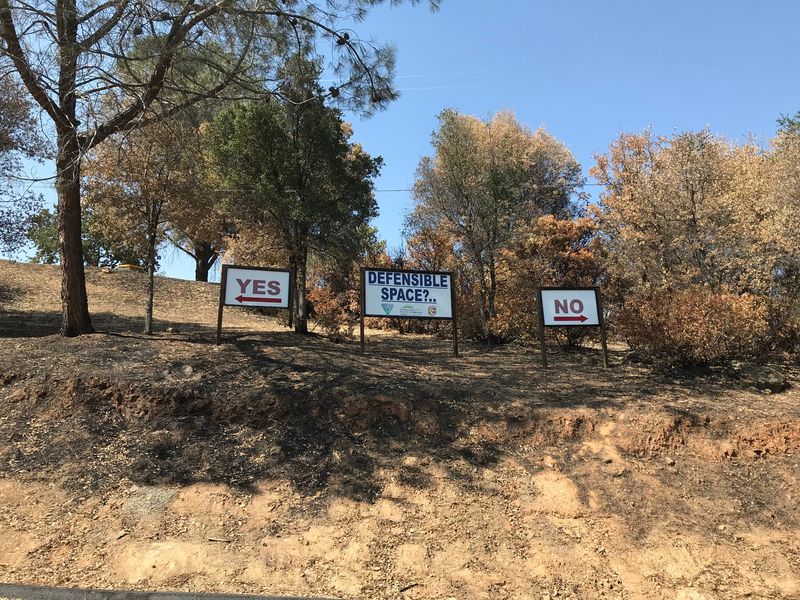
Living in a wildfire prone area like Shasta County, the danger of losing one’s homeowners insurance is ever-present. But if you live in an unincorporated area of the county, complying with the updated defensible space ordinance will reduce the risk of being dropped by your provider.
That’s the thought from some in the insurance industry, including from Janet Ruiz, director of strategic communication at the Insurance Information Institute, and Mike Littau, a local insurance agent at Goosehead Insurance who also is on the Redding City Council and this year is the vice mayor.

The updated ordinance places stricter requirements for clearing flammable vegetation in unincorporated areas of Shasta County. Residents in Redding as well as those in the cities of Anderson and Shasta Lake are not affected. It requires parcels under two acres to be fully cleared, and parcels between two and 10 acres to maintain a 30 foot perimeter clearance. Split parcels or multiple parcels under the same ownership will be treated as one.
According to the Shasta County Fire Department, the ordinance is not set in stone just yet. The ordinance is currently up for public comment and could be altered before its finalization later this year.
Ruiz says those who follow the ordinance will be less likely to lose their home insurance.
“As people clear their land and harden their homes, and communities put together programs to clear land and harden communities, that’s what we’ll need to have in the future moving forward to really be able to insure whole communities and individual homes,” Ruiz said in an interview with Record Searchlight.
Littau also says insurance companies will look more favorably upon those who comply with theordinance.
“You know clearing out a house, cutting down trees, getting rid of vegetation is definitely gonna help someone keep a policy as the insurance companies, you know, they look at these aerial maps and make decisions if they’re gonna keep a customer or non-renew them,” Littau said in an interview with the Record Searchlight.
Littau notes, however, that many of the factors insurers take into account when deciding to renew a policy are out of the policyholder’s control.
These factors include ease of road access, access to water resources like fire hydrants, brush within a one-mile radius, and the slope of a property. Littau says insurers also use proprietary maps that use data such as “prior burn areas” to assess wildfire risk.
As the updated defensible space ordinance currently stands, there will be a few requirements to meet compliance.
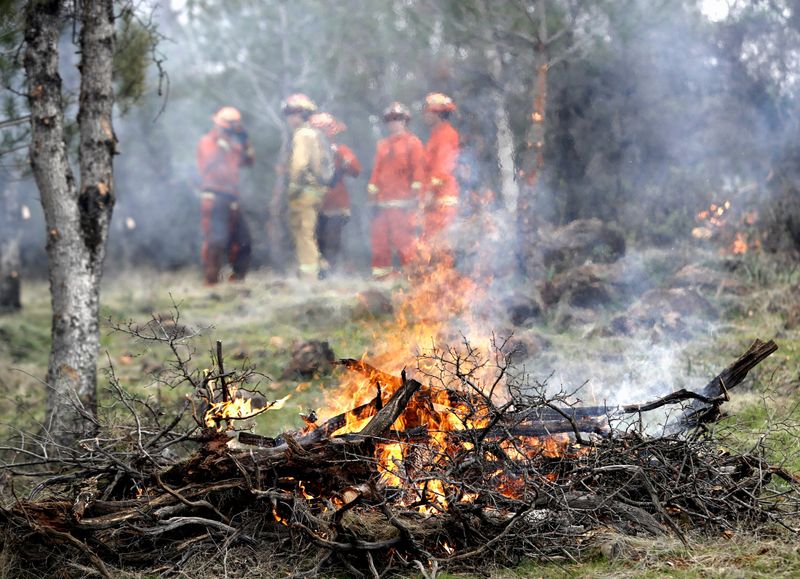
Tree stumps must be cut no higher than eight inches above the ground, and weeds and grasses must be cut no higher than four inches above the ground. If you’re chipping vegetation on-site, chipped materials dispersed on the ground may not exceed six inches in depth. While exceptions to these rules may be made in special cases, they will need to be approved by the fire warden.
The ordinance states that certain vegetation — including “single specimen trees, fire-resistant ornamental shrubbery, fire-resistant planting materials, or cultivated ground covers” — can be replanted in place of the removed vegetation.
For those who are disabled or for other reasons unable to comply with the ordinance, the fire department is working on a program to assist with compliance.
“We are going to be working with an agency on coming up with a standard on how that’s going to look for those individuals. The programs are already out there throughout different counties, I just want to make sure that it’s correct for Shasta County,” said Fire Chief Sean O’Hara at a Board of Supervisors meeting in August.
O’Hara says the goal is to fully implement the ordinance by spring 2026, in preparation for next summer.
At that same meeting, Battalion Chief Matt Alexander, of the Cal Fire Shasta-Trinity Unit and Shasta County Fire Department, outlined his plans for enforcement of the ordinance.
The fire department plans to hire two to four defensible space inspectors over the course of the next two years to hand out educational materials to land owners and inspect the approximately 6,000 parcels of land in the unincorporated areas of the county.
The county plans to enforce the ordinance with fines, starting at $100 for the first violation, $200 for the second violation within a one year period, and $500 for each additional violation within a one year period. Fines collected will go into a committed fund to be used for abatement.
Take action
For more information, see the full ordinance here.
For more comprehensive protection from wildfires, Janet Ruiz — director of strategic communication at the Insurance Information Institute — recommends making your home a “Wildfire Prepared Home.”
The Wildfire Prepared program run by the Insurance Institute for Business and Home Safety offers “Base Level” and “Plus Level” certificates to homes that comply with their risk mitigation requirements. Ruiz says the program is “really well respected by the insurance industry.” More information can be found at wildfireprepared.org.
Drew Askeland is a freelance reporter based in Redding. He graduated from the University of California, Irvine where he worked as an assistant editor for the school’s newspaper.
This article originally appeared on Redding Record Searchlight: Short lawns, tree stumps: What Shasta County rules to protect homes mean for insurance
Reporting by Drew Askeland / Redding Record Searchlight
USA TODAY Network via Reuters Connect