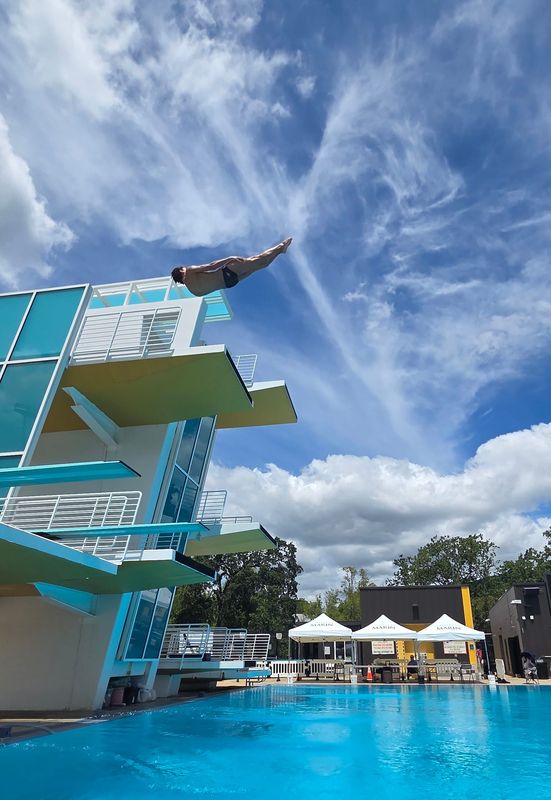
Ask most people watching Olympic diving what they’re looking for, and they’ll probably give the same answer: no splash — the less water that flies upward, the better.
St. Mary’s junior Lucius Haddad has turned that into an art form. Coach Robert Wimberly calls him a “master” at it.

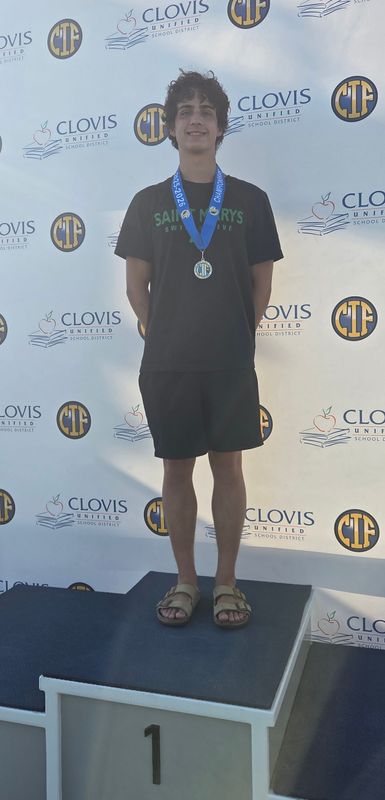
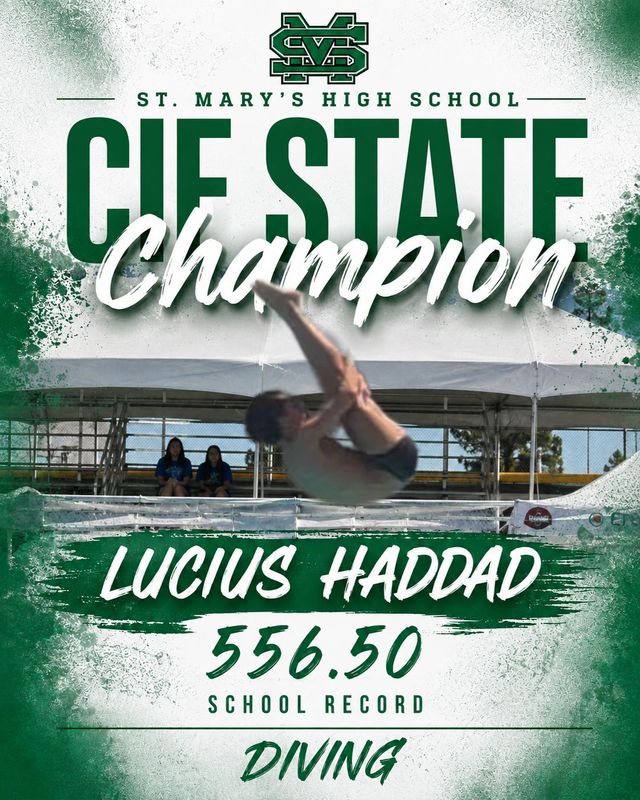
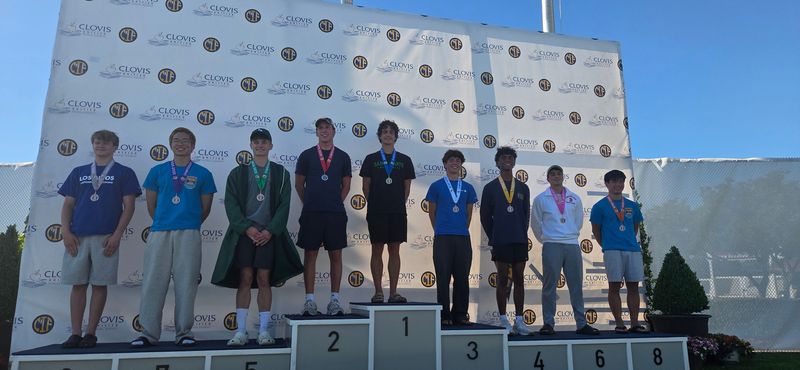
It’s helped Haddad win three straight Sac-Joaquin Section titles and earn St. Mary’s first individual state championship at the CIF State Swimming and Diving Championships on May 16 at the Clovis Olympic Swim Complex.
“Going into his 10th and second-to-last dive down nine, he very easily could’ve crumbled in that situation,” Wimberly said. “Every dive coach has seen it before when you’re doing your hardest dive. Instead, he pulls out the best dive of his career at the right time and in the right place.”
What people don’t see, though, is everything it took to make it look that easy.
“It sounds cliché, but I can’t even put his success into words,” Wimberly said. “He’s been doing this since he was 9 years old and training five days a week since he was 11. Even while struggling to learn harder dives, he’s never once complained about practice or not wanted to be there. To me, that’s his superpower. Almost 10 years in a sport without burnout is unheard of, especially when things aren’t going well.
“The state title is wonderful. Nationals are wonderful. But his journey is even more impressive.”
‘Always been flippy’
The reason Haddad grew to love diving was actually pretty simple.
He grew up “flippy.”
Tumbling, trampoline flips, acrobatics — anything involving flipping, Haddad loved. He just needed somewhere to channel it.
At 9 years old, his mom signed him up for a diving camp at Tokay in Lodi.
He fell in love almost instantly.
“I’ve always been flippy,” Haddad said. “Mix that with the adrenaline rush of seeing how many flips and twists I can do and how well I can do them. I just loved being able to push myself physically.”
Wimberly added jokingly, “We’re doing that same camp again this year at St. Mary’s. If you want to be the next Lucius, come join us.”
The camp was run by Delta Valley Diving, and soon after, Haddad joined the club where Wimberly coached.
Back then, the club was small, so everyone practiced together.
Wimberly still remembers standing beside future University of Arizona diver and 2021 Jim Elliot Christian graduate Collin Brownell, watching Haddad in awe.
“There would be times where both Lucius and Collin were practicing at the same time,” Wimberly said. “Collin and I would just look at each other like, ‘Yep, this boy is going to be good.’ He already had so many of the qualities needed for diving. He was strong, flipped fast and had what we call a rip entry — the kind you see in the Olympics where there’s barely any splash.”
‘Put in the work’
During the 2020 Tokyo Olympics, Simone Biles stepped away from team competition after getting lost in the air on her opening vault.
She later attributed it to the “twisties.”
Often compared to the “yips” in golf or baseball, the phenomenon causes athletes to lose spatial awareness mid-air, creating a frightening disconnect between the brain and body.
And diving isn’t immune to it.
“You feel like you don’t know where you are in the air,” Wimberly said. “Then you get scared to try new dives and harder dives because you think you’re going to smack every time you do one.”
While it wasn’t exactly the twisties, Haddad found himself nearing that point entering eighth grade.
“I’m kind of a late bloomer, so this was around the time I was really growing,” Haddad said. “One day, all of a sudden, I started underestimating myself. Robert would be like, ‘You’re not 9 years old anymore. You don’t have to baby these flips. You can do them easily.’ But I just couldn’t do it. I was underestimating myself.”
Wimberly added, “He had a lot of difficulty doing some of the dives he needed to be competitive. Mentally, he just wouldn’t allow himself to do the bigger and more difficult dives. We’d go to these meets and he was very clean and had that rip entry, but his degree of difficulty just wasn’t where it needed to be against some of his opponents.”
By the time freshman year arrived, Haddad knew he needed to make a change if he wanted to reach the level he envisioned for himself.
That process started with a sports psychologist.
“It’s beneficial because I get to talk to someone about what I’m dealing with,” Haddad said. “They lay everything out for me and say, ‘OK, you’re thinking like this, but it’s unreasonable. You’re being negative for no reason.’ They help explain why I feel certain ways.”
Eventually, the mental side started catching up to the physical gifts.
Haddad won Sac-Joaquin Section titles as a freshman, sophomore and junior.
“He’s put a lot of work into that over the years,” Wimberly said. “He’s always been a great competitor, which is something some divers struggle with. That’s never really been a problem for him, and it’s why he’s been able to do what he’s done.”
Haddad added, “At the end of the day, the change had to come from within me. Don’t get me wrong, I give huge props to the sports psychologist, but it was still up to me to put in the work. And I did.”
‘The grass is always greener on the other side’
All eyes were on Haddad.
In diving, they usually are. There’s nowhere else to look besides the lone one-meter springboard.
At the high school level, divers perform 11 dives across five categories — front, back, reverse, inward and twisting — with two dives required from each category and one extra dive allowed from any group.
Haddad chose inward.
That meant his 10th dive, his final inward, carried enormous weight.
It was the best dive in his arsenal, and he needed it.
Entering the moment, Haddad trailed Palisades Charter’s Jasper Nemeth by nine points after the two spent the entire CIF State Swimming and Diving Championships trading the lead.
“I knew this was the dive I needed to hit if I wanted a chance to win,” Haddad said. “So I just focused and remembered all the training I’d put in. I kept telling myself, ‘You’ve done this hundreds of times before.’ I just had to trust my training and come out at the right time.”
Standing at the edge of the springboard, Haddad bounced lightly on his toes before launching himself upward.
The second he hit the water, he knew.
“My mom has a video of it,” Haddad said. “You can see me swimming back to the stairs, just staring at the scoreboard. It’s such a tense moment because not all the judges have put their scores in yet, so you’re just waiting to see what you got. The second the scores went up on the board, I just had this rush of euphoria and adrenaline all go through me. I had to get myself to stop shaking before my next dive.”
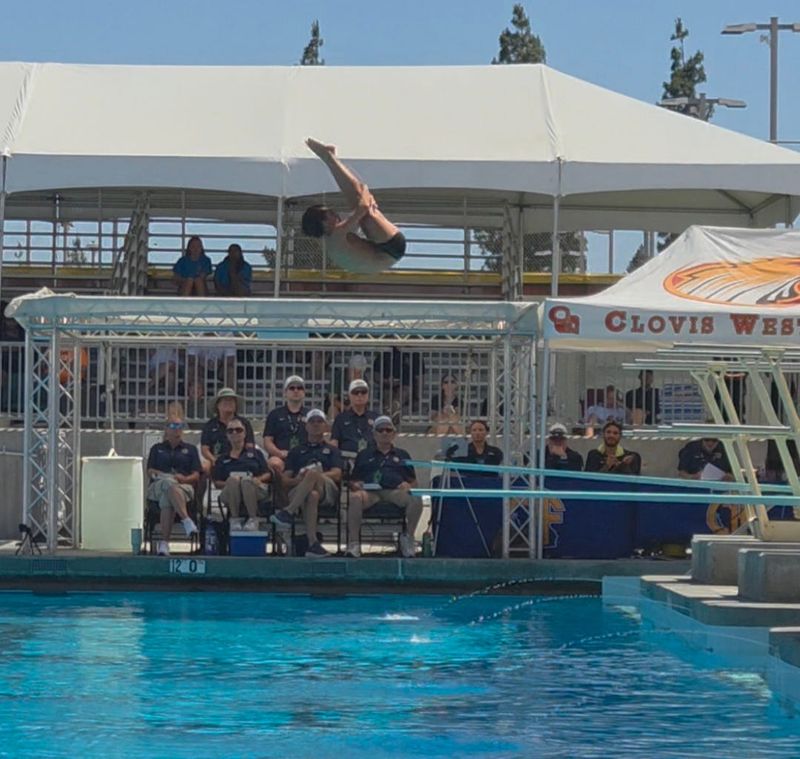
He had just executed an inward two-and-a-half tuck — a highly technical, high-degree-of-difficulty dive.
Starting with his back facing the pool, Haddad had to rotate two-and-a-half times toward the board while tucked tightly into a ball before slicing into the water with almost no splash.
“Each dive is assigned a difficulty multiplier,” Wimberly said. “That dive, the multiplier was a 3.1, which was the highest of the meet. He did the dive for, I believe, eights and eight-and-a-halfs, which ended up being a 72-point dive. That was the highest-scoring dive of the meet.
“That dive right there was the reason why he ended up winning the competition.”
That 10th dive, however, had every reason to rattle Haddad. He knew exactly what was at stake and easily could’ve let the mental battles from earlier resurface.
Instead, he leaned into it — something he hopes others can learn from.
“Although you’re going through a rough patch, the grass is always greener on the other side,” Haddad said. “If you’re really this low in your career, the only way you can go is up.”
Now, Haddad hopes the next step in that climb comes at the USA Diving Zone F National Qualifier Championships in Novato from May 29-31.
Divers from across Region 10 — including Alaska, California, Idaho, Nevada, Oregon, Washington and Utah — will compete there.
Only three divers will advance directly to the USA Diving Championships in Morgantown, West Virginia, scheduled for Aug. 5-11.
If Haddad falls short there, he’ll still have another path available through the West Championships in Midland, Texas, from June 25-28.
“The rules for USA Diving changed this year,” Wimberly said. “It used to be the top 10 athletes moved on to nationals, and now we’re down to the top three, so it makes it a lot more difficult.
“Don’t get me wrong, though. He absolutely has a chance to be in the top three at this meet.”
This article originally appeared on The Record: Inside St. Mary’s divers’ journey from self-doubt to CIF state champion
Reporting by Dylan Ackermann, The Stockton Record / The Record
USA TODAY Network via Reuters Connect