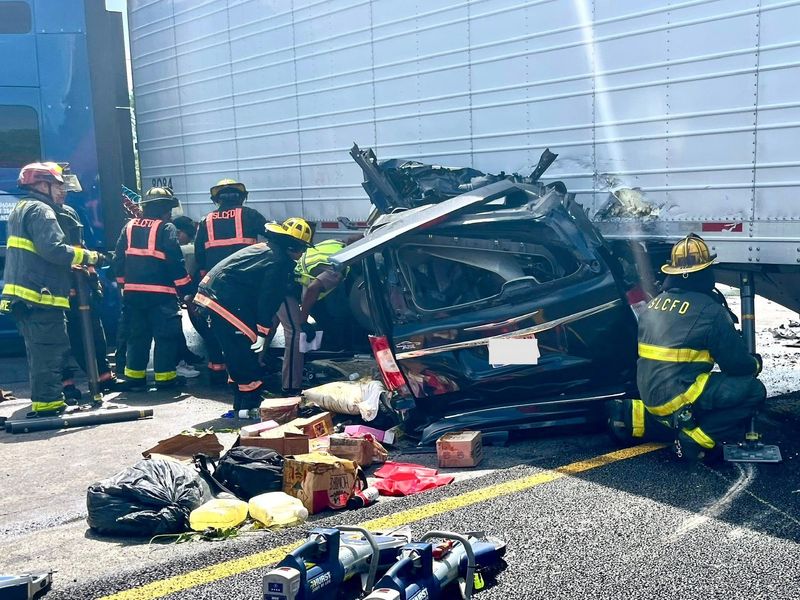
The U.S. Supreme Court on May 26 declined to hear Florida’s lawsuit seeking to hold California and Washington responsible for a deadly 2023 crash involving a Stockton truck driver — a case that had escalated into a national fight over immigration, commercial licensing and state authority.
Florida officials argued that West Coast licensing policies allowed unqualified drivers, including undocumented immigrants, to obtain commercial licenses and operate across state lines. The lawsuit centered on Harjinder Singh, a Stockton trucker.

Singh returned to Stockton after the Aug. 12 crash, in which he is accused of making an illegal U-turn on Aug. 12 on Florida’s Turnpike in St. Lucie County while driving a commercial semi-truck and trailer. The U-turn resulted in a collision between the semi-truck and a minivan. A 37-year-old Pompano Beach woman, a 30-year-old Florida City man and a 54-year-old Miami man were killed in the collision.
By rejecting the case without a full hearing, the justices effectively halted Florida’s attempt to challenge how other states license commercial drivers, though Justices Clarence Thomas and Samuel Alito said they would have allowed the lawsuit to proceed. Singh returned to Stockton after the crash and continues to face scrutiny as the political and legal debate over immigrant truck drivers intensifies.
The decision keeps the dispute out of the nation’s highest court even as the underlying criminal case continues to play out in Florida.
How a deadly Florida crash led to Supreme Court case
At the center of the legal fight is Harjinder Singh, a Stockton-based truck driver originally from India who is accused of causing a deadly crash on Florida’s Turnpike in August 2025.
According to the Florida Highway Patrol, Singh was driving a semi-trailer near Fort Pierce when he allegedly attempted an illegal U-turn in an “official use only” area, crossing multiple lanes of traffic. A Chrysler minivan traveling in the inside lane collided with the trailer and became lodged underneath it.
Three people in the minivan — a 30-year-old man from Florida City, a 37-year-old woman from Pompano Beach and a 54-year-old man from Miami — died as a result of the crash. Two were pronounced dead at the scene, and a third died later at a hospital.
Singh pleaded not guilty to three counts of vehicular homicide and has not yet been tried.
The case quickly escalated beyond a criminal proceeding. Florida Attorney General James Uthmeier pointed to Singh’s licensing history — he had commercial driver’s licenses issued by Washington and later California — as evidence that other states’ policies were putting Floridians at risk.
Florida sought to sue both states directly at the Supreme Court, arguing their licensing practices enabled unsafe drivers to operate nationwide.
Why the Supreme Court rejected Florida lawsuit against California
California and Washington officials pushed back strongly, calling the lawsuit a “political stunt” and arguing that federal regulators — not the courts — oversee commercial licensing standards.
Washington Attorney General Nicholas Brown warned that allowing the lawsuit could open the floodgates for states to sue each other over a wide range of policy disagreements, from vaccination rules to gun laws.
The Supreme Court ultimately declined to take up the case, leaving those arguments unresolved but signaling reluctance to step into broad interstate policy disputes.
In a dissent, Thomas said Florida had no other path to bring its claims and that the court should have heard the case.
Why a Florida official came to Stockton in crash case
The case also drew national headlines for an unusual moment far from the courtroom.
Florida Lt. Gov. Jay Collins traveled to Stockton in August 2025 to oversee Singh’s transfer back to Florida custody, holding a press conference at Stockton Metropolitan Airport in the San Joaquin Valley.
During the stop, Collins sharply criticized California Gov. Gavin Newsom, accusing him of prioritizing politics over public safety.
“I am not some run-of-the-mill lieutenant governor,” Collins said, using the visit to amplify Florida’s broader criticism of California’s immigration policies.
The appearance added another political dimension to a case that was already drawing attention from state and federal leaders, including President Donald Trump, who has called for stricter rules on commercial driver licensing for people without legal status.
Ongoing questions about arrest and handling of crash case
The crash has also raised lingering questions about how the case was initially handled.
Singh was not arrested at the scene of the crash and was able to return to Stockton before later agreeing to extradition. Florida officials have not fully explained why he was not detained immediately, a point that has fueled criticism and confusion.
At the same time, federal agencies offered differing perspectives.
The Department of Homeland Security has blamed California policies for enabling the situation, while California officials say the state followed all federal requirements in issuing Singh’s license, including verifying his authorization to work in the United States at the time.
The California Department of Motor Vehicles has said Singh’s credentials were confirmed through federal systems, and state officials argue the case reflects broader federal immigration policy challenges rather than state-level failures.
How the ruling could affect California trucking and licensing
For California drivers and trucking companies, the Supreme Court’s decision means no immediate changes to how commercial licenses are issued.
But the case highlights several ongoing issues:
With the criminal case still pending in Florida, the legal and political fallout from the crash is far from over — even as the Supreme Court steps aside.
This article originally appeared on Palm Springs Desert Sun: High Court rejects Florida suit over Stockton trucker’s deadly crash
Reporting by Maureen Groppe, James Ward and Elizabeth Roberts, USA TODAY NETWORK / Palm Springs Desert Sun
USA TODAY Network via Reuters Connect