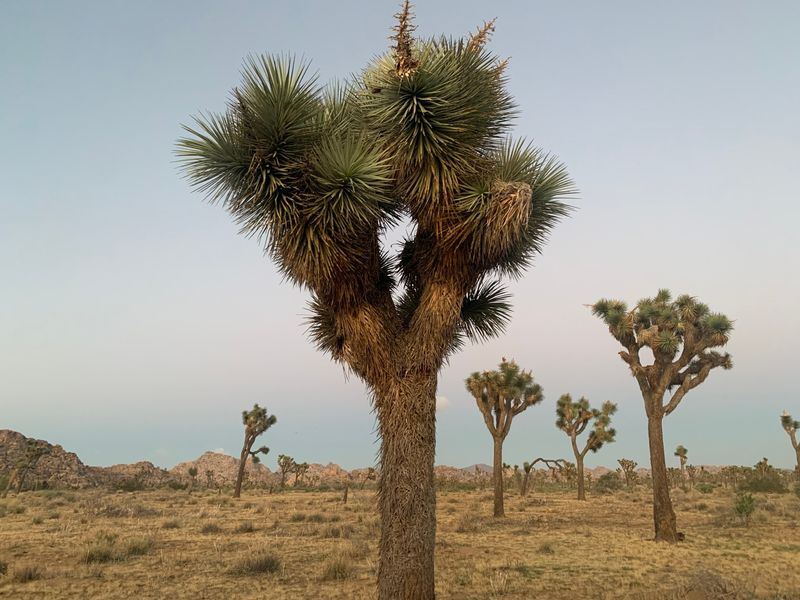
Joshua trees are defining features of the Mojave Desert. Once woven into baskets and sandals by the Cahuilla, Joshua trees thrive in the extremely arid conditions of the High Desert.
At 20,053 square miles, San Bernardino County is home to numerous dense Joshua tree stands.

In 2020, 119 Joshua trees were surveyed from one 360-acre site in Victorville alone. Adelanto, Hesperia, Victorville and Phelan have the spiked tree in their official city logos, and it’s not unusual to see friends’ and neighbors’ landscaped pomegranate or apricot trees growing alongside naturally growing Joshua trees.
The ever-changing protection of the Joshua tree can be hard to keep up with, especially for High Desert residents with the yucca-style tree on their property. While they technically aren’t endangered, strict restrictions are still enforced for Joshua tree handling, which will be addressed at an upcoming Hesperia workshop.
Joshua trees in the High Desert
The High Desert tree is well protected in the county’s 1.5 million-acre Mojave National Preserve, 800,000-acre Joshua Tree National Park, Mojave Trails National Monument, Sand to Snow National Monument, Castle Mountains National Monument and other areas.
Joshua trees are also nationally protected under the Western Joshua Tree Conservation Act (WJTCA), which was passed in July 2023. As a result, homeowners with dying or in-the-way Joshua trees cannot simply remove or relocate the plant without the necessary permits.
Assemblymember Juan Carrillo understands this confusion and, together with the city of Hesperia and the California Department of Fish and Wildlife, he has organized a Joshua tree workshop at 10:30 a.m. on Friday, June 20 at Hesperia City Hall.
The workshop will provide information on the regulations and protections in place for Joshua trees in the Mojave River Valley amid ever-changing legislation regarding their protected status.
Ever-changing protections for the Western Joshua tree
Reviews conducted by the U.S. Fish & Wildlife Service revealed that the iconic trees are not facing endangerment and therefore do not require additional protection under the Endangered Species Act.
A Los Angeles federal judge ruled this “unlawful,” “illegal,” and “sidesteps climate science” last month, the Desert Sun reported.
According to WildEarth Guardians, an environmental organization that sued U.S. Fish and Wildlife twice to secure federal protections for the Joshua tree, Joshua trees will become extinct by the end of the century without immediate and robust action.
What will the workshop cover?
The workshop will provide information on the regulations and protections in place for Joshua trees in the Mojave River Valley including:
“Let’s make sense of the rules,” the workshop flier states, “and protect your property rights while staying in compliance.”
McKenna is a reporter for the Daily Press. She can be reached at mmobley@gannett.com.
This article originally appeared on Victorville Daily Press: Does your land have Joshua trees? Learn new protections at Hesperia workshop
Reporting by McKenna Mobley, Victorville Daily Press / Victorville Daily Press
USA TODAY Network via Reuters Connect