Following an unusual outbreak of mushroom poisonings, the California Department of Public Health is loosening its safety recommendations. But can these dangerous mushrooms still be found in the Shasta Cascade region? And if so, how can you tell which wild mushrooms are safe, and which are toxic?
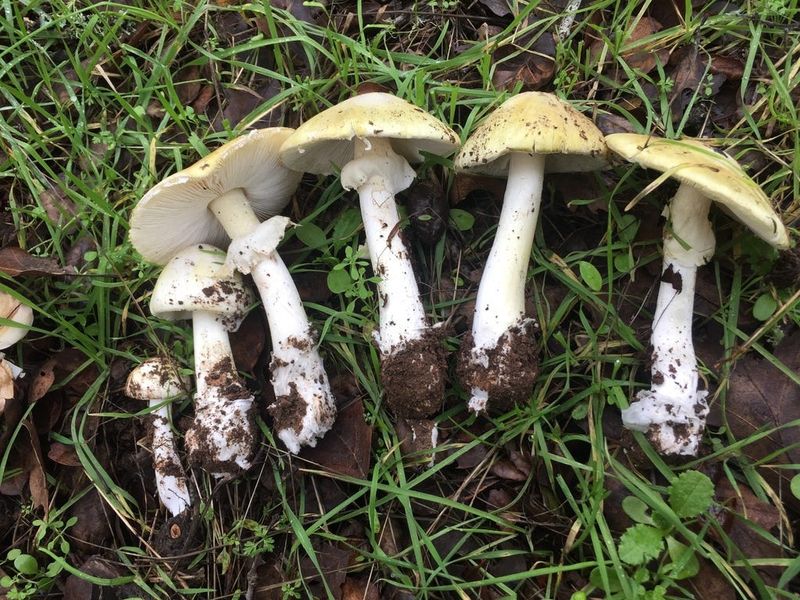
The department said the toxic “death cap” and “western destroying angel” mushrooms “have been found in Shasta County,” and while they are no longer “appearing in unusually large numbers,” they can still appear “in small, localized flushes beyond their strong growing season.”

The department is still urging the public, particularly foragers and pet owners, to remain cautious.
Between November 2025 and May 2026 there were 50 recorded California cases of poisonings caused by the consumption of the death cap and western destroying angel mushrooms, in four cases requiring individuals to get a liver transplant, and in four other cases causing death.
A statement by the department said that, while western destroying angels typically “bloom into the spring,” it was unusual for the death caps to continue flourishing throughout the first half of the year instead of declining as they typically do.
None of the poisonings occurred in Shasta County, and no additional related poisonings have occurred in the state since May 19.
To learn more about the death cap and western destroying angel, as well as the varieties of mushrooms in the area that are edible, the Record Searchlight spoke with experts on local fungi.
How to identify the death cap and western destroying angel
According to Mikhael Crystallah-Selk, an instructor of mushroom classes at Fork in the Path — a forest-to-table learning program that hosts classes across Northern California, stretching from Mount Shasta to Santa Cruz — and a leading mushroom identifier in California, the two mushrooms share some key identifying features:
Where the mushrooms differ is in their cap color and where they can be found.
Death caps have “yellow to greenish” caps, and often grow under or near the coastal live oak.
Western destroying angels have white caps, “sometimes with an ocher blush,” and grow under or near oaks of all kinds.
Also dangerous, Crystallah-Selk said, is the “fiber cap” family of mushrooms. He said these mushrooms are, small, usually never growing taller than three inches, and light-brown. When they are young, they have a veil over their gills, and as they mature, “fibrils” on their cap “become uplifted.”
He also said their scent is attractive to dogs and is a leading fungal cause of dog poisonings.
Edible summer mushrooms that can be found in the North State region
Crystallah-Selk said summer is peak season to find edible mushrooms in mountainous regions.
That’s because, during the summer, higher elevations retain the moisture necessary for mushroom growth, particularly in elevations between 4,000 and 5,500 feet.
Crystallah-Selk said the following edible mushrooms can commonly be found during this season:
Boletes, Crystallah-Selk said are mushrooms that don’t have gills, but rather are “spongy, porous, (and) spore-bearing” on the underside of their cap.
The butter bolete should not be confused with the bitter bolete, a non-toxic but bitter tasting lookalike.
He said the main differences between the two are that butter boletes have red caps, bright yellow reticulated stems, bright yellow pores, and bruise cerulean blue, while bitter boletes have khaki-brown, often cracked, caps, smooth stems that shift color from yellow at the top to red at the base, dull yellow pores, and bruise a darker, cobalt blue.
Crystallah-Selk said mushrooms can be found on the west and east sides of Mount Shasta, but are more commonly found on the east side because “afternoon sun doesn’t hit that side as much.”
To learn more about mushrooms in the Mount Shasta area and beyond, keep an eye out for mushroom foraging classes instructed by Crystallah-Selk and other mushrooms experts posted on Fork in the Path’s website.
How to forage for mushrooms safely
Carrie Staller, the founder of Fork in the Path and an instructor of mushroom programs, said it’s a good idea to get an instructor that can teach you how to accurately identify mushrooms.
“There were like 40 hospitalizations for mushroom poisonings this year in California, and sadly that was because people misidentified mushrooms and ended up consuming deadly toxic mushrooms. So it’s not something that you ever want to take a risk on, you want to be 100% sure before you try consuming foraged mushrooms,” said Staller.
Another resource recommended by Staller was iNaturalist, an app and online resource used by professionals to identify plants, animals and mushrooms.
Staller said prospective foragers should ensure they know the rules and regulations of the land they plan to forage on beforehand.
Foragers in the Shasta area, she said, will “need to get a free mushroom permit from the ranger’s office.”
Drew Askeland covers Redding and Shasta County government issues, as well as anything else that needs reporting for the Record Searchlight and USA Today Network. Reach him at drew.askeland@redding.com or (530) 225-8247. Please subscribe today to support our newsroom’s commitment to public service journalism.
This article originally appeared on Redding Record Searchlight: Deadly toxic mushrooms still lurk in Shasta County forests
Reporting by Drew Askeland, Redding Record Searchlight / Redding Record Searchlight
USA TODAY Network via Reuters Connect
By Drew Askeland, Redding Record Searchlight | USA TODAY Network