The 10-day historic Artemis II mission ends today, April 10.
The four astronauts onboard the Orion capsule are scheduled to splash down off the coast of California shortly after 8 p.m. EDT.

The mission sets the stage to build a moon base. First, though, would be a lunar landing planned for 2028 with Artemis IV.
➤ When does Artemis II crew return to Earth? See timeline, photos
Thursday night, April 9, Orion’s thrusters were scheduled to ignite to “fine‑tune the spacecraft’s path toward Earth. The maneuver will further refine Orion’s trajectory and ensure the spacecraft remains aligned for atmospheric re-entry,” NASA said.
There are several ways to watch live streams of their splash down today, including by NASA and Florida Today.
NASA live mission coverage of Artemis II mission
NASA has a live stream providing continuous coverage of the Artemis II mission.
The stream includes commentary in real-time.
A separate stream of the splashdown will start at 6:30 p.m. April 10 on NASA’s YouTube channel.
Florida Today live stream of Artemis II splashdown April 10
USA Today live stream of Artemis II splashdown
More ways to watch Artemis II splashdown April 10
According to NASA, you can also watch live streams not only on most major TV networks, but also on:
Watch NASA+ with Amazon Prime Video
Communication blackout will happen as Artemis II enters Earth’s atmosphere
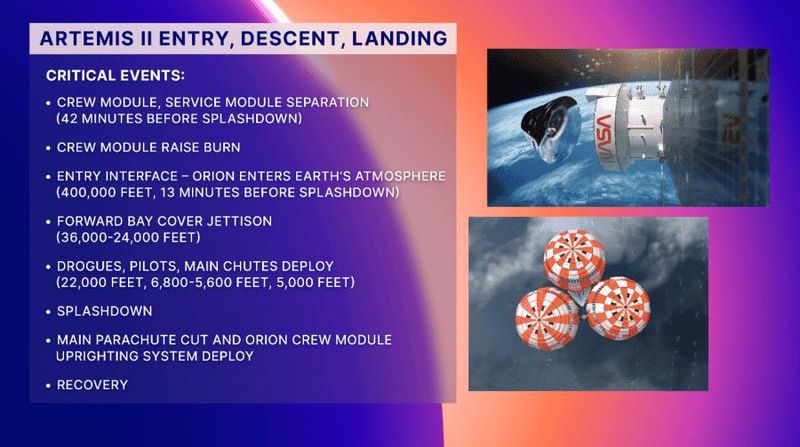
“As Orion descends through about 400,000 feet, the spacecraft will enter a planned six‑minute communications blackout as plasma forms around the capsule during peak heating,” NASA said.
➤ Artemis II mission by the numbers: How fast, how far, how hot?
Temperatures are expected to reach 3,000 degrees Fahrenheit.
“The crew is expected to experience up to 3.9 Gs in a nominal landing profile.”
Artemis II tracker: Follow moon mission with live updates
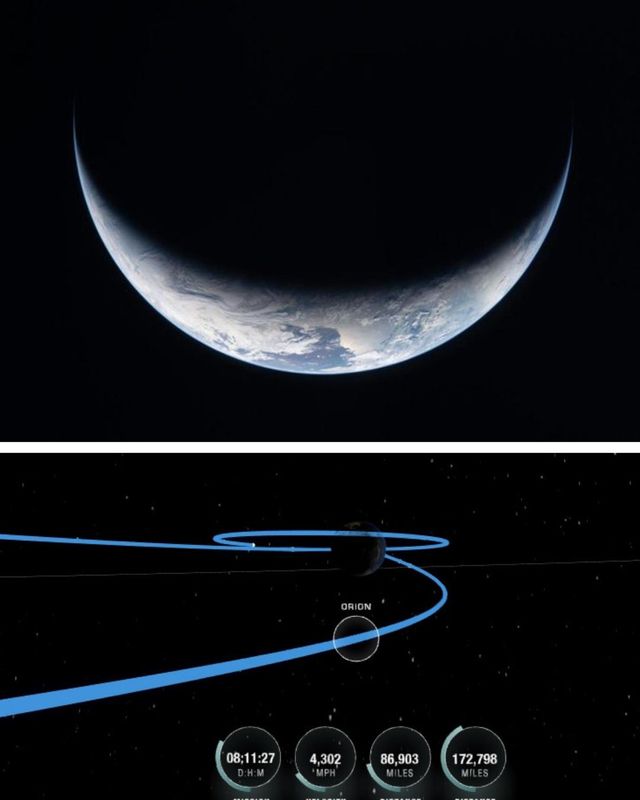
NASA has an online tracker for Artemis II available on desktop and as a mobile app, which allows users to see where the Orion spacecraft is, how fast it’s traveling, and how many miles it is in real time from both the Earth and the moon during its 10-day mission toward and around the moon, according to NASA.
The desktop version of the “Artemis Real-Time Orbit Website” (or AROW) includes key mission milestones and characteristics about the moon, including information about landing sites during the Apollo era. The mobile version included in NASA’s app adds an augmented reality feature that allows users to move their phones to see where Orion currently is, relative to Earth.
➤ Download the app here: Apple App Store | Google Play
The data is collected in real time by sensors on Orion and then sent to the Mission Control Center at NASA’s Johnson Space Center in Houston. That information has been updated since one minute after liftoff and will continue until Orion begins its reentry into Earth’s atmosphere.
What will Artemis II crew do today, April 10, as they prepare for splashdown?
The last day of the Artemis II mission is focused on getting the crew safely home,” NASA said.
“A final return trajectory correction burn will ensure Orion is on the right path for splashdown, and the crew will return their cabin to its original set up — with equipment stowed and seats in place — and get back into their spacesuits.
“The crew module will separate from the service module, whose engines have steered them around the moon and back to Earth. This will expose the crew module’s heat shield, which will protect the spacecraft and crew as they make their way back through Earth’s atmosphere and temperatures of up about 3,000 degrees Fahrenheit.
“Once safely through the heat of reentry, the cover that protected the spacecraft’s forward bay will be jettisoned to make way for a series of parachutes to deploy — two drogue parachutes that will slow the capsule down to about 307 miles per hour, followed by three pilot parachutes that will pull out the final three main parachutes.
“These will slow Orion down to approximately 17 mph for a splashdown in the Pacific Ocean, where NASA and U.S. Navy personnel will be waiting for them, concluding the Artemis II mission.”
What was the mission of Artemis II?
Under its Artemis campaign, NASA intends to return astronauts to the surface of the moon for the first time since the Apollo missions came to an end in 1972.
NASA is planning to establish a permanent foothold on the lunar south pole, using a series of crewed and uncrewed missions in the years ahead to build a moon base.
From there, the first humans could head toward Mars.
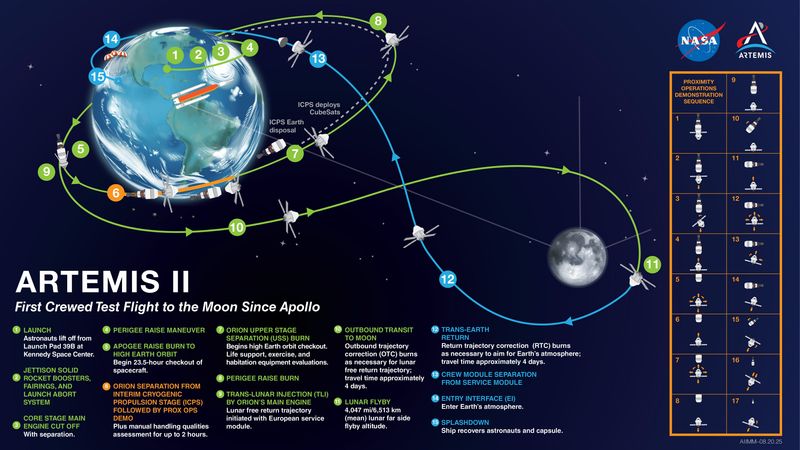
The 10-day mission primarily serves as a test flight, with the four-person crew testing systems and hardware ahead of a future moon landing.
When will we land on the moon?
In 2027, another crew of astronauts is due to ride Orion to Earth orbit to test docking capabilities with one or both of the commercial lunar landers being developed by Elon Musk’s SpaceX and Jeff Bezos’ Blue Origin.
A lunar landing would then come in 2028 under Artemis IV.
Meet the Artemis II crew
The four crew members of Artemis II are:
Contributing: Brooke Edwards, FLORIDA TODAY
Cheryl McCloud and Eric Lagatta are journalists for the USA TODAY Network-Florida’s service journalism Connect team. You can get all of Florida’s best content directly in your inbox each weekday day by signing up for the free newsletter, Florida TODAY, at https://floridatoday.com/newsletters.
This article originally appeared on Florida Today: Watch live stream of splashdown as Artemis II moon mission comes to end
Reporting by Cheryl McCloud, USA TODAY NETWORK – Florida / Florida Today
USA TODAY Network via Reuters Connect