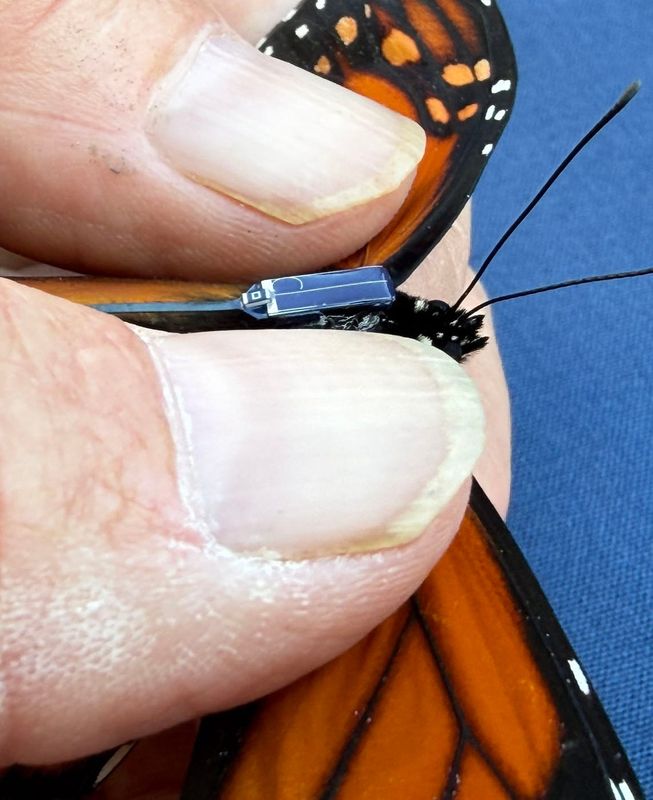
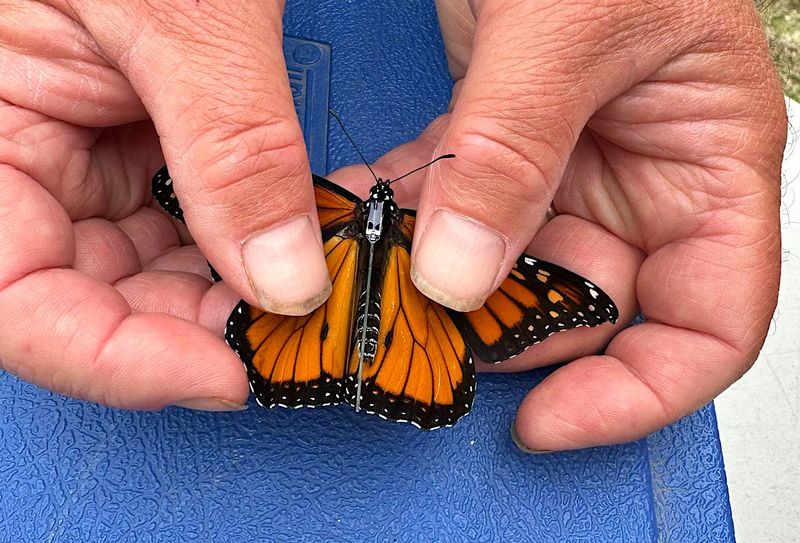
A transmitter small and light enough to fit on a butterfly and with a signal that can be picked up by smartphones is breaking barriers in wildlife science.
Several hundred of the BlūMorpho tags were placed on monarch butterflies in fall 2025.

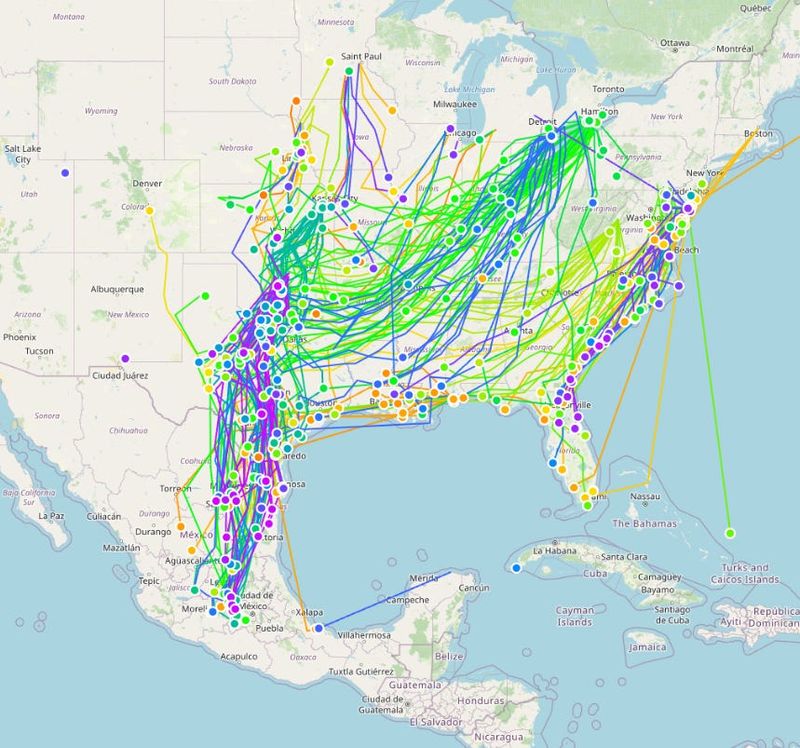
The tiny devices aIlowed scientists for the first time to follow the migration paths of individual monarchs from the United States and Canada to Mexico.
Now they are doing the same as the insects travel north.
Although it’s long been known the butterflies wintered in Mexico, the routes and the hundreds of stopover sites for individual monarchs had never been documented.
“Every detection is a window into something no scientist has ever been able to see before,” said Sean Burcher, science director of Cape May Point Arts and Science Center in Cape May, New Jersey, where some of the monarchs were tagged. “These are the winter survivors, the founders of the next generation, and we’re watching every step of their journey home.”
Tracking animals is among the most important aspects of wildlife science. It allows researchers to learn about animal behavior, habitat needs, food sources, life spans and causes of mortality.
Historically, wildlife transmitters have been heavy and bulky and required scientists to spend lots of field time and expense to obtain data.
As recently as 1995, when 25 elk were reintroduced to Wisconsin, each animal was fitted with a VHF collar weighing several pounds. To obtain a single location on an elk, the University of Wisconsin-Stevens Point researchers on the project had to deploy a large antenna on a pickup truck that was driven in several directions in the vicinity of the animal to triangulate the signal.
But at least it was possible with large mammals.
For birds or insects, the primary tagging methods have been an aluminum band on a leg or a numbered sticker on a wing. While they provide some value, they are limited to time and place, beginning and end. And it required the dead animal to be recovered and reported.
The notion of 24/7 tracking an animal as small as an insect was the wildlife research equivalent of a moonshot.
“We await the day when technological advances will make it possible to track individual monarchs continuously,” Lincoln Brower wrote in 1996 in “Monarch Butterfly Orientation: Missing Pieces of a Magnificent Puzzle.”
Brower’s plea has been answered.
Decade of work went into developing tiny transmitter
The BlūMorpho transmitter was developed and is manufactured by Cellular Tracking Technologies (CTT) in Rio Grande, New Jersey.
The company specializes in wildlife tracking and had been working for about a decade on something small and light enough to fit on a butterfly, essentially the industry’s holy grail.
Key developments came during the COVID-19 pandemic when CTT, after facing growing delays from suppliers, brought all manufacturing processes in-house, said David La Puma, CTT’s vice president of global market development.
The company’s engineers were able to refine a design that didn’t require a battery and operates on the same frequency as Bluetooth.
The signal is picked up by smartphones as well as the Motus wildlife tracking system.
The BlūMorpho transmitter weighs 60 milligrams, about as much as a grain of rice, and uses a tiny solar panel for power. For comparison, monarchs weigh 500 to 600 milligrams and have 3- to 4-inch wingspans.
Tests in 2023 and 2024, including through the Project Monarch Collaborative, helped prove the product’s feasibility.
Show time came in late summer and fall 2025 when hundreds of the transmitters were fitted to monarchs at dozens of sites in Canada and the U.S., including some deployed in northern Illinois by the U.S. Forest Service and staff at McHenry County College in Crystal Lake, Illinois.
Data from tags offer wealth of information about monarchs
From the first days the new transmitter began answering decades-old questions. Researchers in Ontario, for example, observed for the first time how monarchs made their way around, and in some cases over, Lake Erie.
The following weeks and months revealed the paths and hundreds of stopover sites used by individual monarchs on their way to their wintering habitat in Mexico.
More BlūMorpho transmitters were fitted to wintering monarchs in Mexico, too. And some of those butterflies are now in the cohort being tracked north.
Monarchs have a unique life history that features multiple generations in one year. The first three generations live only two to six weeks, mating and migrating north during spring and summer. The fourth generation is born in late summer or early fall and lives six to eight months, during which it migrates to Mexico, overwinters and begins migrating north, renewing the annual cycle.
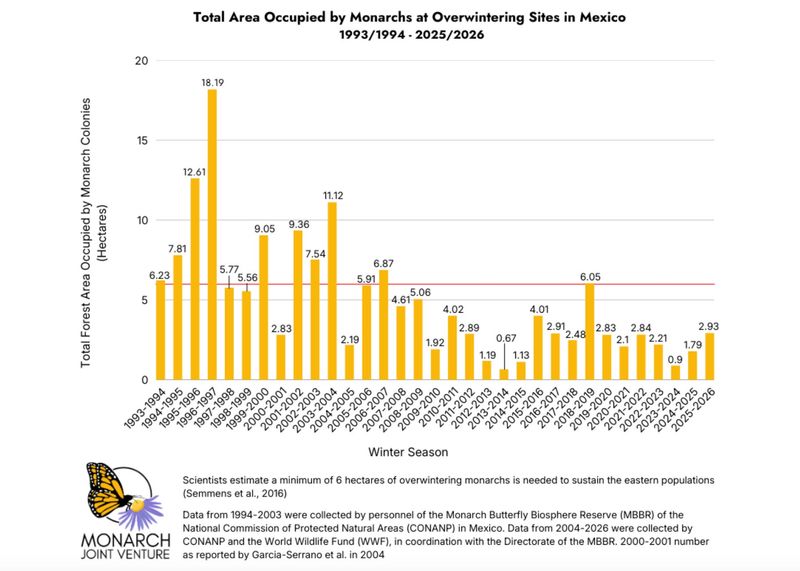
Ecologists are hopeful the technological breakthrough will help increase awareness of and protections for monarchs and other insects. A recent study documented a 22% drop in butterfly abundance over two decades in North America. In 2024 the U.S. Fish and Wildlife Service proposed listing the monarch as threatened under the federal Endangered Species Act.
The precise data from the new transmitters could allow scientists to identify key migration pathways and stopover sites, including patches of milkweed and flowering plants.
Conservation groups and land managers could then use this information to understand where milkweed restoration will matter most and what other areas are important to protect, said Jennifer Thieme, senior science manager with the Monarch Joint Venture, a nonprofit based in St. Paul, Minnesota.
Innovation sets a path for other wildlife tracking
The BlūMorpho transmitter represents a breakthrough in tagging technology and is applicable well beyond monarchs, said Thieme, whose background includes VHF tagging on federally endangered Kirtland’s warblers.
“It’s wonderful to see monarchs serving as an ambassador in this development,” Thieme said. “I’m hopeful it will open up new frontiers in wildlife tracking and tag deployment.”
As of mid-March, seven monarchs tagged in fall 2025 in the eastern U.S. and that wintered in Mexico were being detected moving north during the spring migration season.
The public can see the most recent data and follow individual monarchs via the Project Monarch app.
For example, monarch JMU004, tagged Sept. 23, 2025 in Harrisburg, Virginia, was the first recorded CTT tag to arrive at the overwintering grounds in Mexico. And it not only survived the winter but was heading north in late March near Dallas, Texas.
The data are helping scientists see things about monarchs for the first time.
“It answers some questions and raises questions, too, about things we didn’t know we didn’t know,” Thieme said.
What’s the plan for 2026? The Project Monarch Collaborative – including CTT, non-governmental organizations such as the Xerces Society and Monarch Joint Venture as well as staff from state and federal agencies – plans to meet in June to fine-tune research questions and create a plan for this year’s deployment of many more BlūMorpho transmitters.
La Puma said CTT was working on additional features for the transmitters, perhaps including an altimeter, which measures altitude.
“Every day was and is something new,” said La Puma, who lived in Madison, Wisconsin, from 2012-14 and before working at CTT led the Cape May Bird Banding Laboratory. “We’ve got this new device that works with millions of smartphones acting as passive receivers, and combined with the Motus system, a level of continuous coverage that no single array of stations could replicate.
“We’re excited about helping more researchers working on more species in projects across the globe.”
This article originally appeared on Milwaukee Journal Sentinel: How tiny transmitters made for butterflies are revolutionizing wildlife tracking
Reporting by Paul A. Smith, Milwaukee Journal Sentinel / Milwaukee Journal Sentinel
USA TODAY Network via Reuters Connect