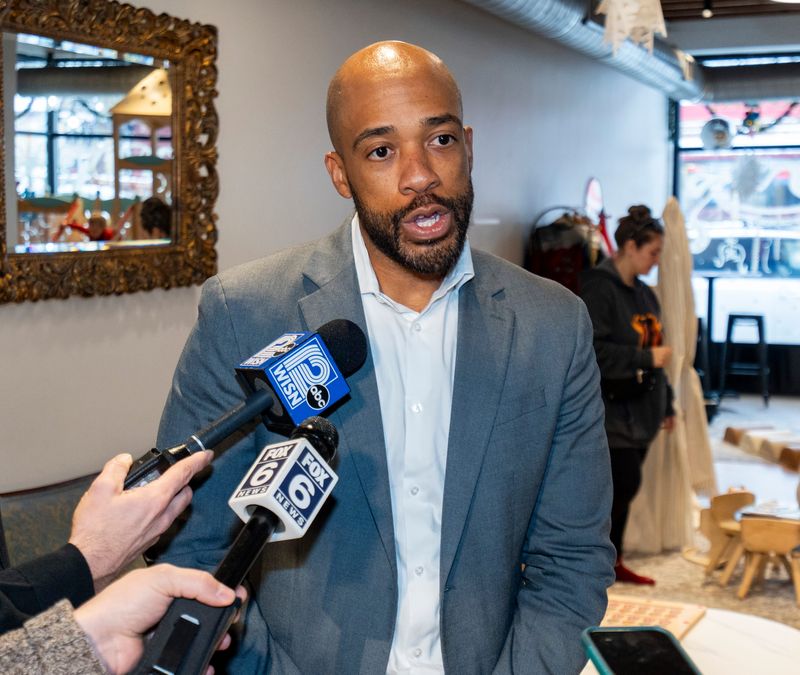
Democrat Mandela Barnes is trying to do something no Wisconsin politician has done in a very long time: win major office after losing a big statewide election.
Barnes, the former lieutenant governor, announced Dec. 2 his bid for governor in 2026. Almost four years ago, he lost a close race to incumbent Republican Ron Johnson for U.S. Senate.

In short, Barnes is trying to follow a high-profile election loss with a high-profile election win. Historically, that’s a rarity in Wisconsin. In fact, no one has done it in more than 50 years.
For this analysis, I went back and looked for every case of a Wisconsin politician who lost a major November election and then sought high office again. I considered only campaigns for governor and U.S. Senate, because these are easily the most important and attention-getting elections short of president.
I found nine examples in the past half-century. In each case, the attempted “comeback” failed. You need to go all the way back to 1970 to find a successful comeback, as I’ve defined it here.
That was the year that Democrat Pat Lucey was elected governor after losing the same office to Republican Warren Knowles four years earlier (Lucey was elected again in 1974).
The last comeback before that involves the astonishing career of a Wisconsin political legend, Democrat Bill Proxmire. He lost three general elections for governor in 1952, 1954 and 1956 (when governors served two-year terms) before winning six Senate elections in a row, starting in the 1957 special election held after the death of Joe McCarthy.
The full list of failed comebacks since then is below. In some cases, the comeback ended with a defeat in a party primary. In others, it ended with another November loss. And because two of the nine politicians on this list suffered multiple failed comebacks, the scorecard for attempted comebacks since the 1970s is actually 0-11, not 0-9.
Does this 50-year record of futility mean that Barnes has a lousy chance of getting elected governor in 2026? Not at all. All of these cases are different. Some of these defeats were narrow. Some weren’t. Some of these candidates had major political limitations. Others were quite viable. Some lost winnable races. Others were up against unbeatable incumbents. Some ran in very unfavorable political cycles, others didn’t.
History is not predictive. But it is instructive. It makes sense that, collectively, losers of big November elections have a poor record in subsequent campaigns, either because their initial defeat reflected their own shortcomings as a candidate, or because general election voters were wary of voting for someone they’d already rejected, or because primary voters and activists and donors in the candidate’s own party doubted their electability and backed someone else to be their nominee.
And this record of failure comes, as Marquette Law School pollster Charles Franklin notes in his own analysis of political “second acts” in Wisconsin, despite the initial advantages that second or third-time candidates bring in name ID, experience and fundraising.
Wisconsin’s long list of failed political comebacks
Now onto the list, starting with the most recent comeback attempts and going back in time:
∎ Republican Tim Michels lost a double-digit U.S. Senate election to Democratic Sen. Russ Feingold in 2004. Then 18 years later he suffered a much more narrow defeat (by 3.4 points) in 2022 to Democratic Gov. Tony Evers.
∎ Feingold was unseated by Republican Ron Johnson in the Tea Party election of 2010, then lost again to Johnson six years later. Feingold’s losing margin in 2016 was only slightly smaller (3.4 points) than it was the first time around (4.8 points).
∎ Democrat Tom Barrett lost the governor’s race to Republican Scott Walker in 2010, then lost to Walker again in the extraordinary recall election of 2012. Like Feingold, Barrett’s comeback attempt came against the very same politician he had lost to previously, though in this case the rematch came just two years later. In this election “replay,” Barrett’s losing margin was slightly bigger (6.8 points) than the first time around (5.8 points).
∎ Republican Mark Neumann lost his 1998 Senate race against Feingold, then lost a GOP primary for governor in 2010 against Walker, then lost a GOP Senate primary in 2012 to former Gov. Tommy Thompson.
∎ Republican Bob Welch lost a landslide U.S. Senate race to Democratic Sen. Herb Kohl in 1994, then 10 years later lost a GOP Senate primary to Michels.
∎ Republican Scott McCallum lost a landslide U.S. Senate race to Proxmire in 1982, then 20 years later lost an election for governor to Democrat Jim Doyle. McCallum was the interim governor at the time of the 2002 election. He had been serving as Gov. Tommy Thompson’s lieutenant governor when Thompson resigned in 2001 to become U.S. health secretary, elevating McCallum to higher office.
∎ Democrat Ed Garvey lost a competitive U.S. Senate election in 1986 to incumbent Republican Bob Kasten, then lost a Democratic Senate primary to Kohl in 1988, then lost a one-sided 1998 election for governor to Thompson.
∎ Democratic Gov. Tony Earl was unseated by Thompson in 1986, then lost the 1988 Democratic Senate primary to Kohl.
∎ Democrat Marty Schreiber lost a governor’s race to Republican Lee Dreyfus in 1978 (while he was serving as interim governor), then lost a closely contested 1982 Democratic primary for governor to Earl.
Some of these examples bear little resemblance to Barnes’s case, either because the candidate’s first defeat was so one-sided, or because so much time passed before the attempted comeback, or because they faced extremely formidable incumbents in their comeback attempt. And the way partisan politics works today is a lot different from the way it worked in the 1980s and 1990s.
But fairly or not, Barnes’ 2022 defeat will figure in his 2026 campaign. Even before he announced, Democratic activists were debating his potential candidacy. And that debate centered on what his 2022 defeat signifies about his 2026 electability.
If you are a Barnes supporter, you can point to the fact that he lost by only a single point to Johnson in 2022. You can argue that some national Democratic and liberal groups wrote off his prospects prematurely. You can note that it’s extremely difficult to defeat an incumbent senator like Johnson who belongs to the “out” party (the party opposed to the sitting president).
History shows they rarely lose, because they enjoy the benefits of incumbency without the baggage of being tied to the party in power. No incumbents in either party lost a Senate election in 2022.
If you are a Barnes skeptic, you can argue Barnes lost a very winnable race, based on Johnson’s clear vulnerability, reflected in Johnson’s negative poll ratings and his ultimately narrow victory margin. You can point out that Barnes lost in 2022 while fellow Democrat Evers won a three-point victory for governor on the same Wisconsin ballot. You can question why your party should nominate someone coming off a high-profile defeat in a big, winnable race when other candidates are available in a very crowded field.
It will be up to Democratic primary voters next August whether electability is a voting issue for them, and if so, whether Barnes’ 2022 defeat is a nagging concern.
This is a different office, a different campaign and a different political environment than 2022. But when it comes to political comebacks in Wisconsin, history is not on Barnes’ side.
(This story was updated because an earlier version contained an inaccuracy.)
This article originally appeared on Milwaukee Journal Sentinel: The feat Mandela Barnes is attempting almost never happens in Wisconsin | Gilbert
Reporting by Craig Gilbert, Special to the Journal Sentinel / Milwaukee Journal Sentinel
USA TODAY Network via Reuters Connect