The final regulations haven’t been set and the first hunting opportunity is still about three months out.
But it’s not too early to say the 2026 Wisconsin deer hunting seasons will have a lot in common with last year.

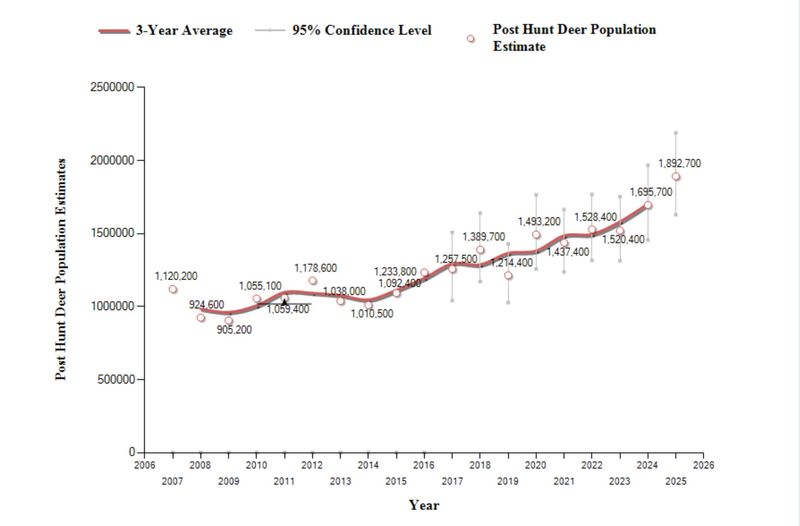
For starters, the state’s deer population is at another record high. The Department of Natural Resources most recent deer metrics report estimated the statewide deer population at 1.89 million following the 2025 hunting seasons, up from 1.70 million the previous year.
Most of the deer and most of the population growth is in the central and southern agricultural zones, areas characterized by mild winters and large food supplies.
But continuing another trend, even most of the northern deer herd had another less than severe winter in 2025-26. Only three deer management units in far northern Wisconsin ranked in the “severe” category of the DNR’s Winter Severity Index. All the others were mild or moderate.
Mild to moderate winter conditions generally allow female deer, or does, to come through winter in better shape and give birth to bigger, healthier fawns, thereby increasing survival and recruitment.
So on a statewide basis there will be a lot of deer available again for hunters.
And hunters in Wisconsin will be once again be offered lots of opportunity. In fact, if the recommendations of the DNR and Citizen Deer Advisory Councils are approved, there will be slightly more opportunity in 2026 than last year.
What’s already known is the bow seasons will run Sept. 12 to Jan. 3, the youth gun season will be Oct. 10 and 11, the gun season Nov. 21 to 29, the muzzleloader season Nov. 30 to Dec. 9 and the antlerless-only gun season Dec. 10 to 13.
But the Natural Resources Board will be voting on other aspects of the seasons at its June 24 meeting in Black River Falls.
These include the DNR and CDAC recommendations for Holiday Hunts and extended bow seasons in individual deer management units, as well as the antlerless quotas and number of antlerless authorizations to be offered with each license.
The DNR provided an online public input opportunity during a 9-day period in April, with 9,203 people participating compared to 6,383 in 2025, according to the agency.
A report was created for each DMU which was considered by CDAC members in developing final recommendations.
Final CDAC recommendations were reviewed by the department’s Deer Advisory Committee, which includes representatives of the Conservation Congress, Ojibwe tribes, Wisconsin Bowhunters Association, Wisconsin Wildlife Federation, County Forest Association, The Nature Conservancy and U.S. Forest Service.
The Deer Advisory Committee suggested only one adjustment to CDAC recommendations that Iowa County hold the Holiday Hunt in 2026. The Deer Advisory Committee identified concerns of limiting antlerless harvest opportunity in the core of the CWD endemic area as well as the fact that all surrounding counties are offering the Holiday Hunt, according to the DNR.
Biologically, increased opportunity to harvest antlerless deer is beneficial to managing the local population, the season framework that best achieves this outcome is varied based on local hunter desires, said Ryan Haffele, DNR acting deer program specialist.
After consideration of input received from both the Deer Advisory Committee and the CDACs and review of past quotas and harvest levels, the DNR recommended adoption of all CDAC recommendations, including not holding the Holiday Hunt in Iowa County.
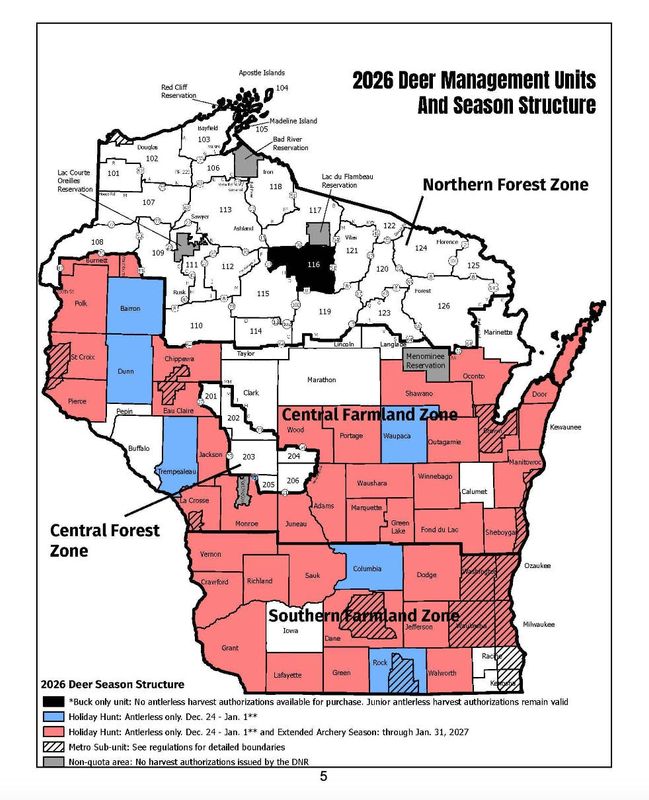
So the rules package being presented to the NRB includes: a Dec. 24 to Jan. 1 Holiday Hunt in 48 farmland counties (up from 45 in 2025); extended archer and crossbow seasons in 42 counties (up from 38 in 2025); and one unit, DMU 116 in northern Wisconsin, to have “bucks only” in an attempt to increase the local deer population.
All in all, it’s very similar to 2025, but featuring three additional units with a Holiday Hunt and four more with extended bow seasons.
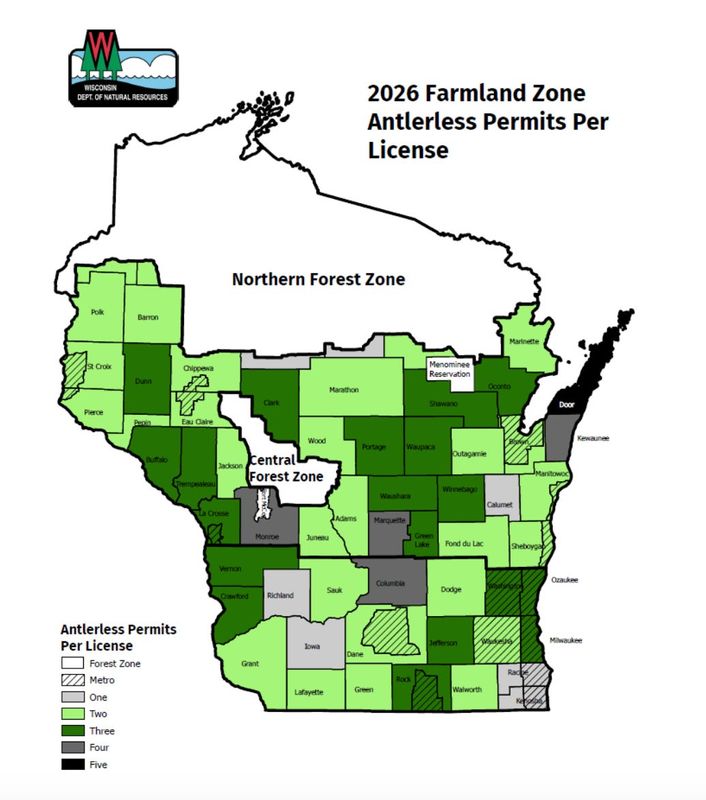
Farmland counties will offer from one to five antlerless deer permits with each license.
Based on antlerless deer kill goals set by the CDACs, the 2026 antlerless deer quota recommendations have been increased 4% across the state, according to the DNR.
And in the Northern Forest Zone, antlerless permit availability is up 12%, largely as a result of adjusting permit levels to actual success rates from the 2025 harvest in the new DMUs, according to the DNR.
What will the results be? Only time will tell.
But it’s going to require substantial hunter effort to match last year.
Hunters in the 2025 Wisconsin deer hunting seasons registered more bucks than any year since 2007 and the most deer overall since 2012, according to the DNR.
Building off 2024, when 13 counties set records for most bucks killed, hunters in 2025 set records for buck kills in 15 counties. In addition 28 counties had a top five buck kill and 35, or about half the counties in the state, recorded a top 10 buck kill.
What’s more, the harvest of antlerless deer – the key to herd control efforts – showed a year-over-year increase of 5% and the archer, crossbow, holiday, late antlerless and youth seasons all showed higher deer registrations.
“All in all, our harvest numbers were strong, the strongest we’ve seen in a couple decades,” Haffele said following the 2025 deer seasons.
The DNR preliminary data showed hunters in 2025 registered 389,481 deer, including 165,754 bucks and 173,727 antlerless deer.
The seasons started out strong with 8,480 deer registered in the two-day youth hunt, 18% higher than the five-year average, followed by 183,094 deer in the nine-day gun season, which has the most annual participants and contributes the biggest harvest.
However a heavy snowstorm hampered hunters over the last portion of the gun hunt and the deer kill fell 4% from the previous year.
Once the storm passed, though, the snow cover persisted through December and helped hunters see and track deer in the muzzleloader, late antlerless and holiday hunts, Haffele said.
In the muzzleloader season, hunters registered 11,911 deer, 68% higher than the five-year average, while the total in the four-day December antlerless season was 10,591 deer (30% higher) and holiday antlerless deer hunt was 11,278 deer (77% higher).
Despite the increase in antlerless harvest in 2025, it still fell far short of the kill goal set by the CDACs and DNR. That scenario is likely to repeat in 2026 since no new tools have been added to help achieve the objectives.
Historically, Earn-A-Buck and an October gun hunt for antlerless deer were the key means to help control deer herds in Wisconsin. But the DNR hasn’t had access to them since the Legislature outlawed the regulations in 2011.
The strongest remaining tool is a antlerless-only season. It’s hypothetical, though, since no county has held one and its unknown if it would meet the desired result.
However awareness of the failure of current hunting regulations and hunting pressure to control the Wisconsin deer herd is growing among hunters and the public. This year several CDACs recommended the Legislature approve Earn-A-Buck again.
And the Winnebago CDAC issued a warning: if its antlerless kill quota of 2,000 isn’t met in 2026, the council will recommend “antlerless-only” deer hunting seasons for the county in 2027.
The strong 2025 deer seasons came despite a drop, although small, in license sales. In 2025, the DNR reported sales of 792,969 deer hunting licenses (gun, crossbow and archer combined) a 0.1% decline from 2024. The gun license sales of 552,362 were down 0.5%.
Among the licenses, the DNR reported 40,348 were sold to “new hunters,” a 0.6% decrease from 2024.
Hopefully all those hunters stay in the ranks this year.
It promises to be another Wisconsin deer hunting season with lots of opportunity.
This article originally appeared on Milwaukee Journal Sentinel: Smith: Wisconsin deer hunting seasons lining up similar to last year
Reporting by Paul A. Smith, Milwaukee Journal Sentinel / Milwaukee Journal Sentinel
USA TODAY Network via Reuters Connect
By Paul A. Smith, Milwaukee Journal Sentinel | USA TODAY Network