For dairy producers, the milk check is a central monthly revenue statement, yet it often contains line items that are difficult to interpret without background on how milk is priced. Unlike many agricultural commodities, milk is marketed within a framework that combines end-product price formulas, classified pricing, pooling, component testing, quality adjustments, voluntary premiums, and deductions. The standard term for the per-hundredweight price a producer receives, after all regulated and market-determined adjustments, is the mailbox price.

In Wisconsin, interpretation of the milk check matters because most of the state’s milk supply is used to make manufactured dairy products, particularly cheese, and is priced under multiple component pricing in the Upper Midwest Federal Milk Marketing Order (FMMO). The objective of this paper is to explain, in plain terms, the main line items commonly found on a Wisconsin dairy producer’s milk check and to describe how each is determined.
Economic and regulatory background
Milk differs from many farm products in ways that have historically led to more complex pricing arrangements. It is highly perishable, bulky because of its high water content, produced every day of the year, and tied to specialized on-farm assets. Dairy markets have often featured many more producers than buyers, while demand for dairy products tends to be relatively inelastic. Under those conditions, small changes in supply or demand can produce comparatively large changes in price.
Federal milk regulation emerged in part as a response to the destructive competition those conditions produced. The federal order structure was established under the Agricultural Marketing Agreement Act of 1937 and continues to shape regulated milk pricing today.
FMMOs regulate the terms of trade between dairy producers and regulated handlers. Handlers, including processors and, in some cases, cooperatives that function as handlers, are required to account for the milk they receive and pay at least the minimum regulated price on the milk pooled under the order. Class I distributing plants meeting the route-distribution threshold set in their order must be pooled. Manufacturing milk in Classes II, III, and IV can be kept out of the pool under the performance and qualification rules of each order, a practice known as depooling. Pooling is a handler-level decision, not a producer-level decision. All amendments to FMMO provisions must be approved by producers through a referendum before taking effect.
Classified pricing and pooling
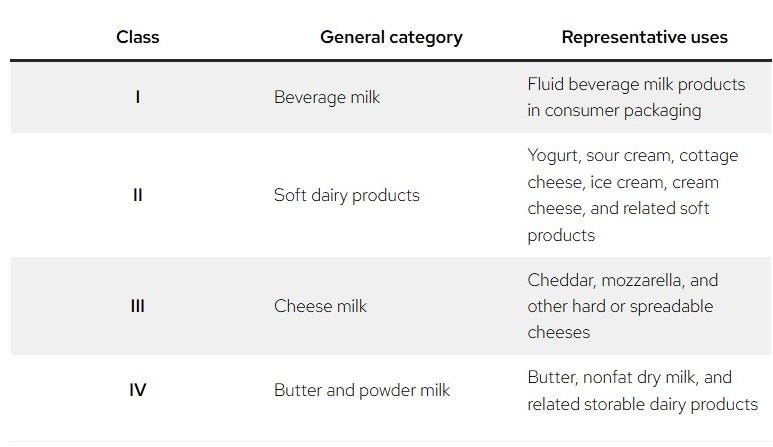
Classified pricing assigns producer milk to one of four end-use classes and produces a minimum regulated formula price for each class. Pooling then redistributes value across the order. Pooled producers share the weighted blend of class values rather than competing solely for access to the highest-valued uses.
Pooling is best understood as a pool of dollars rather than a physical pool of milk. In simplified terms, the FMMO market administrator calculates the total value of pooled milk across classes and divides it by the total pooled pounds. The result is the uniform or blend price for that order and month.
A handler whose classified obligation exceeds the blend value contributes money into the pool. A handler whose classified obligation falls below the blend value draws from the pool, so pooled producers receive the weighted blend value rather than only the class value of milk at that handler. Under typical market conditions, Class I carries the highest class value, which makes pooling attractive to manufacturing handlers because they can draw from the pool and pay their producers above the Class III or Class IV standalone value. That incentive reverses when a manufacturing class price rises above the blend price, at which point depooling becomes profitable for a handler.
Two producer pricing methods in the FMMO system
Even within the FMMO system, producers are paid under two different methods depending on their order. Seven FMMOs use multiple component pricing (MCP): Upper Midwest, which includes Wisconsin, Northeast, Mideast, Central, California, Pacific Northwest, and Southwest. Under MCP, pooled producers are paid on butterfat pounds, protein pounds, other solids pounds, and a producer price differential (PPD) that captures the remaining pool value. Four FMMOs, Appalachian, Arizona, Florida, and Southeast, use skim-fat pricing. Under skim-fat pricing, pooled producers are paid on a uniform skim milk price and a uniform butterfat price, without separate values for protein and other solids. The remainder of this paper discusses the MCP system that applies in Wisconsin.
An important consequence of MCP is that the producer’s actual milk check is not the order’s blend price. The blend price is the order’s announced uniform value, calculated on standard milk composition. Producers are paid on their own butterfat, protein, and other solids tests. Producers with above-average components typically receive a mailbox price above the blend price; producers with below-average components typically receive a mailbox price below the blend price. Two producers in the same order, in the same month, can receive materially different mailbox prices for this reason alone.
How product prices become milk component prices
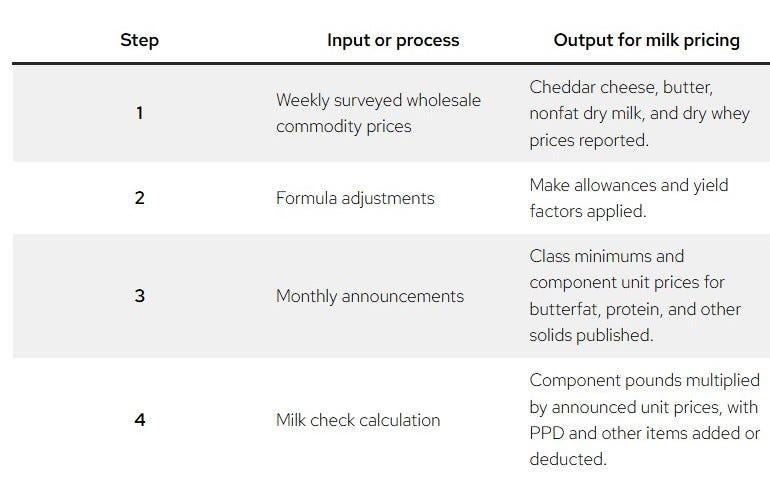
The component prices used in FMMO formulas are derived from surveyed wholesale prices for four dairy products: cheddar cheese, butter, nonfat dry milk, and dry whey. USDA’s Agricultural Marketing Service (AMS) collects these prices weekly through the Dairy Product Mandatory Reporting Program. The surveyed prices are combined with yield factors and manufacturing cost allowances, known as make allowances, to produce component values for butterfat, protein, nonfat solids, and other solids.
Each class minimum has its own formula. Class III and Class IV minimums are announced monthly and are derived from the surveyed commodity prices through formulas that apply yield factors and make allowances for those wholesale values. The Class II skim milk price is the advanced Class IV skim milk pricing factor plus a fixed differential per hundredweight, and the Class II butterfat price is set as a small premium above the announced monthly butterfat price (the same butterfat price used in the Class III and Class IV formulas). Class I is priced in advance of the month. Under the 2025 FMMO final rule, the advanced Class I skim milk price is the higher of the advanced Class III or advanced Class IV skim milk pricing factor, with an extended-shelf-life adjustment applied. A location-specific Class I differential is then added based on the regulated handler’s location. The higher-of method replaced the average-of method that had been in effect since May 2019 under the 2018 Farm Bill.
Once the formulas are applied, the resulting values are published in monthly class and component price announcements. These announced values are the unit prices that appear on producer milk checks under MCP and form the basis for the largest share of most producer payments.
Walkthrough of common milk check line items
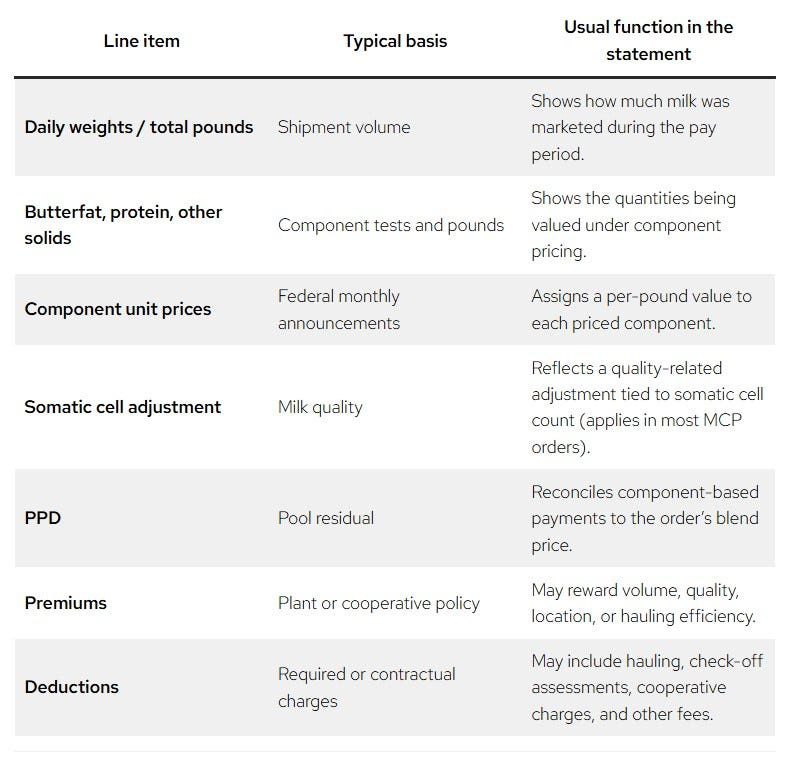
Most milk checks open with the milk shipped during the pay period, often with daily weights and a monthly total. They also list average butterfat test, protein test, other solids, somatic cell count, and other quality indicators.
Under MCP, the statement then converts component percentages into pounds of butterfat, protein, and other solids, and multiplies those quantities by the federally announced component unit prices for the month. The component values themselves are calculated within the Class III formula, but they apply to all pooled milk in MCP orders, not only to milk used in cheese. Butterfat and protein typically account for the largest share of milk check value under MCP, while other solids contribute a smaller amount.
After component values are calculated, the milk check will typically include a PPD, one or more premiums, and deductions. The following sections describe those items and their usual role in the monthly settlement statement.
Producer price differential (PPD)
Under MCP, a handler first pays its pooled producers based on the announced butterfat, protein, and other solids prices. These component prices are calculated through the FMMO component pricing formulas and define the per-pound value of each component for the month. The PPD is the residual, positive or negative, that reconciles the component-based payments to the order’s uniform or blend price. By construction, the Class III price plus the PPD equals the order’s blend price.
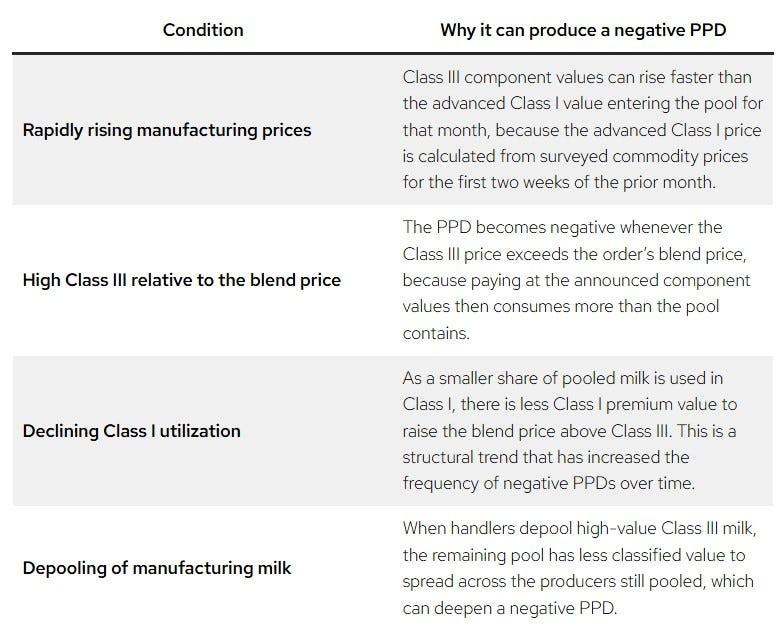
A positive PPD means that the total classified value of all milk pooled on the order exceeds the amount paid out at the announced component values, with the remainder distributed to pooled producers as the PPD. A negative PPD means the opposite: more has been paid out at the component values than the order’s classified value, and the shortfall is distributed across pooled milk as a deduction. A negative PPD is an accounting outcome within the pooling system, not an error in the milk check.
The 2025 FMMO final rule restored the higher-of Class I skim milk pricing method, replacing the average-of method that had been in effect since May 2019. This change is designed to reduce, though not eliminate, the frequency of large negative PPDs driven by wide Class III-to-Class IV price spreads.
PPD experience varies meaningfully by order. The Upper Midwest FMMO, which serves Wisconsin, has historically had relatively low Class I utilization compared with southern orders, so its blend price has typically been close to its Class III price. This means the Upper Midwest PPD is often small in absolute value, and Wisconsin producers see less variation in the PPD line than producers in higher-Class-I orders. The structural factors that produce negative PPDs still apply, but the swings tend to be smaller.
Why nearby farms may receive different milk prices
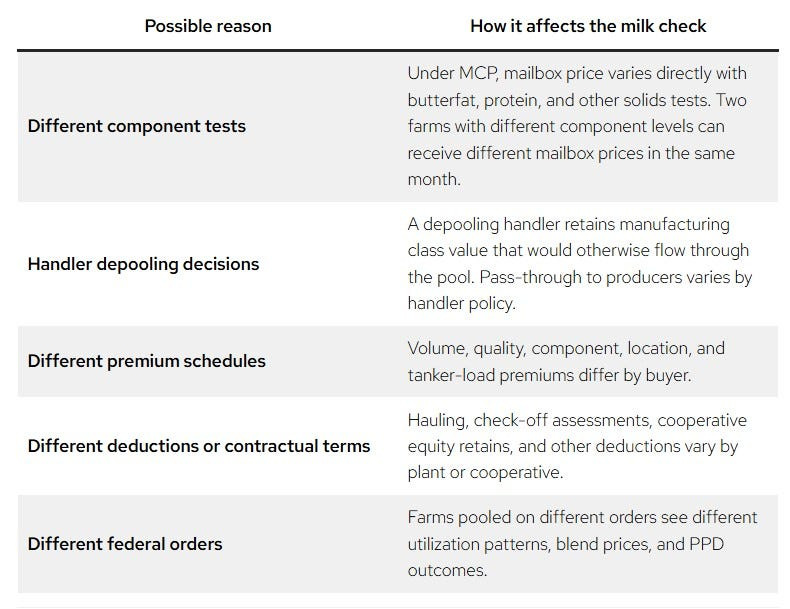
One source of producer frustration is that neighboring farms can receive noticeably different mailbox prices even when both are shipping milk for similar end uses. Several explanations apply within the FMMO framework.
Component test differences. Under MCP, two producers shipping milk to the same handler in the same month can receive different mailbox prices simply because their butterfat, protein, and other solids tests differ. This is the most common reason for differences between similar-sized neighboring farms.
Handler depooling decisions are another common driver. When price relationships make pooling less profitable for a handler, the handler may keep its Class II, III, or IV milk out of the pool. A depooling handler retains the manufacturing class value rather than paying it into the pool, and some of that value is often passed through to producers as premiums or a higher plant pay price, though the amount is set by handler policy. A farm that ships to a depooling handler and a neighbor that ships to a pooling handler can see materially different milk check results for the same month.
Plants and cooperatives also apply different schedules for premiums (volume, quality, components, hauling) and for deductions (hauling, check-off assessments, cooperative equity retains, and other fees), which further widens differences. In border regions between orders, nearby farms can even end up pooled on different FMMOs, each with its own utilization pattern and blend price.
Reading the milk check in sequence
For practical interpretation, the milk check can be read in a logical sequence. First, identify the total pounds of milk shipped. Second, review the component tests and calculate pounds of butterfat, protein, and other solids marketed. Third, verify the announced component unit prices applied to each component. Fourth, examine the PPD, any voluntary premiums, and any quality adjustments such as somatic cell premium or penalty. Finally, review deductions such as hauling, check-off assessments, and cooperative charges. The result is the producer’s mailbox price for that pay period.
Conclusion
The milk check is not a simple receipt for milk sold. It is a settlement statement that reflects milk volume, component composition, quality measures, FMMO minimum formula prices, pool accounting, voluntary premiums, and deductions. For Wisconsin producers, the check sits inside the MCP system of the Upper Midwest FMMO, which values butterfat, protein, and other solids separately and reconciles the result to the blend price through the PPD.
The major line items fall into four categories: physical shipment data, component-based value, pooling-related adjustments such as the PPD, and deductions. Read in that sequence, the milk check becomes more clearly connected to the pricing system that produced it. Two producers with different component tests, different handlers, or different premium and deduction schedules can receive meaningfully different mailbox prices in the same month, even within the same FMMO.
This article originally appeared on Wisconsin State Farmer: The anatomy of a milk check: key pieces shaping dairy farm profit returns
Reporting by Leonard Polzin, Special to Wisconsin State Farmer / Wisconsin State Farmer
USA TODAY Network via Reuters Connect
By Leonard Polzin, Special to Wisconsin State Farmer | USA TODAY Network